Why Will I Still Have an Electricity Bill After Solar?
Understand electricity you use directly, electricity you import, and credits for exports before accepting a zero-bill promise.
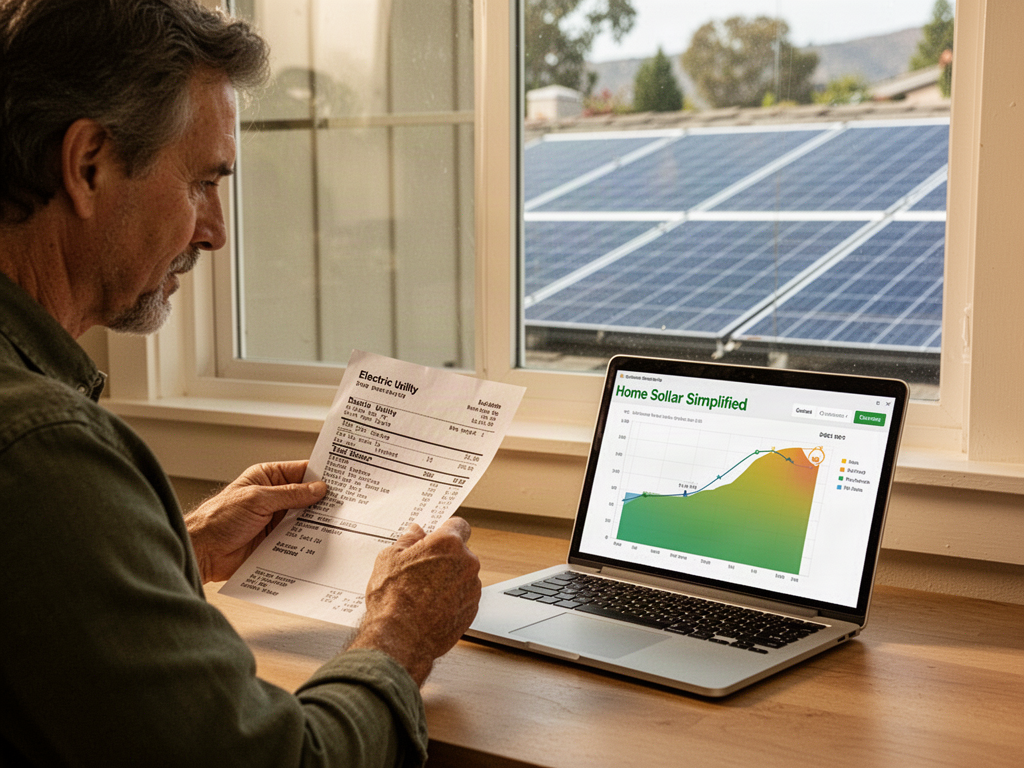
Solar changes your electricity flow
Some solar production goes directly to household loads. Extra production may go to a battery or the grid. When your home needs more than the system supplies, it imports electricity. Annual solar production matching annual consumption does not automatically mean the utility bill disappears.
Production and export are different numbers
The monitoring app may show total solar production. The utility typically measures electricity exchanged with the grid. Electricity used immediately in your home does not first become an export. Compare these readings carefully; a difference between monitoring production and utility exports is not by itself proof of a fault.
Export credits are not always the retail purchase price
Your tariff determines how exported electricity is credited. Under SCE’s Solar Billing Plan, export values vary by hour; they are not a blanket promise that every exported kWh cancels the cost of an imported kWh. Other utilities and older tariffs have their own rules. Verify the plan on your bill rather than applying a neighbor’s arrangement.
A fictional energy-charge example
Imagine 200 kWh of imports billed at an invented $0.35/kWh, producing $70 in energy charges. If 200 kWh of exports receive an invented $0.08/kWh, the credits total $16. The difference is $54 before other charges or adjustments. Equal kWh totals do not imply equal dollar amounts. These are teaching numbers, not SCE rates or a utility-bill calculator.
Look beyond energy charges
SCE explains that Solar Billing Plan bills include electricity charges, export credits and applicable taxes or fees. Some charges may remain each month, and an annual settlement reviews the account. Solar financing or lease payments are separate obligations; add them when comparing your household’s overall spending.
Ask for a remaining-bill estimate
Ask your installer to identify the tariff used, expected monthly imports, export assumptions, seasonal pattern and any fixed charges included. Request both monthly and annual estimates. If a community choice aggregator supplies generation, check that provider’s terms as well. Treat a zero-bill claim as something requiring a written explanation.
Your next step in the app
Open Energy calculator and record the kWh and days shown on a recent bill. After solar is installed, use utility import and export details alongside production monitoring. A flat-rate appliance estimate does not reproduce time-of-use billing or a true-up calculation. Keep those distinctions visible when judging results.
Questions worth asking
- Which solar tariff and generation provider apply to my account?
- What are imports and exports expected to be each month?
- Which charges are not offset by credits?
- Does the household-cost estimate include solar payments?
Sources and further reading
SCE: How to Read Your Solar BillSCE: Understanding Solar Export PricingDOE: Homeowner’s Guide to SolarExplore more for your home
Home Solar Simplified
Explore solar education, battery planning and home energy tools to prepare for your next decision.
Explore Home Solar SimplifiedConnectPoint ISP
Visit ConnectPoint ISP to explore home internet options and ask about service availability at your address.
Visit ConnectPoint ISP