Clouds change available sunlight
Panels can still generate in cloudy weather. Output varies with cloud cover and the light reaching the panels.
THE ILLUSTRATED SOLAR GUIDE · PART 1
Solar panels turn sunlight into electricity. An inverter makes that electricity usable in your home, an optional battery stores some for later, and the utility meter records what you exchange with the grid. Understanding those separate jobs helps you read a proposal, ask better questions and make sense of the bill that remains.
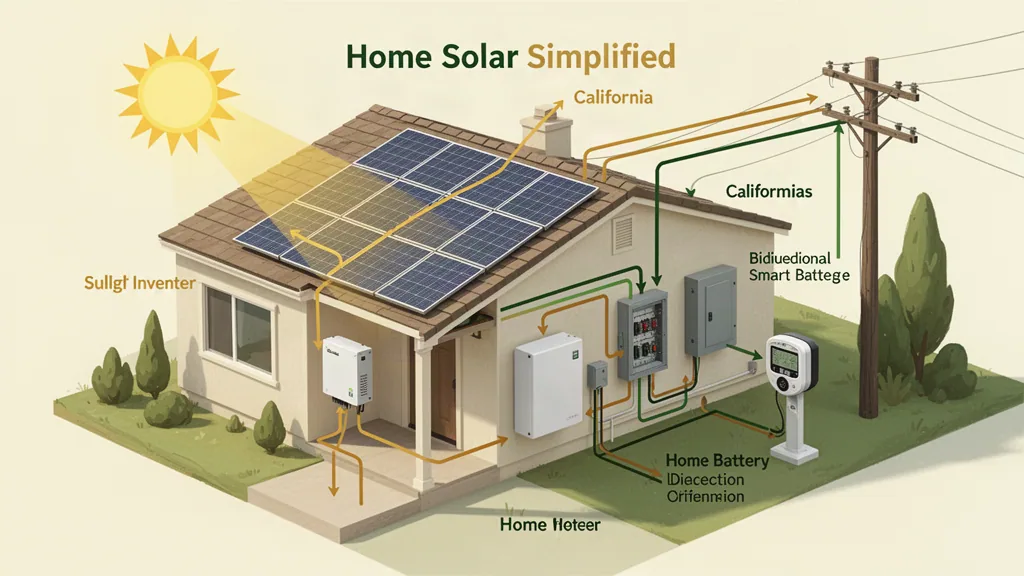
Conceptual illustration only. Every home has a different approved electrical design; not a wiring or installation schematic.
Start with the whole system, then follow each part below. The path electricity takes changes as the panels produce more or less power, appliances turn on, and battery controls respond.
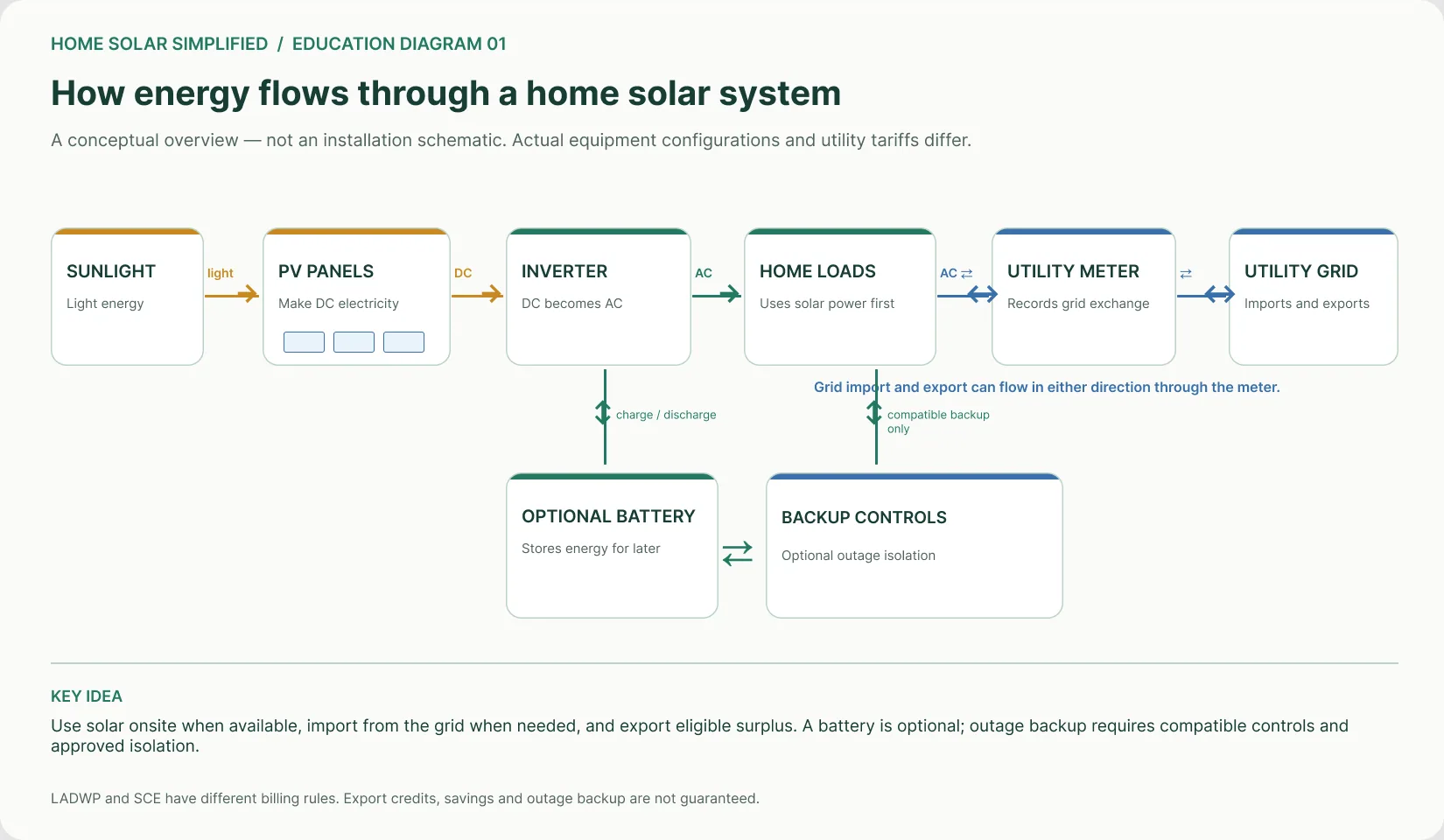
Battery connection, backup isolation and utility interconnection vary by system. Arrows are explanatory, not electrical wiring instructions.
Panels use light. Weather, shade and cell temperature all affect how much electricity they produce.
Panels can still generate in cloudy weather. Output varies with cloud cover and the light reaching the panels.
Trees and roof features can shade panels. The effect depends on where shade falls and the system design.
At the same sunlight level, higher cell temperature generally reduces power. Hot air is not extra solar fuel.
Ask your installer: Does the annual production estimate include local weather, roof shading and temperature losses?
Conceptual explanation, not a production forecast. Sources: DOE: photovoltaic performance and efficiency · DOE: system design and energy yield.
Panels generate direct current (DC). An inverter converts that electricity to alternating current (AC) for the home. These two examples show where that conversion happens.
Energy paths only—not wiring diagrams. Protective equipment, disconnects, grounding, batteries and utility connections are omitted. Neither diagram promises backup power during an outage.
Ask your installer: Which inverter design is proposed, and how does it suit my roof, shade and battery plans?
Source: U.S. Department of Energy: inverters and grid services.
Turning on another appliance increases household demand. It does not make the panels produce more sunlight-derived electricity. Available solar can serve that demand, with other sources meeting any shortfall according to the system design and settings.
Usable energy capacity describes how much energy the battery can deliver. Reserve settings can leave less available for everyday use.
Power output limits how much equipment can run together. Starting a large appliance can require more power than keeping it running.
Backup requires more than storage. Outage operation needs compatible equipment and controls that isolate the backed-up system from the utility grid. Ask which circuits will be powered and for how long under your expected loads.
Conceptual energy paths, not installation instructions. Sources: DOE: solar and storage · DOE: solar and resilience.
Solar used immediately inside the home generally does not cross the utility meter. The meter measures electricity exchanged with the grid—not all the electricity your panels produce.
Measurement and billing are different. The meter records energy; your utility tariff determines charges and any export credits. Exporting one kWh does not necessarily cancel the cost of importing one kWh.
Source: ENERGY STAR: on-site generation, imports and exports. See the utility-specific explanation below for California billing context.
Use these milestones to follow the project. Some tasks overlap, and the exact sequence depends on the property, installer and utility.
Use this overview as a map, then use the milestones below to track responsibility and evidence. Tasks can overlap: utility paperwork may begin before installation, for example. Ask who owns each step and what document confirms it is complete. The last stage is ongoing ownership, not simply the day the panels reach the roof.
Gather a full year of electricity bills and note planned changes, such as an electric vehicle or heat pump. Identify your utility from the bill. Write down your main goal: reducing grid purchases, backup for selected equipment, or both. This gives each installer the same starting information.
Ask for a property-specific review of roof condition, shade, usable space and electrical equipment. An aerial image is a useful starting point, but it cannot settle every site question. Find out which assumptions still need an inspection and whether repairs or upgrades are included in the proposal.
Put equipment models, solar capacity, expected monthly production and battery capabilities side by side. Separate the installation price from borrowing costs and any estimated incentives. Ask each company to explain differences rather than choosing by panel count or the lowest advertised monthly payment.
Keep the complete proposal, agreement and warranty documents together. Identify the business responsible for installation and the contact for future service. Ask which work is excluded, how changes will be priced, and what happens if the final design differs from the sales proposal. Get unresolved answers in writing.
Ask who prepares the final design, submits permit documents and handles utility paperwork. Request a written sequence of milestones rather than treating an installation date as a promise that the whole project will be operating that day. Local review and utility requirements can affect the schedule.
After installation, ask what inspections remain and whether any corrections were requested. Keep the inspection outcome and any revised equipment list with your project records. Panels being mounted on the roof does not, by itself, establish that every required approval is complete.
Ask the installer to explain the utility authorization required for your system and provide the relevant documentation. At handover, obtain equipment details, warranty contacts and access to monitoring. If backup was included, ask for an explanation of the supported circuits and normal owner controls.
Save the initial monitoring records and compare complete reporting periods with the proposal’s seasonal estimates. Review utility imports and exports alongside generation, since they measure different things. Keep a dated list of questions or unexpected alerts so the installer or utility can investigate a specific issue.
Identify the utility and tariff on your bill before comparing savings estimates. These conceptual diagrams explain different billing arrangements; they are not a bill calculator.
For an eligible LADWP net-energy-metering account, the utility applies its NEM rules to electricity exchanged with the grid. This is not SCE’s Solar Billing Plan. Confirm your account’s rate and agreement before using a savings estimate. LADWP’s guidelines describe credits that can carry forward, with exclusions such as taxes and minimum charges. A credit balance does not mean every bill charge disappears.
Under SCE’s Solar Billing Plan, exported electricity earns credits whose value depends on when it is exported. Imported electricity is billed separately under the applicable rate. Export credits do not offset every charge, including certain taxes and fees. Ask the proposal provider to show its import and export assumptions separately; a yearly generation total cannot establish the value of each exported kWh.
Using solar electricity while your appliances need it generally reduces the electricity you buy from the grid. Sending unused electricity out is a different transaction: the utility decides how credits are calculated under your actual tariff. For SCE customers on the Solar Billing Plan (the Net Billing Tariff), the California Public Utilities Commission explains that export values change with the time of export and are usually below the retail purchase rate, although some late-summer evening hours can be exceptions. A proposal that assumes every exported kWh offsets a purchased kWh at the same price may materially overstate savings.
LADWP is a municipal electric utility, not an SCE Solar Billing Plan account. LADWP's own net-energy-metering guidelines describe a different billing and credit framework, including restrictions on the use of credit balances for certain charges. Confirm whether your account is eligible, which rider and rate schedule apply, and what minimum charges or taxes remain. The rules for an existing installation may also differ from those for a new application.
Request a written monthly estimate showing projected solar generation, onsite use, grid imports, grid exports, the assumed rate plan, any time-dependent export credits, fixed or minimum charges, and the cost of any solar loan, lease or power purchase agreement separately. If a battery is proposed, ask how its charging and discharge assumptions affect these figures. Compare a conservative scenario against the expected case rather than relying on a single annual savings percentage.
Official references: CPUC: Net Energy Metering and Net Billing · LADWP: NEM guidelines. See also how California's net-billing rules differ from traditional NEM. Utility rules and individual account details should be verified before signing.
A single expensive bill is a poor starting point for sizing a system. Gather electricity use in kWh across a complete year, and identify changes the history does not capture, such as a planned electric vehicle. Ask the installer to distinguish measured usage from assumed future demand.
An annual production estimate can hide seasonal differences. Ask for the monthly breakdown and the roof direction, shade and loss assumptions behind it. Compare modeled production with household use for corresponding periods. Producing enough electricity over a year does not mean producing enough during every hour.
PVWatts uses system inputs and representative weather to estimate generation. Actual weather and site conditions can differ, so its output is a planning estimate, not a guarantee. Keep the assumptions with the proposal so later comparisons have a clear starting point.
Sources: DOE: homeowner solar planning · PVWatts: interpreting monthly and annual results.
Ask for a property-specific assessment. A roof image or instant estimate does not establish that the roof is suitable.
Source: U.S. Department of Energy: Homeowner’s Guide to Solar.
Use the same equipment and household assumptions when comparing offers. Keep purchase costs, financing terms and estimates of utility savings distinct.
An itemized proposal should make it possible to see what you are buying and which costs remain outside the quoted price. Request the equipment list, site work and exclusions together. Keep the production forecast separate from the price: it depends on assumptions, not just the equipment selected. When comparing bids, ask both companies to use the same usage history and identify any planned future loads.
Request a cash quote and the complete financing disclosures for the same system. For a payment comparison, add the down payment, scheduled loan payments and any charges paid separately. Do not add a financed fee again if it is already included in those loan payments. Keep estimated incentives and utility savings outside this comparison so you can see the obligation before assuming either benefit.
Read the full schedule, not only the introductory payment. Ask whether the loan assumes a later lump-sum payment and what happens if you do not make it. Compare the amount financed with the cash price to identify embedded fees. For a lease or PPA, separately check any annual payment or price escalation; that contract feature is different from a loan payment changing under its repayment schedule.
A lease generally charges for using equipment owned by another company. A power purchase agreement generally charges for the electricity the company’s system generates. Read who handles repairs, how payments can change, and what happens when you sell the home or want to end the agreement. Ask for those provisions in writing. Solar contract payments and the utility bill are separate obligations.
Each milestone answers a different question: is the proposed work approved, does the installation pass inspection, has the utility authorized operation, and who helps afterward?
Ask who will submit the design and respond to the permitting authority. A requested revision is a task to resolve, not proof that approval is complete. Keep the approved plans and permit with your records. Local procedures differ, and utility review may run alongside permitting. The diagram shows the local plan-review milestone; it does not promise a fixed approval time.
After installation, find out which inspections are required and who schedules them. If corrections are requested, ask for the responsible person and the next review step. Keep the final inspection record rather than relying on a verbal statement that the project is finished. A passed local inspection is an important milestone, but utility authorization is a separate requirement.
SCE issues permission to operate after its final approval. Ask your installer for the utility’s written authorization and keep it with the inspection documents. Do not treat mounted panels or a working monitoring screen as evidence that interconnection approval is complete. Other utilities have their own procedures; confirm the requirements for the account serving your home.
At handover, obtain monitoring access and a clear service contact. Review performance over comparable periods and save specific evidence when something changes. Ask the installer for the maintenance schedule appropriate to your equipment and site. Keep equipment warranties and workmanship coverage separately, including exclusions and claim instructions. Monitoring helps identify questions; it does not replace professional diagnosis or establish that a warranty covers a particular repair.
First check what each number measures. The inverter’s generation total describes electricity produced by the solar system. The utility’s import total describes electricity received from the grid. Its export total describes electricity sent back. Solar used by appliances inside the home can appear in generation without appearing in exports. Those numbers are not supposed to match automatically.
Then check the dates. An app’s calendar-month report may cover a different period from a utility bill. Compare the same start and end dates, and distinguish power in kW from energy in kWh. For a simple example, equipment drawing a steady 1 kW for two hours uses 2 kWh. A momentary reading of 1 kW does not tell you the day’s total. If the totals still look wrong, save both reports and ask which measurements and reporting periods the provider used.
Yes. Start by separating generation from the household’s use of that generation. Roof direction, shade and local conditions can change output. Even with similar generation, one household may run appliances during daylight while another uses more electricity after sunset. The second household may buy more from the grid unless available storage supplies that demand. A panel count alone cannot explain either home’s bill.
When comparing a neighbor’s experience with your proposal, ask what is actually comparable. Are the panel wattages, system ages, utility arrangements and battery settings similar? Does the comparison include all utility charges and any solar payments? A neighbor’s experience can help you identify questions and service providers, but it should not replace a forecast based on your roof and usage.
Keep a small comparison folder: your electricity records, the equipment list, roof assessment, expected monthly production, itemized scope and price, warranty documents, and the company’s explanation of remaining utility charges. If a battery is included, add its usable energy, output power and the circuits intended for backup. Ask the company to identify assumptions that still need confirmation.
Use that folder to resolve differences between bids. One quote may include electrical work another excludes; one may model future vehicle charging while another uses only past consumption. Ask for a revised written comparison using the same assumptions. The goal is to understand what you are buying, who is responsible for each stage, and what evidence will let you check performance after installation.