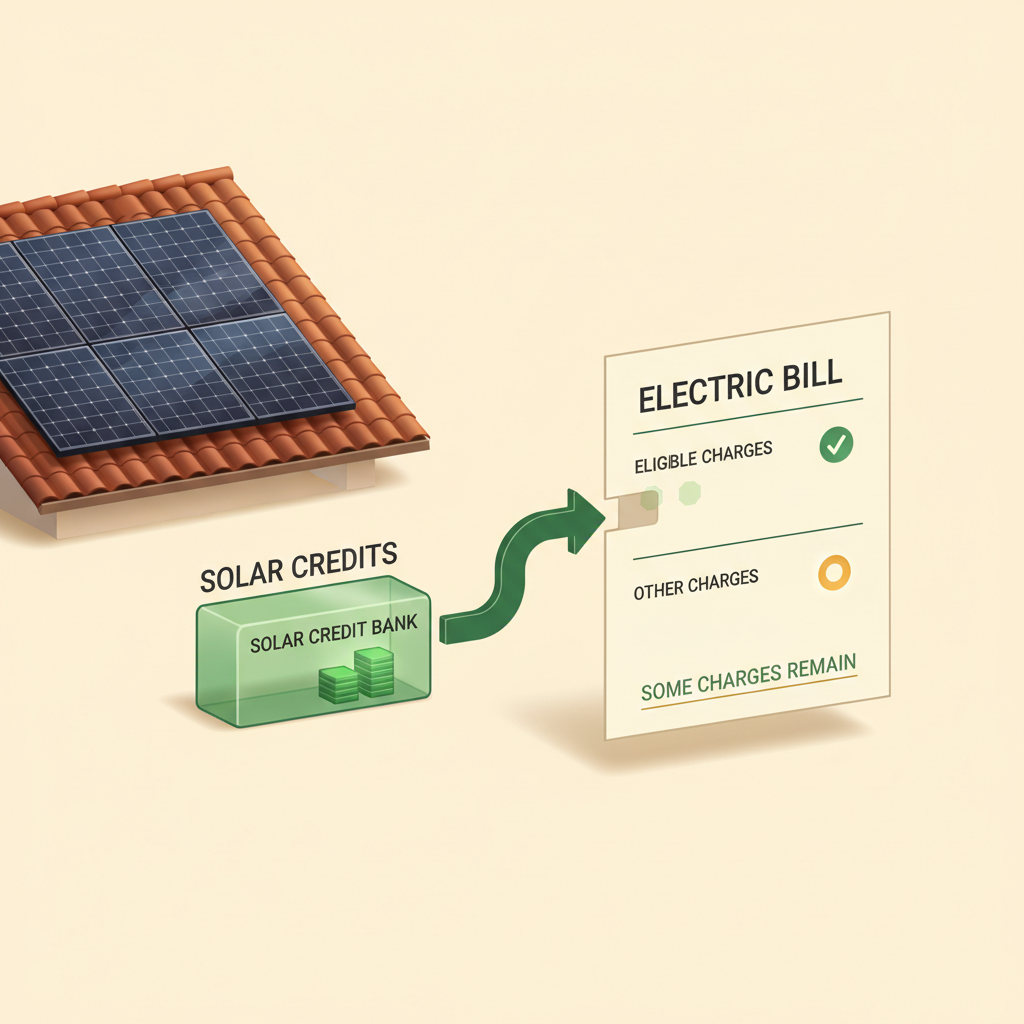
Solar panels can reduce the electricity you buy from the grid. But having money in a solar-credit bank does not necessarily mean your electric bill will be zero.
The reason: a utility bill combines different charges, and solar credits do not pay every category. Understanding those categories can help you ask better questions, spot unexplained changes, and compare rate plans without guessing.
This guide explains LADWP’s residential billing terms using its published information.
Why can you owe money when you have solar credits?
Your solar-credit balance and your amount due measure different things. The bank records accumulated credits; the bill also includes charges that those credits may not cover. LADWP’s published NEM rider excludes taxes and minimum charges from credit application. Adjustment-factor restrictions also require checking against the applicable rate schedule. [1,2]
That means a remaining payment is not automatically evidence that your panels stopped working or that your credits disappeared. It also does not prove that every charge is correct. The useful question is: Which parts of this bill can my credits pay, and how did LADWP calculate the rest?
What is the “Tier 1 Energy” charge?
It is the charge for electricity billed in the first usage tier under the standard residential schedule. The basic calculation is:
Billed Tier 1 kWh × applicable Tier 1 price per kWh = Tier 1 energy charge.
LADWP’s published total consumption price includes both the base energy rate and adjustment factors. A line labeled “energy” can therefore include several cost components rather than one unrestricted credit-eligible charge. Rates can change, and a bill spanning a rate change may divide the calculation into separate periods. [3]
- Why can it appear on a solar bill? Solar homes can still import electricity. Net metering accounts for imports and exports under the applicable billing rules; solar ownership alone does not eliminate all billed consumption. [1]
- Why might banked credits not erase it? Credits have limits. LADWP must distinguish eligible charges from excluded charges and apply the relevant minimum-charge and discount rules. Do not assume the entire combined energy line can be paid from the bank. [1–3]
- Is it the amount you ultimately owe? Not necessarily. Discounts, eligible credit applications, separate charges, and taxes can change the final electric total.
- What if the NEM withdrawal is zero? Ask LADWP to show whether any eligible amount remained after its calculation. A zero withdrawal alone neither explains the calculation nor establishes an error.
What is the separate Power Access Charge?
The Power Access Charge is a fixed monthly component of standard residential billing. LADWP bases its tier on historical usage and reassesses it annually on October 1. It is separate from the current period’s Tier 1 energy calculation. [5]
A bill can therefore show Tier 1 energy and a different tier for the access charge without those labels contradicting each other. The access charge is not a fee that purchases access to Tier 1 pricing. Ask which historical usage determined your PAC tier, how many months were billed, and how credits or discounts were applied.
A simple bill-review checklist
- Confirm the dates and rate code. Check the billing period and whether the account uses R-1A, R-1B, or another schedule.
- Read imports and exports separately. A solar-production app and a utility meter can measure different things; household self-consumption matters.
- Follow the NEM bank. Compare the opening balance, deposits, withdrawals, and closing balance.
- Separate charges from discounts. Identify energy, adjustment factors, access or service charges, minimum-charge calculations, assistance discounts, taxes, and surcharges.
- Compare with an earlier bill. Look for changes in usage, rates, billing days, discounts, or credit application.
- Request the calculation. A general explanation of solar billing is not a substitute for showing how your statement was calculated.
What to ask LADWP
Please explain my electric bill line by line. Which charges were eligible for my NEM bank credits, which were excluded, and which rate provisions apply? Please show how the minimum charge, adjustment factors, and any assistance discounts affected the calculation. If no solar credit was withdrawn, please explain why. Would a comparison of R-1A and R-1B using my actual usage and exports be appropriate?
LADWP lists customer service at 1-800-342-5397 and offers service-center appointments through its official website. Request a reference number and written explanation when a calculation remains unclear. [7]
Keep account numbers, addresses, meter identifiers, and barcodes private when seeking help online.
Tiered billing versus time-of-use
LADWP offers two residential schedules relevant to this comparison:
- R-1A — Standard residential: Uses consumption tiers and a Power Access Charge.
- R-1B — Time-of-use: Prices electricity by defined time periods, with a separate service charge. [3,5]
Labels such as “High Peak,” “Low Peak,” and “Base” describe time registers or periods. Confirm the actual rate code used to calculate your charges rather than inferring your plan from meter labels alone.
LADWP says solar customers who consistently bank credits may be good candidates for time-of-use. That is a reason to compare plans, not a guarantee of a lower bill. [5]
Before switching, ask for a comparison using:
- A full year of your grid imports and exports.
- The timing of electricity use and solar exports, where available.
- Each plan’s recurring charges and treatment of banked credits.
- Continued eligibility for existing discounts and any changes to their value.
- The rates and rules applicable when the change would take effect.
Plain-English definitions: a quick reference
Electricity and solar
- kWh — kilowatt-hour: A unit of electrical energy. A 1,000-watt appliance running for one hour uses one kWh. It measures energy used over time, not the size of a monthly payment.
- kW — kilowatt: A measure of power at a moment in time. It is commonly used to describe a solar system’s rated capacity. kW and kWh are not interchangeable.
- Delivered energy: Electricity LADWP sends from the grid to your property. Solar homes may still import electricity when their own production is insufficient.
- Received energy: Electricity LADWP receives from your property—solar electricity exported to the grid. This is not necessarily all the electricity your panels generated; some can be used directly in your home.
- Net energy: Grid imports minus grid exports for the relevant billing interval or period. The bill’s rate schedule determines how quantities are combined and priced.
- NEM — Net Energy Metering: The billing arrangement that accounts for electricity supplied by the utility and qualifying electricity sent back to it. LADWP’s NEM service rider governs its program. [1]
Your solar-credit bank
- Opening credit balance: The banked credit available at the start of the statement’s accounting period.
- NEM bank deposit: New credit added to the bank through the billing calculation.
- NEM bank withdrawal: Banked credit applied to eligible charges.
- Closing credit balance: The amount left after the statement’s deposits, withdrawals, and any other adjustments.
- No withdrawal: No banked credit was applied on that statement. This alone does not establish a mistake or explain why no credit was used.
Charges on your bill
- Base energy charge: The underlying rate for electricity, before applicable adjustment factors. LADWP publishes this separately from its combined consumption rate. [3]
- Adjustment factors: Additional components used to recover costs such as fuel, purchased electricity, system reliability, and other authorized expenses. They can change over time. [3,4]
- Tier 1, Tier 2, and Tier 3: Usage-based pricing categories under the standard residential schedule. Thresholds depend on factors including the applicable zone and billing period; higher usage can move part of consumption into another tier. [5]
- “Tier 1 Energy” on a statement: Do not assume this represents only the base energy rate. LADWP’s published total consumption rate combines the base rate with adjustment factors. [3]
- Power Access Charge, or PAC: A fixed monthly charge under standard residential billing, tied to the relevant historical usage tier. LADWP says it is reassessed annually on October 1 using the highest usage in the prior 12 months. Its tier can therefore differ from the energy tier appearing on a particular bill. [5]
- Minimum charge: A required billing floor under the applicable schedule. LADWP describes the standard residential minimum as a monthly amount plus adjustment factors. Ask how discounts and credits interact with that calculation on your account. [3]
- Service charge: A separate recurring charge under schedules such as residential time-of-use. A service charge and a minimum charge are different concepts; their credit treatment should be confirmed under the applicable schedule. [3]
- Utility tax and state surcharge: Separate government-related line items. Do not assume every tax or surcharge can be paid using solar credits; ask LADWP to identify their treatment individually. [1]
- Subtotal versus total: A subtotal may exclude taxes or other charges added later. Read the final electric total and the overall account total separately.
Discounts versus solar credits
Assistance programs and solar banking are separate mechanisms.
- PCAD — Physician Certified Allowance Discount: LADWP assistance based on qualifying physician-certified medical eligibility. It is not a withdrawal from a solar bank. [6]
- Other assistance discounts: Programs may have different eligibility requirements and billing treatment. Check the specific program rather than assuming all discounts work alike.
- Where to verify solar-credit use: Read the NEM bank section. A discount elsewhere on the bill does not, by itself, show that solar credits were redeemed.
Investing in solar starts with education—and understanding the bill is part of that education.
Explore more at HomeSolarSimplified.org or read our LADWP bill assistance guide.
Sources
- LADWP: EV / NEM / REO Rates—NEM service rider
- LADWP Solar NEM Billing Explanation, May 10, 2017, hosted by Porter Ranch Neighborhood Council — historical background only.
- LADWP: Residential Rates
- LADWP: Residential Adjustment Billing Factors
- LADWP: Residential Electric Rates
- LADWP: Physician Certified Allowance Discount
- LADWP: Customer Service
Source review: November 7, 2026. Rate schedules, adjustment factors, and eligibility rules can change. This is general education, not an account-specific calculation. No individual customer details, screenshots, quotations, or billing amounts are used.