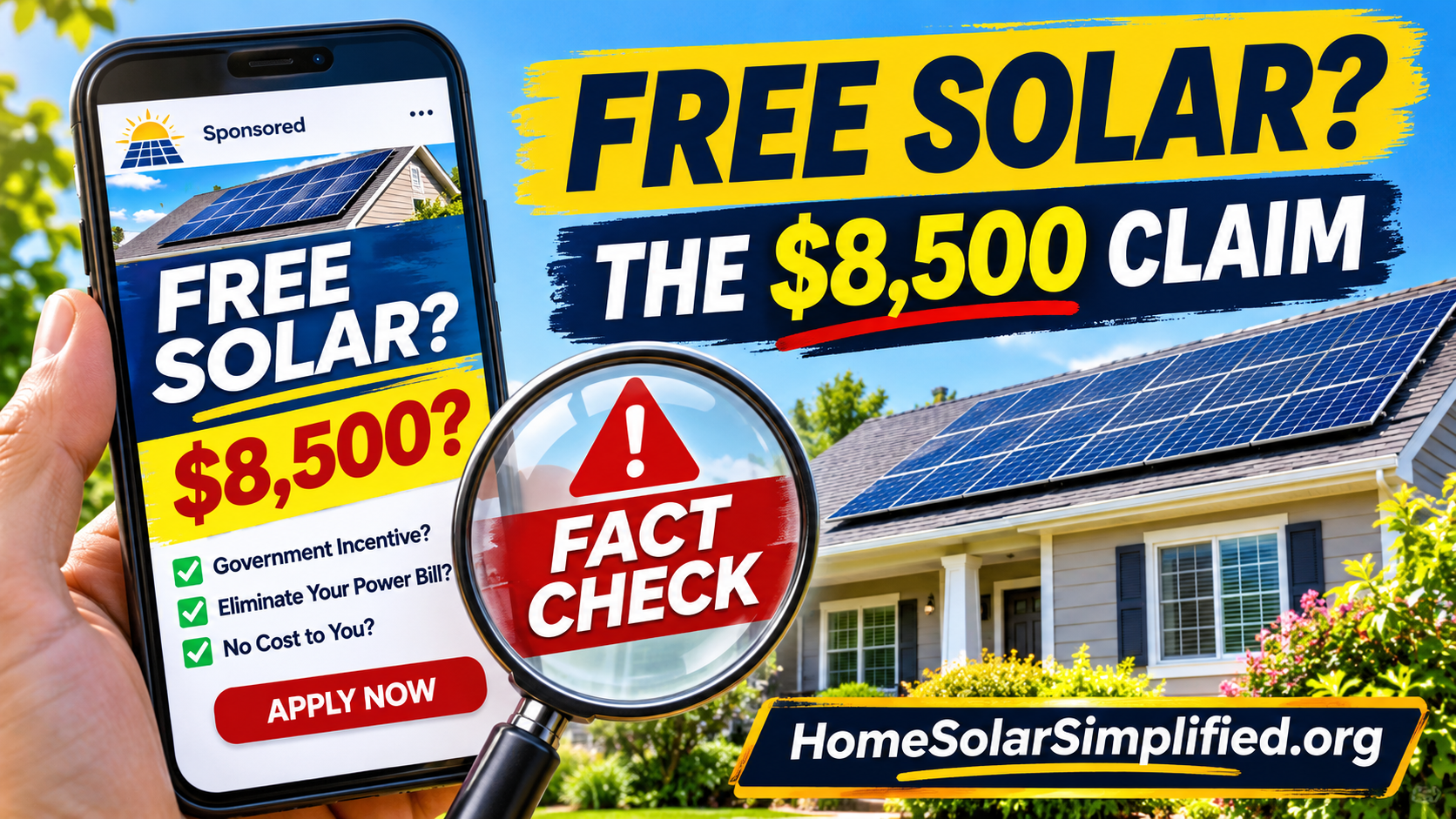
The advertised $8,500 government check is not a verified nationwide federal benefit. Claims of automatically approved ZIP codes, universally free systems and a deadline that can be beaten with a quick form are unsupported or misleading without a specific, verified program.
There is a reason this sort of solar pitch works: it borrows the authority of a real federal law and surrounds it with the language of a limited-time giveaway. The Inflation Reduction Act did expand the federal homeowner solar tax credit. But the ad turns that complex, conditional tax benefit into the promise of an easy cash windfall—and leaves out the most consequential update of all.
As of November 2026, the former 30% Residential Clean Energy Credit is not available for newly completed qualifying homeowner installations. The IRS says the original installation must have been completed by December 31, 2025. A purchase or payment made in 2025 does not by itself rescue a system completed in 2026. [1][2]
Five promises worth examining before you click
Here is how the advertising language compares with the available evidence. This analysis concerns the claims as described, not the conduct of an identified company.
“The government will send you an $8,500 check.”
Unsupported as a nationwide benefitNo general federal homeowner program establishes a guaranteed $8,500 cash payout merely for submitting a solar-ad questionnaire.
“Your ZIP code has been approved.”
Misleading without a named programSome genuine local incentives use geography. A ZIP code alone is not a federal entitlement or approval certificate.
“The Inflation Reduction Act is a new solar program.”
Outdated framingThat federal law was enacted in 2022; later legislation ended the direct homeowner solar credit for new installations after 2025.
“Your panels and electricity are absolutely free.”
Unsubstantiated blanket promiseZero-down loans, leases and power-purchase agreements may still create long-term charges. Bills and eligibility depend on circumstances.
“Submit this 30-second form before the program disappears.”
Pressure tactic, not proof of eligibilityA private marketing form does not grandfather homeowners into an expired federal tax incentive.
The $8,500 check: where is the government application?
The ad suggests that a homeowner can qualify for an $8,500 government payment in roughly 30 seconds. Yet the former federal homeowner credit was not a flat-dollar award or a general-purpose check. It was calculated as a percentage of qualifying costs, claimed on a federal income-tax return, and limited by tax liability because it was nonrefundable. Unused amounts could be carried forward under applicable rules. [1]
For perspective, $8,500 happened to equal 30% of about $28,333 in eligible project costs. That arithmetic does not transform the historical credit into a guaranteed payment of $8,500 to every homeowner. A household's eligibility, qualified expenditure, installation date and income-tax liability mattered. The ad's flat-dollar promise conceals those differences.
And there is a timing problem: the 2022 Inflation Reduction Act is not a newly introduced 2026 enrollment offer. A later federal law, enacted July 4, 2025, ended the direct residential clean-energy credit for expenditures treated as made after December 31, 2025. The IRS specifically explains that the installation-completion date controls in ordinary cases. [2]
“What is the exact government program name, and where does the administering agency publish the $8,500 payment?”
The ZIP-code approval trick
Location is relevant to real solar incentives. A legitimate state program might depend on utility territory, neighborhood income thresholds, grid constraints, or local program funding. New York's NY-Sun program, for example, has its own state-administered rules and qualified installers. [7]
What the ZIP-code claim cannot establish by itself is federal approval of a specific household or an entitlement to a promised dollar amount. The phrase “your area has been approved” sounds official but is meaningless unless the ad names an actual administering agency, publicly accessible program requirements and a current application process.
“Free” solar is often a financing term, not a price
A zero-dollar upfront payment may mean something very different from a zero-dollar obligation. A homeowner could be offered a loan, a solar lease or a power-purchase agreement (PPA). Under a loan, the owner repays principal and any interest or fees. Under a lease or PPA, a third party typically owns the equipment while the homeowner agrees to pay for use of the system or the electricity it produces.
The Consumer Financial Protection Bureau has documented how solar financing presentations sometimes emphasize an estimated net cost after an assumed tax credit, while understating financing charges, dealer fees or a possible later payment increase. The bureau also warned that projected tax benefits are not guaranteed. [5]
There are genuine, targeted public programs that can substantially reduce or sometimes cover up-front costs for eligible households. Those programs must be evaluated by their individual terms. The FTC's warning is about unverified universal offers—not a claim that every low-income assistance program is fictional. [4]
Will the electricity bill really disappear?
Solar production can offset a significant portion of grid electricity purchases, but a complete bill of zero dollars is not assured. Fixed utility charges, night-time imports, winter output, seasonal demand, rate-plan differences, export compensation and eventual equipment maintenance can all change the result. A financed system may also add a separate monthly obligation.
Instead of asking whether the panels will “erase” a bill, compare the total annual cost of electricity plus solar financing against the same home's likely utility-only cost. Ask for a written estimate that shows assumptions, not just a photograph of a smiling family beside a suspiciously small dollar figure. The CFPB identifies overstated savings as a recurring consumer risk. [5]
The 30-second questionnaire—and the disappearing deadline
The ad's last instruction may be its most revealing: complete ten questions, with no commitment, before the program disappears so you can be “grandfathered in.” That is a deadline claim, not evidence that a government benefit exists.
The FTC warns that some supposed solar-benefit forms are designed to capture names, phone numbers, addresses and other details for lead generation. More harmful schemes may impersonate government or utility representatives or seek personal and financial information. An advertiser's identity and its destination website would have to be examined before anyone could conclude what a particular form does. [3]
Entering contact information cannot revive a federal credit whose statutory installation deadline has already passed. The IRS eligibility rules, not a marketing countdown, control the former Section 25D benefit. [2]
So what legitimate solar help remains in 2026?
Solar incentives have not vanished everywhere. The critical difference is that programs are no longer interchangeable: state, municipal, utility, community-solar and certain business or third-party ownership provisions may have different funding sources, beneficiaries and eligibility rules.
New York's NY-Sun is an example of a continuing state program. Other localized programs may assist income-qualified households. The existence of such programs does not validate the specific “$8,500 check” advertisement or provide evidence of a uniform national payout. [7]
Another source of confusion is the federal Solar for All initiative. Although it was a real EPA program, the EPA Inspector General reported that the federal program was terminated in August 2025. Do not confuse it with similarly named state initiatives or assume that old announcements remain open today. [6]
Also distinguish the former homeowner tax credit from business tax credits or third-party-owned installations. Those have different taxpayers, rules and expiration provisions. A commercial developer's possible incentive is not automatically a government check payable to the resident.
Before you give an advertiser your information: a seven-point safety check
- Demand the official program name. Search the government or utility website directly rather than relying on an ad's application link.
- Confirm the date. Old Inflation Reduction Act articles may describe provisions that no longer apply to new 2026 installations.
- Ask who receives the money. A utility incentive to an installer is not the same as a cash payment to a homeowner.
- Get the full 25-year cost in writing. Compare cash price, loan principal, interest, dealer fees, lease or PPA escalators and early-termination terms.
- Request a realistic utility model. Include remaining fixed charges, seasonal imports, net-billing rules, roof conditions and maintenance assumptions.
- Protect your data. Do not provide Social Security or bank information merely to “check a ZIP code.” Read the lead-sharing and privacy disclosures.
- Walk away from high-pressure deadlines. Verify the actual application window with the agency itself and obtain independent competing proposals.
The bottom line
There is a legitimate conversation to have about solar economics, energy independence and government incentives. But it starts with verifiable facts—not a sponsored countdown promising the easiest money you will ever make.
Based on the claims provided, the advertisement combines a real historic law with unsupported promises of a specific government check, blanket no-cost solar and instant eligibility. That is a serious consumer-information problem. Without the advertiser's actual destination page and disclosures, this article does not accuse a particular company of fraud. It does explain why homeowners should not treat the promises as established facts.
Solar is an investment decision. A government check should never be something you have to take on faith.
Investing in solar starts with education.
Compare the actual costs, incentives and questions that matter—before sharing your details or signing a contract.
Explore homeowner guidesQuestions homeowners are asking
Is the government mailing an $8,500 solar check in 2026?
There is no verified general federal homeowner program guaranteeing an $8,500 check for completing a questionnaire or residing in an eligible ZIP code. Ask for the exact agency, program, eligibility rules and official government application.
Is the federal 30% homeowner solar tax credit still available for new installations in 2026?
No. The IRS says the Residential Clean Energy Credit cannot be claimed for qualifying systems with original installation completed after December 31, 2025. Eligible prior-year claims and carryforwards are a separate matter.
Are all free-solar offers fraudulent?
Not necessarily. Genuine income-qualified or local assistance may substantially subsidize eligible households, and some contracts require no money down. But claims of a universal free installation or a guaranteed government payment should not be accepted without documented program terms.
Can solar make my electric bill disappear?
Solar can reduce grid purchases, sometimes substantially, but fixed charges, seasonal imports, usage changes, export-credit rules and loan or lease payments can leave real ongoing costs.
Primary sources and further reading
Sources checked November 7, 2026. Where an older source describes prior tax-credit rules, the current IRS termination guidance controls.
- IRS — Residential Clean Energy CreditHistorical 30% homeowner credit, termination date and nonrefundability
- IRS — 2025 federal energy-credit changes, FAQ 7Installation timing rules for the former residential credit
- FTC — How to avoid solar and clean-energy scamsWarnings about free-solar promises, fake officials and data-collection forms
- FTC — Solar energy is rising in popularity. So are the scamsSolar ads promising no costs or no electric bills
- CFPB — Solar financing issue spotlightDealer fees, tax-credit assumptions and misleading net-cost calculations
- EPA Inspector General — Solar for All audit (2026)Records federal Solar for All program termination in August 2025
- NYSERDA — NY-Sun programExample of a distinct state-level solar incentive program
- DOE — Homeowner's guide to solarDescriptions of solar purchases, loans, leases and PPAs; check current credit rules with the IRS
To report a suspicious offer, visit ReportFraud.ftc.gov.
Editorial disclosure: Independent consumer education, not a government program or an endorsement of an advertiser. The ad language was supplied for analysis; its originating advertiser and landing page were not independently identified.