Federal Plug-In Solar Bill vs. California SB 868: What Changed in 2026?
H.R. 10851 is an introduced federal proposal, not federal law. California separately enacted SB 868, with qualifying-device rules effective January 1, 2027. Compare the two before buying.
Quick answer: one proposal and one enacted California law
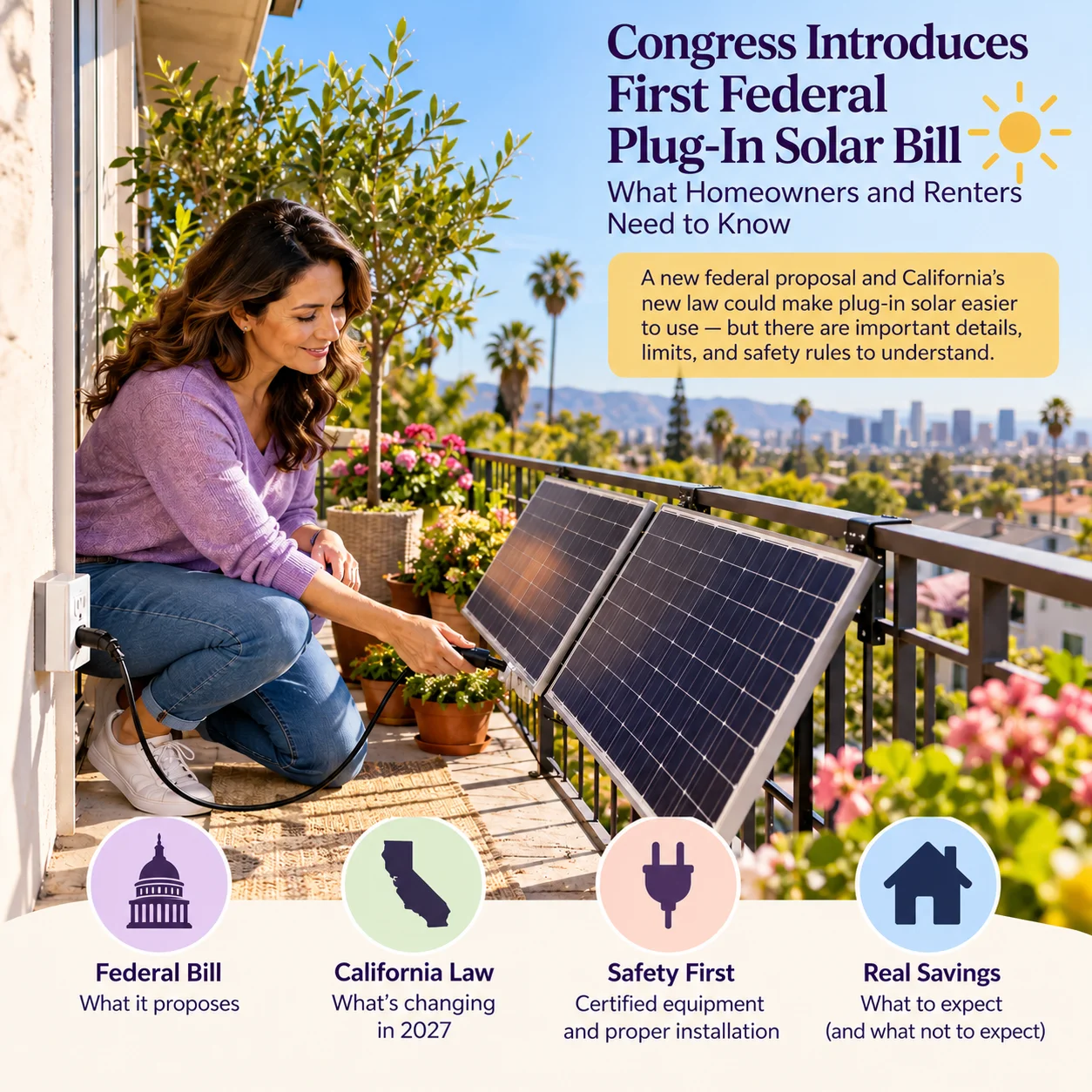
Congress introduced H.R. 10851, the Socket Full of Sunshine Act, on October 19, 2026. It was referred to the House Committee on Energy and Commerce and is not federal law as of this October 25 review. Its proposed nationwide standards, grant-funded rebates and federal safety work therefore are not available today.
California separately enacted SB 868 on September 30, 2026. Its qualifying portable-solar rules are scheduled to take effect January 1, 2027. That California law does not make every panel, inverter or battery safe to connect to an outlet, and it does not erase product, electrical, mounting, lease or property requirements.
What H.R. 10851 would do if enacted
The federal proposal would amend the Public Utility Regulatory Policies Act so states must consider measures promoting qualifying portable solar. That is a states to consider framework, not an automatic nationwide authorization. It proposes consideration of exemptions from interconnection and net-metering requirements and limits on extra utility approvals, fees, insurance and controls.
The bill defines a proposed qualifying device as no more than 1,200 watts, designed for a standard 120-volt AC outlet, intended mainly to offset onsite use, compliant with the latest National Electrical Code and certified by UL or an equivalent nationally recognized testing laboratory. It would require a power control system when output is greater than or equal to 400 watts.
It also proposes Department of Energy grants for state point-of-sale rebates of up to $1,000 for qualifying low- or moderate-income households, with domestic-content and tenant-protection conditions. Congress has not created or funded that consumer rebate merely by introducing the bill; treat any offer claiming an active H.R. 10851 rebate as unverified.
What California SB 868 changes
California's enacted framework applies only to a device meeting every statutory condition, including an aggregate maximum of 1,200 watts AC per dwelling, connection through a single standard outlet, onsite-consumption intent, compliance with the National Electrical Code and California Electrical Code, system-level certification by UL or an equivalent nationally recognized testing laboratory, and a certified isolation feature that prevents outage backfeed.
For a qualifying device, the law limits specified utility interconnection requirements, approvals, fees and extra controls. A utility may still require utility registration through a simple online form, including the address and device size. A product that misses a required condition does not receive these exemptions.
The interconnection exemption is scheduled to sunset January 1, 2030 unless lawmakers extend or replace it. Before relying on it, verify the current statute, the exact make and model, utility instructions, lease or HOA terms, mounting safety and any applicable building requirements.
Safety and outage behavior come before convenience
A conventional panel, portable power station, generator cord or ordinary grid-tied inverter is not automatically a qualifying plug-in solar system. Never improvise a cable that can energize household wiring or the grid. Match the whole system—not merely one component—to the required certification and the manufacturer's approved connection method.
Anti-islanding protects workers and equipment by isolating the device during an outage. It also means ordinary grid-interactive plug-in solar generally will not power household loads while the grid is down. Backup operation requires equipment explicitly designed and approved for that mode.
Estimate production without promising savings
For an illustrative gross-energy estimate, an 800-watt system receiving four equivalent full-sun hours would produce 0.8 kW × 4 hours = 3.2 kWh in a day, or 96 kWh over 30 days before losses. Shade, orientation, temperature, weather, inverter behavior, clipping and downtime can reduce actual output.
To estimate potential bill value, multiply energy actually used onsite during production by the avoided retail rate, then add any verified export value. This is not a savings promise: timing, utility tariffs, fixed charges, export treatment, product performance and household load can materially change the result.
A seven-step buying check
1. Confirm the law's current effective status. 2. Obtain the exact system-level certification—not a certification for only the panel or inverter. 3. Match rated AC output and connection method to the rule. 4. Verify outage isolation and power-control features.
5. Check current utility registration instructions. 6. Get written landlord, HOA or property approval when applicable and use structurally safe mounting. 7. Compare the all-in price with a conservative production estimate and written warranty.
Do not buy from a headline or a promise that every product is now legal. Save the model number, certification record, instructions, receipt and any registration or permission documents.
Read a product listing as evidence, not authorization
A seller's listing may mix a panel's wattage, an inverter's AC rating, a battery's storage capacity and a marketing name. Copy those figures into separate notes before comparing the product with an official rule. Ask the seller to identify the exact complete system, its certification record and the approved connection instructions. A photograph of a familiar certification logo on one component is not an explanation of the complete product's intended use.
Match the model identifiers across the quotation, certification information, instruction manual and equipment label. If the seller substitutes an inverter or accessory after the quote, ask whether the documentation still applies to the substituted system. Save the documents you relied on at purchase, since a later website revision can make it difficult to establish what was originally represented. Do not connect equipment while those questions remain unresolved.
Test whether your daytime load makes the purchase useful
Estimate the electricity your home uses while the proposed panels would generate. A household with an empty apartment at midday can have a different use pattern from someone working at home. Look for interval usage information from the utility if available and compare ordinary weekdays with weekends. Do not assume that annual consumption alone shows how much modest daytime generation you can use immediately.
Use a simple conservative case before paying: expected daytime generation, the portion likely used at home and only verified compensation for any surplus. Keep the purchase price, mounting accessories and professional assessment separate from energy value. If the purchase only appears worthwhile under an unconfirmed rebate or a generous assumed export rate, resolve that assumption before proceeding. This is a household screening exercise rather than a substitute for an electrical assessment.
Keep a proposal-status record before relying on benefits
When a headline refers to legislation, open the official record and note the bill number, jurisdiction, latest action, effective date if enacted and date you checked. Then ask what additional implementation steps would be necessary before a household can use a claimed benefit. A proposed program, an enacted rule and an administrator accepting applications describe different stages. Keep the source link with the offer so you can recheck it before buying.
Ask the seller to identify the specific official page supporting any promise about a rebate, registration exemption or approved connection method. Save the answer in writing. If the answer points only to a news article or another company's advertisement, return to the agency or utility responsible for that claim. The equipment decision should rest on your exact product and address rather than a general statement that plug-in solar has become available.
For a rental, keep installation permission and equipment suitability as separate questions. Written permission from a property owner does not establish electrical suitability, and a product certificate does not answer the lease's mounting or alteration provisions. Obtain the relevant answers before ordering equipment, particularly when a sale limits returns after the package is opened.
Frequently asked questions
Is H.R. 10851 federal law?
No. It was introduced on October 19, 2026 and referred to the House Committee on Energy and Commerce. The proposed standards and programs are not current federal benefits.
Is there an active federal rebate of up to $1,000?
No rebate exists solely because H.R. 10851 was introduced. The bill proposes grants supporting state point-of-sale rebates if it becomes law and is implemented.
When does California SB 868 take effect?
The qualifying-device framework is scheduled to take effect January 1, 2027. Recheck the statute and utility instructions before purchase or use.
Can I plug any solar panel or battery into a wall outlet?
No. Use only a complete system certified and approved for its specific grid-interactive connection. Never improvise an outlet backfeed connection.
Will plug-in solar work during an outage?
Ordinary grid-interactive equipment isolates during an outage. Do not expect backup unless the exact system is designed, certified and approved for that operating mode.
Can my utility still require registration?
California SB 868 permits a simple online utility registration requirement for qualifying devices. Verify the current form and requested device details with your utility.
Will an 800-watt system eliminate my bill?
Usually not. Output is modest and variable, and bill value depends on self-consumption, rates, fixed charges and export treatment.
Questions worth asking
- Did Congress pass H.R. 10851, or only introduce it?
- Does the proposed federal rebate exist now?
- When do California SB 868's key provisions take effect?
- What makes a device qualify under California law?
- Will qualifying plug-in solar provide outage backup?
- Can a utility require registration?
- How should I estimate production and savings?
Related guides
California plug-in solar for rentersCalifornia solar incentivesBefore you buy solar in Southern CaliforniaSize a solar battery by loads and runtimeSix questions before signingVerify a California solar companyStill researching solar?
Search homeowner guides by topic, electric utility, or location.
Sources and further reading
Sources reviewed: October 25, 2026. Confirm changing details with the official sources.
These links identify documents and resources used for this guide. Listing a source does not mean it was independently checked today. Utility rates, incentives, product specifications and program availability may change; confirm the latest version and effective date with the source.
Governor of California — September 30, 2026 legislative update confirming SB 868 was signedCongress.gov — H.R. 10851 statusGovInfo — H.R. 10851 official detailsGovInfo — H.R. 10851 introduced textCalifornia Legislative Information — SB 868California Assembly Utilities and Energy Committee — SB 868 analysisCalifornia Senate Energy, Utilities and Communications Committee — SB 868 analysisStart with a home energy checkup
Organize your usage, home details and goals before comparing proposals.
Try the home energy checkupReady to compare companies?
Explore provider options when you are ready to request quotes.
Explore provider options