Renters Can Go Solar, Too: The Truth About Plug-In Solar Panels and Your Electric Bill
Could a solar panel on your balcony or patio lower your electricity bill? Learn how plug-in solar works, what a 400-watt panel can produce, California's new rules, costs, safety and the trade-offs renters should know.
The solar question renters were told not to ask
For years, solar power was marketed almost exclusively to homeowners with suitable roofs, money for installation and the authority to approve major electrical work. But millions of people pay electric bills while renting apartments, duplexes, townhomes and houses. Why should ownership of a roof be the price of admission to cleaner, cheaper daytime electricity?
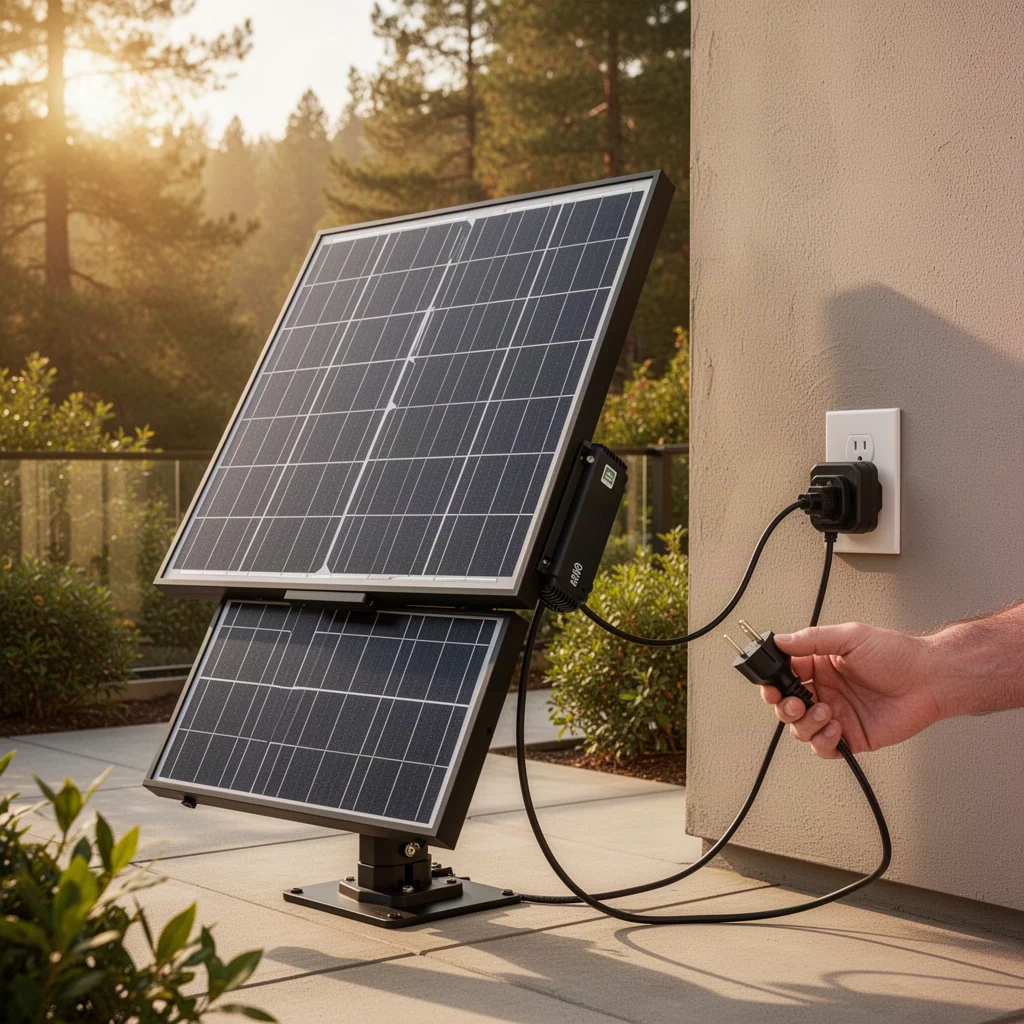
Plug-in solar—also called balcony solar or small portable grid-interactive solar—is an emerging answer. The concept is straightforward: a small photovoltaic panel captures sunlight; a purpose-built inverter converts the panel's direct current (DC) into synchronized alternating current (AC); and, where permitted, an approved connection supplies power to circuits in the home. The panel is a generator, not a magic electricity-saving gadget. Every safety, wiring and utility requirement still matters.
What does 'plugging in a solar panel' actually mean?
A photovoltaic panel produces DC electricity. Household wall outlets distribute AC electricity from a utility-backed electrical system. A grid-interactive microinverter must convert DC to AC, synchronize with the grid and disconnect automatically when utility power disappears. A panel alone must never be wired directly to a wall socket.
A certified plug-in system is fundamentally different from a DIY cable that backfeeds a regular outlet. The fact that a connector physically fits does not make it safe or lawful. The electrical circuit, outlet, inverter certification, instructions, installation method, local electrical authority and applicable utility rules must all support the proposed configuration. Never improvise a 'male-to-male' cord, use an extension cord as a substitute for approved equipment, defeat grounding or modify electrical protections.
A portable solar panel connected to a battery power station is another category. Its outlets can power devices separately, but it should not feed household wiring unless a specifically approved transfer and connection system is installed. Plug-in grid-interactive solar usually provides no power during a blackout because anti-islanding protection shuts it down.
The numbers: how much can a 400-watt panel make?
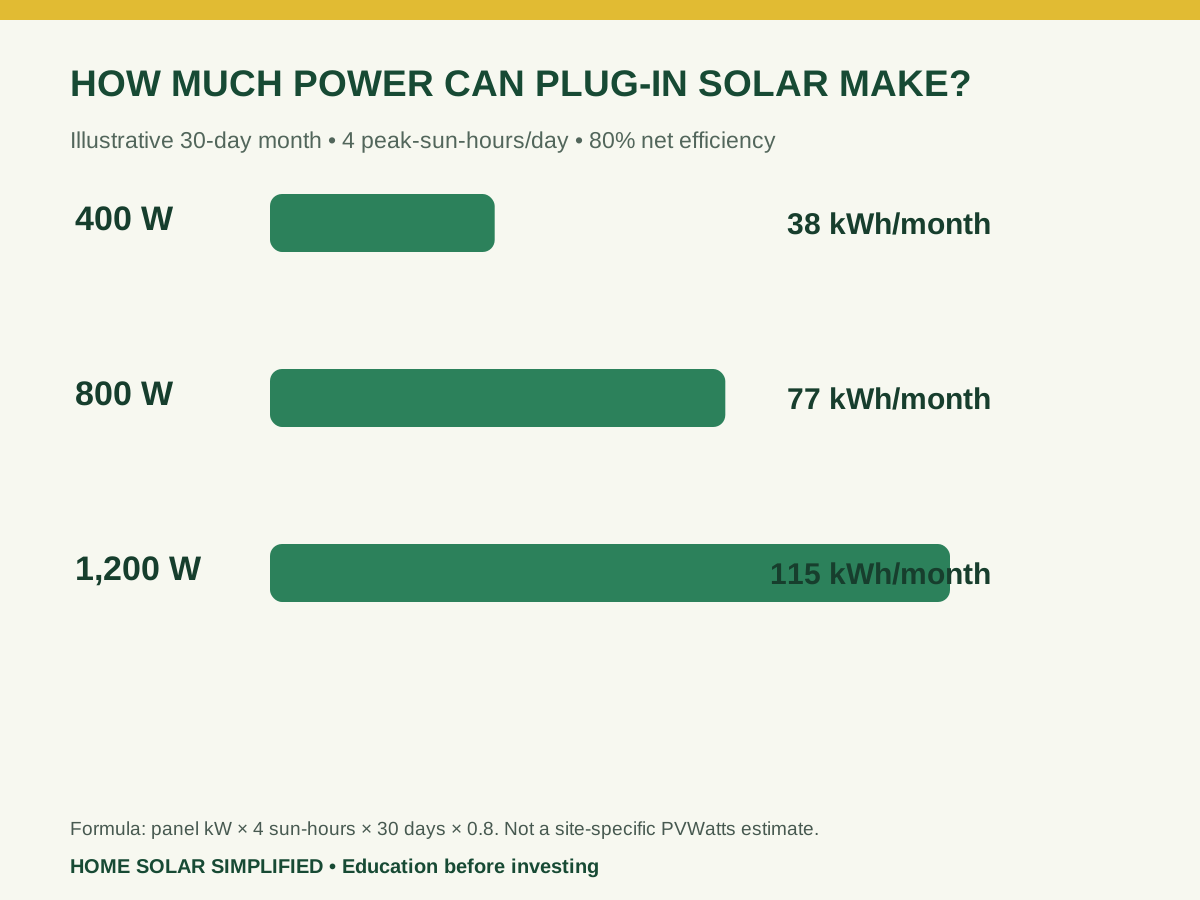
Start with the correct units. A 400-watt panel has a rated peak POWER of 0.4 kilowatts (kW). Electricity production is ENERGY measured in kilowatt-hours (kWh). Under illustrative conditions of four peak-sun-hours per day, 30 days and a 0.80 overall performance factor, the math is: 0.4 kW × 4 hours × 30 × 0.80 = 38.4 kWh per month. That is roughly 1.28 kWh per day, not 1.6 kilowatts per month. 'Kilowatts per month' would mix power and energy incorrectly.
Under the same assumptions, 800 watts of panels yield about 76.8 kWh per 30-day month; 1,200 watts yield about 115.2 kWh. These figures are educational scenarios rather than address-specific forecasts. Real output depends on local weather, orientation, tilt, heat, shading, inverter limits and season. A California south-facing unobstructed panel may outperform this conservative four-hour example; a shaded apartment balcony may underperform it substantially.
For a location-specific estimate, use the National Laboratory of the Rockies (formerly NREL) PVWatts calculator and enter the actual system size, orientation and losses. PVWatts models grid-connected photovoltaic production with weather data; it does not certify a product or confirm local plug-in legality.
What could that save on an electric bill?
Generation is not the same as bill savings. Imagine a 400-watt system that produces 38.4 kWh in a month. If 80% is used in the home while it is generated and those 30.72 kWh avoid a hypothetical marginal electricity price of $0.30 per kWh, the avoided purchase is approximately $9.22 that month, or about $111 across 12 equally productive months. That is an illustration—not a promise, utility quote or a forecast for every month.
If the same production is fully used at $0.20 per kWh, the gross avoided energy charge is about $7.68 for that month. If all 38.4 kWh are used at $0.40, it is $15.36. Electricity sent outward may earn little or nothing under some arrangements, and approved devices may limit export. Fixed charges and other fees can remain even when a household purchases fewer kWh.
Consumption timing is the hidden variable. A refrigerator, internet router, computer and daytime appliances can absorb production while the sun is shining. An empty apartment with very low midday demand might export or curtail much of its output. Compare your actual tariff and 15-minute or hourly usage if available before claiming a payback period.
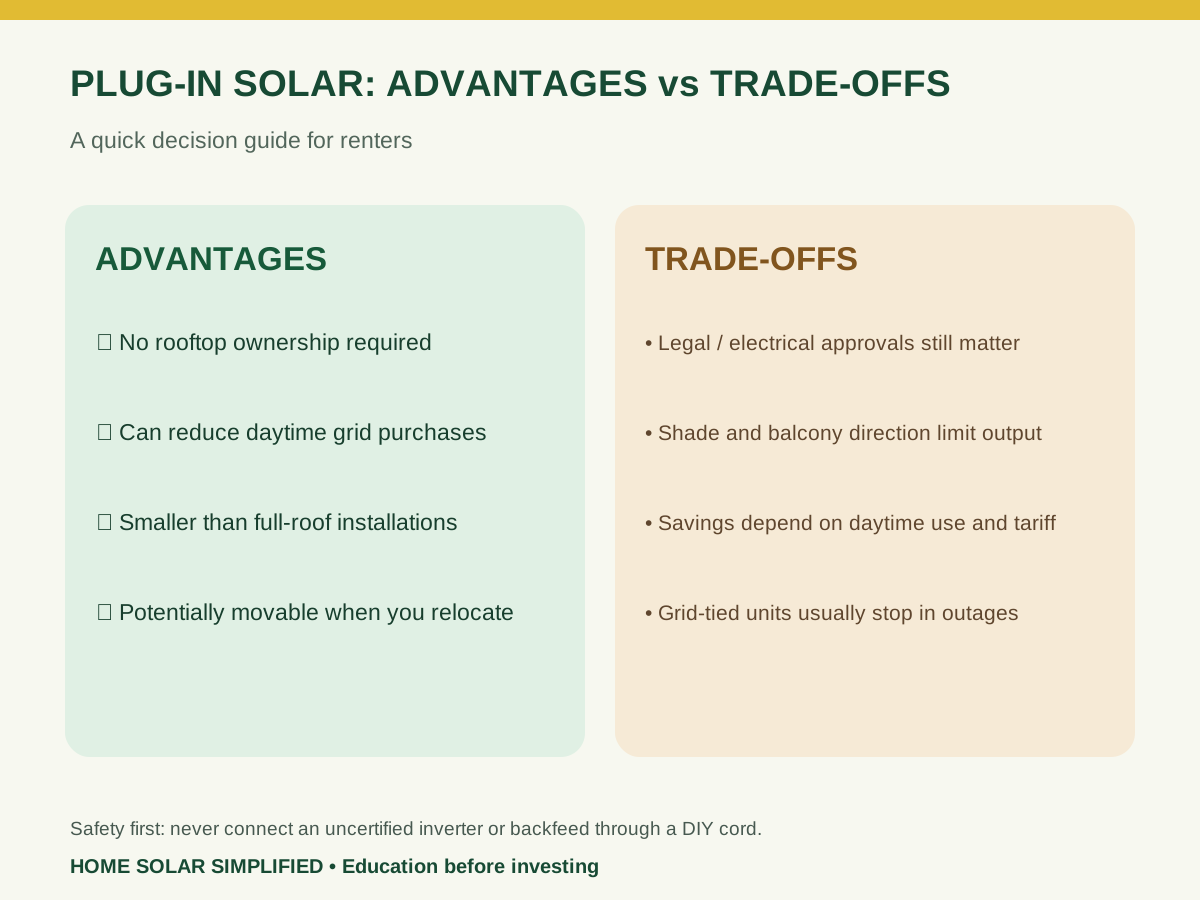
Advantages of plug-in solar for renters
- Potential access to solar without purchasing a house or controlling a roof.
- Smaller initial commitment than a conventional multi-kilowatt roof installation; equipment can sometimes be moved to a future residence.
- Daytime generation may offset electricity consumed by refrigerators, computers, fans and other always-on loads.
- Panels can use a properly permitted sunny patio, yard or balcony instead of a roof.
- Directly seeing solar production can help households understand their energy use and conservation opportunities.
Disadvantages, risks and limitations
- Approval is not automatic. Lease terms, landlord or building approval, balcony-load and attachment rules, local building/fire requirements and electrical codes can apply.
- An upper-floor balcony can be shaded, face the wrong direction or expose equipment to serious wind and falling-object hazards. Never hang panels over a railing without an engineered, expressly approved mount.
- A standard grid-connected microinverter stops exporting when utility power fails; do not market this as emergency backup.
- Your utility rate plan, low daytime consumption or uncompensated exports may make savings modest relative to the purchase cost.
- Some markets do not yet have a certified or clearly approved product and connection path. Avoid buying equipment solely because a retailer calls it 'plug and play.'
California's new plug-in solar law: the timing matters
California SB 868 was signed September 30, 2026, and is scheduled to take effect January 1, 2027. The chaptered statute defines a qualifying portable solar generation device as having a maximum aggregated AC output of no more than 1,200 watts per dwelling, connecting through a receptacle, meeting the current National Electrical Code and California Electrical Code, carrying qualifying plug-in photovoltaic certification, and including certified outage-isolation protection. For devices meeting every condition, the utility interconnection exemption lasts only until January 1, 2030; a utility may still require a simple online notice with the address and device details. As of this article's October 20, 2026 review date, the law's January effective date had not arrived.
That distinction is important. A future statutory exemption is not blanket permission to connect any inexpensive panel, inverter or extension lead to an occupied rental unit today. A renter should verify the final statutory definitions, permitted rating and connection method, applicable certified equipment, utility guidance, local safety review and property approval before installation. The law does not eliminate physical hazards, lease restrictions or the need for safe mounting. Rules also vary outside California.
For the controlling text and any subsequent amendments, read California Legislative Information's SB 868 bill page rather than relying on marketing descriptions. This article is educational, not an installation permit or legal opinion.
Where can a renter actually put the panels?
A ground-level patio with unshaded daytime sun is often easier to evaluate than a high-rise balcony because fall hazards and wind loads can be simpler to control—but neither location is automatically approved. Check whether the proposed mounting system is designed for the local conditions and whether it blocks windows, exits, fire access or walkways.
A balcony needs extra scrutiny: measure available space, confirm sun exposure during the middle of the day, learn the weight limit and building rules, and do not drill into railings, facades or waterproofing without written authorization. Panels act like sails in wind. A loose panel can injure people below.
A small yard or shared outdoor space can also work with permission. Keep cables protected from abrasion, rain, foot traffic and doors; use only equipment and connections approved for those conditions.
A renter's five-step decision checklist
- 1. Confirm whether your location actually receives useful direct sunlight. Watch where shadows fall at 9 a.m., noon and 3 p.m. over several days.
- 2. Check the lease, building policies, landlord permission, HOA conditions where relevant, and local fire and electrical rules.
- 3. Ask the utility and local authority what specific equipment and installation conditions are approved on the date you plan to connect.
- 4. Request documented product certification, inverter anti-islanding behavior, manufacturer installation instructions and an appropriate engineered mounting method. A qualified electrician can assess the intended circuit and connection.
- 5. Calculate realistic kWh and savings with your own tariff, daytime electricity use and product cost. Do not count on unspecified subsidies, net-metering credits or blackout power.
What about an 800-watt or 1,200-watt setup?
More panels increase potential production only if they receive adequate sun and their rated outputs are within the allowed system and inverter limits. The 800-watt example at four peak-sun-hours and 80% efficiency produces about 77 kWh per 30-day month; the 1,200-watt example about 115 kWh. These examples do not imply every size is permitted as a California portable plug-in system.
Larger systems can also create more energy when nobody is home. Export rules, self-consumption, equipment pricing and safety constraints may matter more than the extra nameplate wattage. Never assume that combining multiple kits into several outlets avoids a system-level electrical limit.
The bottom line: renters deserve a real solar option, not a dangerous shortcut
Plug-in solar could broaden access to clean electricity for people who cannot afford a house or cannot install rooftop panels. That is a meaningful shift. But the strongest case for renter solar is based on careful math, safe equipment and clear permissions—not an advertisement promising to erase the utility bill.
Before you buy, understand the connection, verify the rules, calculate your likely daytime savings and compare the total cost with alternatives such as efficiency improvements, community solar where available, or a correctly used portable power station. When investing in solar, always start with education.
Frequently asked questions
Can I plug a regular solar panel into a wall outlet?
No. A standalone DC solar panel cannot be connected to an ordinary AC outlet. Only a specifically compliant, approved plug-in system with the required inverter and connection protections may be connected where local rules permit.
Will plug-in solar power my apartment in a blackout?
Ordinary grid-interactive plug-in systems automatically shut down during utility outages. Backup requires a separate properly designed and approved battery-based arrangement.
Is 400 watts equal to 1.6 kilowatts per month?
No. 400 watts (0.4 kW) describes instantaneous rated power; production is measured in kWh. At four peak-sun-hours, the panel could theoretically capture 1.6 kWh of DC energy before losses during a sunny day. With an 80% overall performance factor, that becomes about 1.28 kWh/day or 38.4 kWh per 30-day month.
Is California plug-in solar fully legal now?
SB 868 was signed in September 2026 but takes effect January 1, 2027. Consumers still need to verify the law's requirements, compliant equipment, mounting and property-specific permissions before connecting a system.
Questions worth asking
- Is the specific plug-in solar device and outlet connection allowed at my property today?
- What does my lease or landlord require in writing?
- Does the approved inverter automatically stop feeding power during an outage?
- How many kWh will my particular shaded or sunny site realistically produce?
- What portion of midday solar production can I actually use, and how does my electric tariff value it?
Related guides
Understand panel wattage and realistic solar electricity productionLearn when battery storage is useful and when it is notCompare the financial commitments of conventional rooftop solarUnderstand solar microinvertersWhat solar equipment actually costsStill researching solar?
Search homeowner guides by topic, electric utility, or location.
Sources and further reading
Sources reviewed: 2026-10-20. Confirm changing details with the official sources.
These links identify documents and resources used for this guide. Listing a source does not mean it was independently checked today. Utility rates, incentives, product specifications and program availability may change; confirm the latest version and effective date with the source.
California SB 868 — official bill text and legislative historyGovernor of California — September 30, 2026 legislative update confirming SB 868 was signedCalifornia legislative committee analysis of SB 868National Laboratory of the Rockies — PVWatts CalculatorPVWatts V8 documentation and assumptionsU.S. Department of Energy — Homeowner's Guide to Going SolarStart with a home energy checkup
Organize your usage, home details and goals before comparing proposals.
Try the home energy checkupReady to compare companies?
Explore provider options when you are ready to request quotes.
Explore provider options