Solar + Battery in Coto de Caza: Backup Planning for Larger Homes
How Coto de Caza homeowners can size battery backup around actual priorities, larger loads and resilience goals without defaulting to an oversized system.
Program information checked October 5, 2026. Confirm current availability with the administrator.
Give the battery a specific job
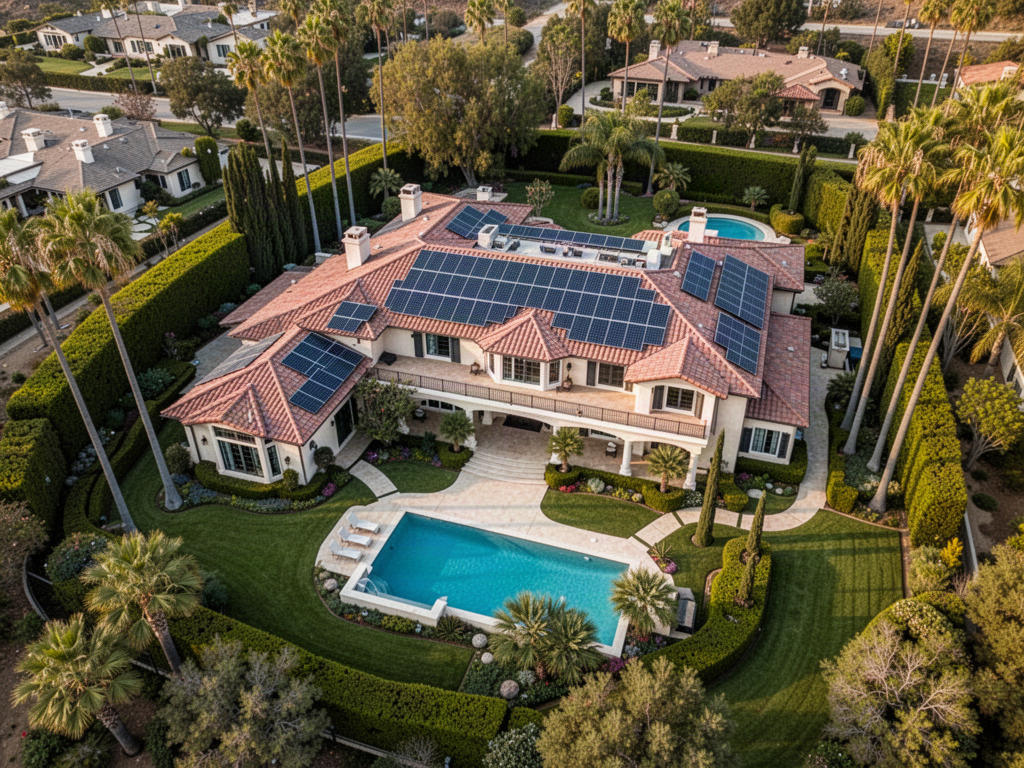
Coto de Caza homes can involve gated-community review, large homes, pools and high cooling loads. That mix can materially affect array layout, construction scope, storage design, equipment placement and price.
Decide whether the priority is outage backup, evening load shifting, solar self-consumption or a combination. Battery sizing becomes more rational once the goal is defined.
Power and energy answer different questions
Usable kWh describes how much stored energy is available. Continuous and surge kW describe what equipment can run at the same time and whether motors or HVAC equipment can start successfully.
A large battery capacity does not automatically mean whole-home backup. Ask the installer to identify the actual backed-up circuits and expected operating limits.
Large homes need load management
Homes in Coto de Caza may have multiple HVAC systems, pool pumps, EV charging, electric cooking, gates, well or landscape equipment and other substantial loads.
Rather than trying to run everything indefinitely, compare critical-load backup, managed whole-home backup and larger multi-battery designs. Ask what happens when several heavy loads call for power at once.
Model outage duration honestly
A runtime estimate should state the assumed average load, reserve setting and whether daytime solar is expected to recharge the battery. Weather, shading and actual household behavior can change the result.
Request both an overnight scenario and a multi-day outage scenario so you can see which loads would need to be reduced.
Compare the full storage proposal
Record usable capacity, continuous and surge output, warranty terms, operating reserve, backed-up loads, solar recharge capability, installation scope and replacement/service process.
If backup is the main reason for buying storage, ask for a demonstration of how the system behaves when grid power is unavailable.
What a media-quality homeowner review should include
For a higher-value Coto de Caza property, the useful question is not whether solar is popular; it is whether the proposed system fits the house, the ownership horizon and the household's real electricity pattern. Review the proposal as a construction and energy project, not as a retail appliance purchase.
Ask the contractor to distinguish measured facts from forecasts. Roof dimensions, equipment model numbers and contract price are facts. Future utility inflation, long-term production and projected lifetime savings are assumptions. A strong article or proposal makes that distinction obvious.
When comparing systems, look at whole-project quality: roof workmanship, equipment compatibility, electrical design, permitting responsibility, utility interconnection, monitoring, service response and how the system will be handled if the home is sold or reroofed later.
For larger homes, check whether the proposal has modeled major loads individually. Multiple HVAC systems, pools, spas, EV charging, guest houses, gates and landscape equipment can change both solar sizing and backup strategy. A system sized from a single recent bill can miss those patterns.
Document aesthetic requirements before final design approval. Premium homes often involve roof visibility, array symmetry, conduit routing, equipment screening and HOA or architectural-review concerns. Those expectations should be written into the design conversation, not raised after installation begins.
Finally, stress-test the economics. Compare the contractor's primary savings case with a lower-production case and a case with different future utility assumptions. If the project still makes sense under a more conservative scenario, the decision is less dependent on optimistic forecasting.
Questions worth asking
- Which circuits are actually backed up?
- What are usable kWh and continuous kW?
- How does the system behave with HVAC and other large loads?
- How much reserve is kept for an outage?
Related guides
How to compare two solar quotesIs solar worth it for my home?Compare solar financing optionsSources and further reading
U.S. Department of Energy — Homeowner's Guide to Going SolarCalifornia Public Utilities Commission — Solar Consumer Protection GuideExplore more for your home
Home Solar Simplified
Explore solar education, battery planning and home energy tools to prepare for your next decision.
Explore Home Solar SimplifiedConnectPoint ISP
Visit ConnectPoint ISP to explore home internet options and ask about service availability at your address.
Visit ConnectPoint ISP