How to Read Your Edison Bill and Check Your Options
Read an SCE Edison bill by separating balances, daily kWh, generation, delivery and the Base Services Charge. Work through examples and find official payment help.
Start with the utility on your statement
To read an SCE bill, first separate the amount due from this period's electricity charges. Then check the dates and kWh, identify who supplies generation, review your exact rate plan and Base Services Charge, and match any payment problem to the appropriate assistance program. This review uses official information checked October 26, 2026; your own statement and effective tariff determine the charges.
An Edison bill can be confusing when generation, delivery, a Base Services Charge, and perhaps another energy provider appear on the same statement. Each deserves a closer look. Their presence alone does not mean that you were billed twice for the same service.
This guide is for Southern California Edison, or SCE, in California. Con Edison in New York and ComEd in Illinois are different companies with different bills and programs. Start with the company name printed on your statement.
Find the current electricity charges
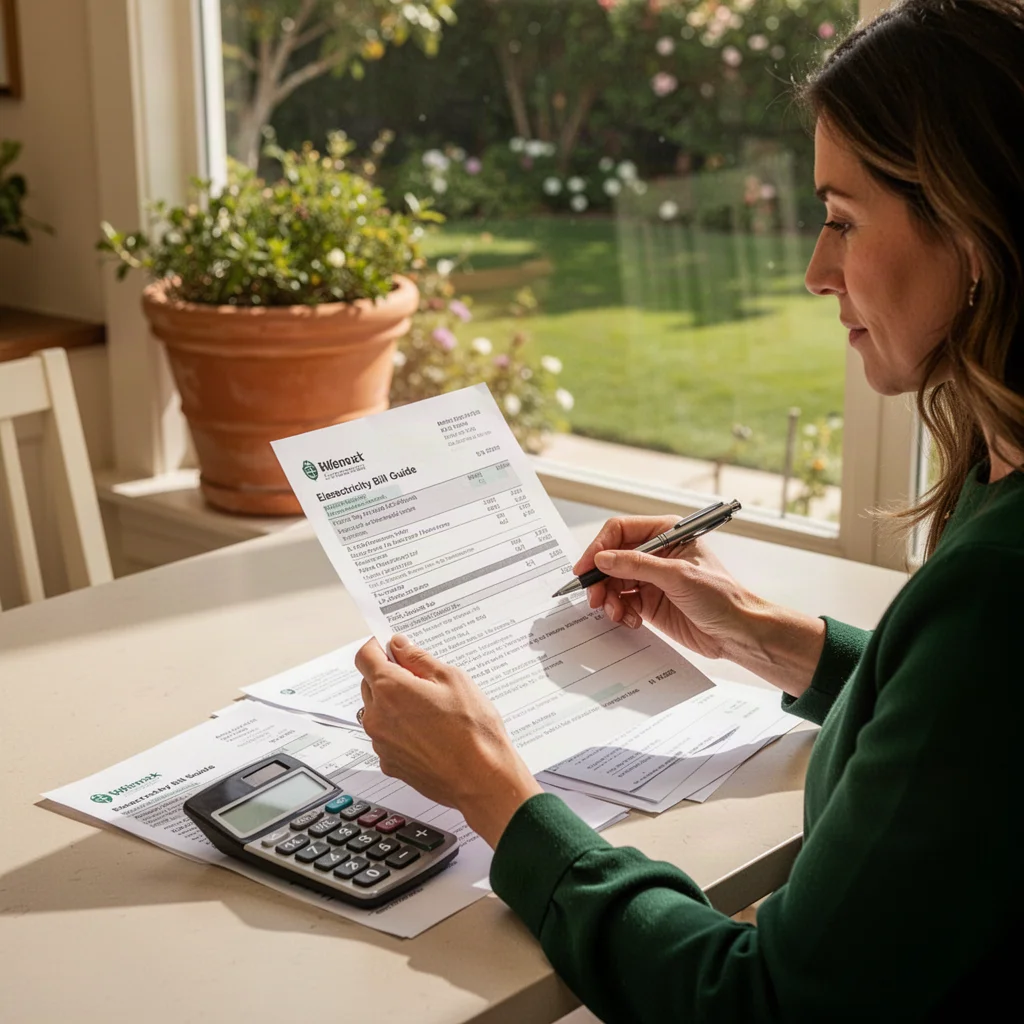
Open SCE's official bill explanation beside your statement. Identify the service dates, total kWh, rate-plan name, current charges, prior balance, credits, and payments. Comparing total amounts due without separating an older balance can make a normal current bill look like a sudden increase.
Divide kWh by the days billed to compare daily consumption. If that figure increased, review your household's electricity use. If it stayed similar, investigate the rate, timing of consumption, discounts, and any adjustments. Both can change at once.
A longer billing period can explain more kWh
Here is an invented example you can reproduce with a calculator. One statement reports 540 kWh over 27 days. Another reports 620 kWh over 31 days. Both equal 20 kWh per day: 540 divided by 27, and 620 divided by 31. The second statement contains 80 more kWh because it covers four more days. Those figures alone do not show an increase in daily household consumption.
Daily averages are a screening tool, not a complete explanation of the dollar change. At the same daily kWh, a household can still pay more because more electricity falls in expensive periods, a rate changes, a discount ends, or an earlier credit does not repeat. Compare similar seasons and note heat waves, guests, vehicle charging and changes in occupancy before deciding which explanation fits.
Reconcile the balance before comparing prices
Use a second fictional example to separate a billing problem from a usage problem. Suppose an account has a $160 previous balance, a $100 payment that posted, $140 in new charges and a $20 credit. The arithmetic is $160 minus $100 plus $140 minus $20, or $180 due. The new charges are $140; treating $180 as the price of this period's energy would mix old debt with current service.
Actual statements may include additional adjustments, fees or account activity. Copy each item once, keep its sign, and match it to the period shown. If a recent payment is missing, check its posting date and confirmation before paying the same amount again. Ask SCE to identify any amount that does not reconcile, rather than forcing the numbers to fit an assumed monthly total.
Read the meter and download SCE interval data
SCE's physical-meter guide describes a SmartConnect display that cycles every five seconds and identifies screen 001 as cumulative kWh. Use that instruction for the documented configuration, and ask SCE about additional solar registers or a different display. Photograph the meter number, identifier, unit and timestamp; comparing one current screen with a bill from an earlier date does not establish a billing error.
For time-of-use questions, SCE's data-access instructions say to sign in to My Account, select Data Sharing & Download, then Green Button Download My Data. SCE says interval usage is available in 15- or 60-minute intervals depending on meter type. Save the file covering the bill's dates, confirm its units and timestamps, and check for missing or estimated records before assigning energy to rate periods. For solar, identify import/export channels rather than treating utility data as total inverter production.
Understand generation and delivery
Generation pays for the electricity supplied. Delivery covers getting that electricity to your home through the utility system. If a community choice aggregator, or CCA, supplies your energy, its generation charges can appear separately while SCE continues to provide delivery.
SCE's CCA explanation describes this arrangement and directs generation questions to the CCA. Metering, delivery, and other account questions generally go to SCE. A CCA line is not, by itself, evidence of duplicate billing. Check the subtotals before adding amounts together.
Know what the Base Services Charge does
SCE explains that the Base Services Charge became effective in November 2025 and replaced its previous Basic Charge, alongside lower usage-based electricity rates. The bill impact depends on your usage and any qualifying discount.
The charge is assessed by billing days and is not eliminated simply by consuming less electricity. Eligible discounted categories have different amounts; the rate restructuring does not guarantee that every household's total bill falls. That makes the entire bill more useful than one isolated cents-per-kWh figure when comparing costs. Solar customers can also continue to owe the charge.
For a time-of-use plan, check the exact plan's pricing periods. SCE's hours are not a nationwide rule, and even customers of the same utility can have different plans. Ask for a comparison using your own usage history before switching. If solar is part of your planning, our [SCE time-of-use and solar guide](https://homesolarsimplified.org/solar-guides/sce-time-of-use-solar) explains why purchases, exports, and household schedules need separate attention.
Check the exact rate and the timing of consumption
Write down the rate-plan name from the statement before looking up prices. For time-of-use service, compare kWh within the stated periods rather than applying one price to the entire month. Review the season and day rules printed in the plan. Moving a flexible load helps only if the alternative period actually costs less under that account's tariff.
Ask for a comparison using your household's usage history, and find out what the result includes. SCE says a CCA customer's rate analysis can use a proxy based on SCE generation prices. That means the output is not automatically a complete forecast of your CCA bill. Confirm the generation supplier and assumptions before switching plans or making an expensive equipment decision.
Use the right statement if you already have solar
Record whether the account is on legacy Net Energy Metering or the Solar Billing Plan before interpreting credits and settlement amounts. A solar monitoring app measures production; that is different from what the utility meter records as electricity imported from or exported to the grid. Electricity used directly in the house does not appear as a grid export.
Keep the loan, lease or power-purchase-agreement payment separate from utility charges. A salesperson's combined savings estimate is not a substitute for the actual statement. For a billing question, gather the service period, plan, imports, exports, credits and settlement information. Use the separate SCE solar-billing guide linked below for that accounting rather than applying a standard non-solar example to the account.
Prepare one focused request for SCE
Before calling, mark the line you cannot explain and the outcome you need: a payment traced, a charge explained, a reading reviewed, a discount checked or a payment arrangement discussed. Keep the current statement and one useful comparison statement together. This is more effective than asking why the entire bill is high without identifying the changed component.
If service is at risk, state the shutoff deadline first and ask exactly what action is required. An assistance application, complaint or promised callback should not be treated as a service hold unless SCE confirms that protection. Record the date, representative, reference number, required payment and next deadline. Ask for written confirmation of an arrangement, and use the official account channel for sensitive documents.
Choose the right kind of bill help
SCE's CARE and FERA information explains ongoing discounts for qualifying households. Check current eligibility rather than assuming you earn too much or that a past determination still applies.
If you already owe a substantial balance, review the Arrearage Management Plan. SCE currently excludes Net Energy Metering (NEM), Solar Billing Plan (SBP), Direct Access, and master-metered accounts from AMP. Other customers must meet its CARE or FERA enrollment, past-due-balance, account-history, and payment requirements. Applying does not automatically erase debt, and current bills must still be paid under the plan. If your solar account is excluded, ask SCE about other payment or assistance options.
For a short-term payment problem, start with SCE's billing and payment options. For local assistance, use California's city and county service finder. Confirm whether the agency serves your address and utility, whether applications are open, and what documents it needs.
A useful customer-service request is: “Please explain my current charges separately from the past balance, confirm my rate and any CCA charges, and check whether I qualify for a discount or payment program.” Have the statement in front of you and write down the answer. A clear explanation helps you decide whether the next step is reducing usage, correcting an account issue, changing plans, or seeking assistance.
Separate SCE bill relief from home energy and solar programs
SCE bill discounts, arrearage help, payment arrangements and one-time aid address the utility account. The Energy Savings Assistance program has a different job: SCE says qualifying homeowners and renters may receive approved energy-saving improvements at no cost. Enrollment in one program does not automatically approve another, so use the official SCE page and current application for each route.
California's Department of Community Services and Development administers separate Low-Income Weatherization Program components. CSD describes LIWP as supporting specified low-income housing pathways with energy-efficiency upgrades and solar photovoltaic systems. Confirm which component serves the household, whether intake is open and which administrator handles the application before relying on it.
Verify nonprofit-administered DAC-SASH before signing a solar contract
GRID Alternatives administers DAC-SASH. Its current eligibility page says an applicant must receive electric service from SCE, PG&E or SDG&E, own and occupy a single-family primary residence, meet the current household-income rule and live in an eligible location. SCE service alone is not enough, and GRID—not a salesperson—determines whether the household qualifies.
DAC-SASH is a solar pathway, not emergency bill payment. Do not sign a solar contract, pay a deposit or assume a project price on the belief that the program will cover it unless the official administrator confirms the required approval and next steps. Funding, technical review and scheduling can still affect a project after initial screening.
Choose a next step you can verify
Finish the review with one measurable action. If daily kWh rose, examine the relevant usage periods and loads. If the balance fails to reconcile, request an account explanation. If a discount disappeared, check enrollment or verification requirements. If affordability is the immediate issue, pursue payment help while the billing investigation continues.
For a household in Ventura County or the San Fernando Valley, the county name alone does not establish SCE service or program eligibility. Use the company on the actual bill. Keep this worksheet for the next statement so you can see whether the payment posted, the correction appeared or the agreed discount began. Do not sign a solar contract simply to obtain an explanation of your existing electricity bill.
Frequently asked questions
Is this guide for Southern California Edison or Con Edison?
This article covers Southern California Edison (SCE) in California. Con Edison in New York and ComEd in Illinois have different bills and assistance programs.
Does the SCE Base Services Charge disappear when I add solar?
No. Solar customers can still owe the Base Services Charge and other remaining charges. Check the current rate schedule and any qualifying discount.
Can SCE solar customers enroll in the Arrearage Management Plan?
SCE currently excludes Net Energy Metering and Solar Billing Plan accounts, as well as Direct Access and master-metered accounts. Ask SCE about other payment options if AMP is unavailable.
How do I compare SCE bills with different numbers of days?
Divide each period's kWh by its billing days. For example, 540 kWh over 27 days and 620 kWh over 31 days both equal 20 kWh daily. Then investigate rates, timing, credits and balances separately.
Do separate SCE and CCA charges mean I pay twice for electricity?
Not by themselves. The CCA generally supplies generation while SCE provides delivery. Review the subtotals and direct a generation question to the CCA; do not add a subtotal to a total that already includes it.
Will switching to a time-of-use plan always lower my bill?
No. Compare your actual usage across the eligible plan's periods and confirm whether the estimate includes your generation supplier. Household schedules, rate rules and remaining charges affect the result.
Does applying for bill assistance stop a disconnection?
Do not assume it does. Tell SCE and the assistance agency about the deadline, and obtain confirmation of the payment or other action required to protect service while the application is reviewed.
What should I have ready when I question an SCE charge?
Have the current statement, a relevant older statement, the exact disputed line, service dates and any payment confirmation. Keep account details private and request a reference number and clear next step.
Can a qualifying SCE homeowner get no-cost solar through a nonprofit-administered program?
Potentially. GRID Alternatives administers DAC-SASH for qualifying owner-occupants served by SCE, PG&E or SDG&E who also meet the program's current income and eligible-location rules. GRID makes the eligibility determination; a contractor's screening is not approval.
Are SCE Energy Savings Assistance, California LIWP and DAC-SASH the same program?
No. SCE's Energy Savings Assistance program provides qualifying utility customers with approved efficiency improvements. California CSD administers separate LIWP components, and GRID Alternatives administers DAC-SASH for qualifying single-family homeowners. Eligibility, service area, funding and application steps differ.
Check eligibility and take the next step
These links open the official program or its application service.
CARE and FERA information Arrearage Management Plan California's city and county service finder Review SCE income-qualified programs Check GRID Alternatives DAC-SASH eligibilityQuestions worth asking
- Is this guide for Southern California Edison or Con Edison?
- Does the SCE Base Services Charge disappear when I add solar?
- Can SCE solar customers enroll in the Arrearage Management Plan?
- How do I compare SCE bills with different numbers of days?
- Do separate SCE and CCA charges mean I pay twice for electricity?
- Will switching to a time-of-use plan always lower my bill?
- Does applying for bill assistance stop a disconnection?
- What should I have ready when I question an SCE charge?
- Can a qualifying SCE homeowner get no-cost solar through a nonprofit-administered program?
- Are SCE Energy Savings Assistance, California LIWP and DAC-SASH the same program?
Related guides
Understand the charges on your electric billUnderstand SCE time-of-use rates and solarFind official electricity-bill assistanceCheck DAC-SASH no-cost solar eligibilityStill researching solar?
Search homeowner guides by topic, electric utility, or location.
Sources and further reading
Sources reviewed: October 27, 2026. Confirm changing details with the official sources.
These links identify documents and resources used for this guide. Listing a source does not mean it was independently checked today. Utility rates, incentives, product specifications and program availability may change; confirm the latest version and effective date with the source.
official bill explanationCCA explanationBase Services ChargeCARE and FERA informationArrearage Management PlanSCE's billing and payment optionsCalifornia's city and county service finderSCE income-qualified assistance programsCPUC Energy Savings AssistanceCalifornia CSD Low-Income Weatherization ProgramGRID Alternatives DAC-SASH eligibility requirementsSCE — Where Is My Meter? How Do I Read It?SCE — Personal Information Request and Interval Data DownloadsStart with a home energy checkup
Organize your usage, home details and goals before comparing proposals.
Try the home energy checkupReady to compare companies?
Explore provider options when you are ready to request quotes.
Explore provider options