SCE Time-of-Use Rates and Solar
Understand SCE's import prices, solar export credits and evening demand before choosing an operating schedule or comparing solar-and-battery estimates.
Published by Home Solar Simplified · Editorial standards
https://homesolarsimplified.org/solar-guides/sce-time-of-use-solar
Published by Home Solar Simplified. Includes 4 linked sources. Documented editorial date: .
A citation or editorial date does not guarantee a tariff, incentive or program remains unchanged today.
Identify both the rate plan and the solar billing program
An SCE solar bill combines two decisions that are easy to confuse: the rate used to price electricity purchased from the grid and the program used to account for customer generation. The name of a time-of-use plan does not establish whether an account is on legacy net energy metering or the Solar Billing Plan. Start with the current statement, the system's utility authorization records and any notice describing a tariff transition. The same rooftop production forecast can lead to different financial results under different programs.
SCE says Solar Billing Plan customers must take service on TOU-D-PRIME, while NEM 2.0 customers must use a time-of-use rate. That means a new Solar Billing Plan shopper should not compare every advertised residential rate as though all were available for their project. A legacy customer should confirm the choices that remain available to that account before authorizing a change. If the property receives generation from a community choice aggregator, identify that provider as well as SCE; generation and delivery can involve separate terms.
Separate the three paths for solar electricity
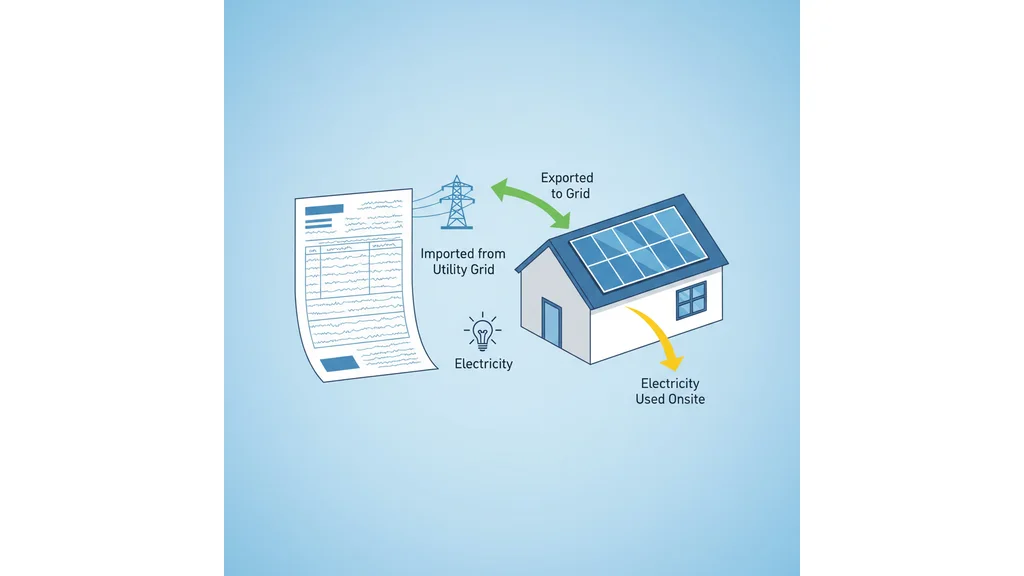
Electricity used by the home at the moment the panels produce it reduces the amount that must be purchased from the grid. Electricity sent outward is an export. Electricity required when production is insufficient becomes a grid import unless a battery supplies it. Those are different flows, and a yearly total does not show when they occur. A home can generate as much electricity as it consumes over a year while still purchasing substantial electricity on evenings and cloudy days.
Ask a bidder to show a representative summer weekday and winter weekday alongside the annual forecast. Look for the air conditioner, cooking, water heating and EV charging after the household returns home. Then look at solar production during those same hours. This comparison reveals whether a proposal's financial claim depends on unrealistic daytime appliance use, a battery's dispatch setting or very generous export assumptions. It also makes clear which behavior changes would be required to achieve the forecast.
The evening window deserves special attention
SCE's TOU-D-PRIME information identifies 4 to 9 p.m. as the higher-priced daily period. The actual price depends on the current tariff and season, so a single cents-per-kWh figure is not a reliable permanent planning assumption. Solar output may fall while household demand remains high during that window. Compare the equipment's output and the family's needs at the relevant hours rather than treating the peak window as an abstract warning.
Practical scheduling begins with flexible loads. A dishwasher or vehicle may be able to run earlier or later without affecting comfort, while cooking, medical equipment or essential cooling may not. Write down constraints before estimating shifted consumption. If the car is parked at work all day, a model that assigns its entire charging demand to midday rooftop generation is unrealistic. A small achievable change is more useful than a large theoretical shift that nobody in the household will maintain.
Export credits need their own schedule
Under SCE's Solar Billing Plan, the credit for exported energy changes with time and is distinct from the retail import price. SCE explains that high-demand summer evening exports may earn more than midday or winter exports. A proposal should therefore name the export-credit schedule and applicable customer vintage rather than multiplying all annual exports by one retail rate. Do not assume the highest illustrated export hour applies throughout a month.
Consider a deliberately hypothetical comparison. If a household would pay 40 cents to import one kWh during an hour and could earn 5 cents by exporting one kWh then, consuming available solar during that hour avoids a larger charge than exporting earns. These are invented example prices, not SCE rates. The conclusion changes when timing, the export schedule or storage losses change. Ask for actual interval calculations so that the model uses the applicable values rather than the illustration.
Evaluate a battery by incremental results
A battery may store daytime solar and discharge later, but its capacity, power limit, operating reserve and energy losses all affect the result. A forecast that counts every kWh charged as a kWh delivered overstates the usable energy. Likewise, an installation designed to preserve a large emergency reserve may have less energy available for daily bill management. Require the proposal to show the settings assumed, including whether grid charging or export is permitted under the applicable arrangement.
Compare solar alone with the same solar array plus storage before comparing completely different packages. The added annual bill reduction should be visible beside the added installed cost, financing and eventual equipment replacement considerations. Keep outage protection as a separately described benefit. A household may reasonably pay for resilience even if bill savings alone are modest, but that choice should not be disguised as guaranteed financial payback. Request a backup-load list that distinguishes refrigerator and lighting support from whole-home operation.
Include recurring charges and the generation provider
Time-of-use optimization does not remove every recurring charge. Ask the estimate to show current applicable fixed or base charges, nonbypassable charges, taxes and any other items that remain payable. A proposed bill of zero should be supported line by line. SCE's Solar Billing Plan information also distinguishes monthly billing from an annual settlement, so the cash amount due during one month should not be treated as the complete annual cost.
For a community choice account, ask who values generation exports and where those credits appear. Avoid adding a generation credit twice because it appears in both a utility summary and a provider statement. The comparison should use the customer's complete electricity expense, including any separate provider balance. Keep utility cost, solar financing, battery financing and service subscriptions separate so that a lower utility bill is not mistaken for a lower total household payment.
Use interval data and test the assumptions
Download the available usage data for a full year, including the hottest and coolest months. Tell the modeler whether the data already includes the EV or heat pump. Otherwise the same future load may be counted twice. Note a move, extended vacancy, new household member or unusual equipment outage that makes the year unrepresentative. If there is no interval history, ask the bidder to explain the assumed profile and show how a different evening-use pattern changes the result.
Require both a current-rate case and a sensitivity case with less favorable conditions. Future utility increases are uncertain and should be stated as assumptions, not promised savings. Include reasonable production degradation and explain any planned increase in usage. A system that looks acceptable only with aggressive annual rate escalation deserves closer scrutiny. Comparing multiple offers is much easier when each uses the same load profile, utility program and escalation assumptions.
Review actual performance after activation
Save the accepted model before installation. After utility authorization, compare several complete billing periods with monitoring data. Check that billed imports and exports correspond to the correct meter and that the battery follows the intended schedule. A first partial month can include commissioning days and may not represent normal operation. Record the relevant dates rather than immediately treating an unexpected first bill as evidence that the system cannot work.
If savings fall short, investigate the cause before buying more equipment. Compare weather, shade, inverter availability, changed household consumption and tariff settings. A charger that ignores its timer or a battery left in a backup-only mode can materially change flows. Ask the installer and utility specific questions supported by dated data. Adding panels will not necessarily solve an evening-import problem, particularly when the added production mostly increases low-value daytime exports.
Illustrated explanation
How to verify your utility's solar rules
- Read your actual electricity bill. Identify the serving utility, rate schedule, monthly kWh usage and any time-of-use periods.
- Verify the applicable program. Use the utility's official tariff and solar interconnection materials, not a neighboring utility's rules or an installer savings headline.
- Compare a written scenario. Request separate estimates for solar self-consumption, exports, grid purchases, fixed charges and any battery behavior. Recheck program dates and eligibility before signing.
For further independent technical context: U.S. Department of Energy — Homeowner's Guide to Going Solar. This is an educational reference, not an installer recommendation.
Frequently asked questions
Does annual solar production equal my annual bill savings?
No. Annual kWh describes an energy quantity. Bill savings depend on the hours when solar serves the home, the hours when electricity is imported or exported, the applicable prices and charges that remain. Request both the energy forecast and a bill forecast using the same household schedule.
Should I charge my EV during the day or overnight?
Compare the actual daytime export value with the cost of the available overnight imports, including charging losses and any household constraints. Daytime solar charging may work well when the car is home. Overnight charging can be practical when it is not. Neither schedule is automatically best for every solar program.
Can a battery eliminate all SCE charges?
A battery can change the timing and quantity of grid purchases, but recurring charges and other billed items can remain. Ask the installer to identify every remaining line item and the annual settlement assumptions. Any zero-bill claim should include the applicable tariff and operating settings in writing.
Questions worth asking
- Is this account on Solar Billing Plan or legacy NEM, and which rate is available?
- Which hourly import and export schedules does the estimate use?
- How much 4–9 p.m. demand remains after solar and storage?
- What battery reserve, losses and operating limits are modeled?
- Which SCE and generation-provider charges remain payable?
Related guides
Understand SCE imports and hourly solar export creditsRead SCE solar statements and annual reconciliationsEvaluate battery charging and dispatch under current California rulesUnderstand solar net metering and export creditsStill researching solar?
Search homeowner guides by topic, electric utility, or location.
Sources and further reading
Updated: October 2026. Confirm changing details with the official sources.
These links identify documents and resources used for this guide. Listing a source does not mean it was independently checked today. Utility rates, incentives, product specifications and program availability may change; confirm the latest version and effective date with the source.
SCE — Time-of-Use PlansSCE — How Solar Billing Plans WorkSCE — Net Energy MeteringSCE — Residential Rate Plan ComparisonStart with a home energy checkup
Organize your usage, home details and goals before comparing proposals.
Try the home energy checkupReady to compare companies?
Explore provider options when you are ready to request quotes.
Explore provider options