Pools, EVs and Air Conditioning: Sizing Solar for Rolling Hills's Bigger Loads
A detailed homeowner guide for Rolling Hills focused on high household loads and future electrification, with quote, equipment, installation, financing and service questions.
Program information checked October 5, 2026. Confirm current availability with the administrator.
Start with the property, not a generic average
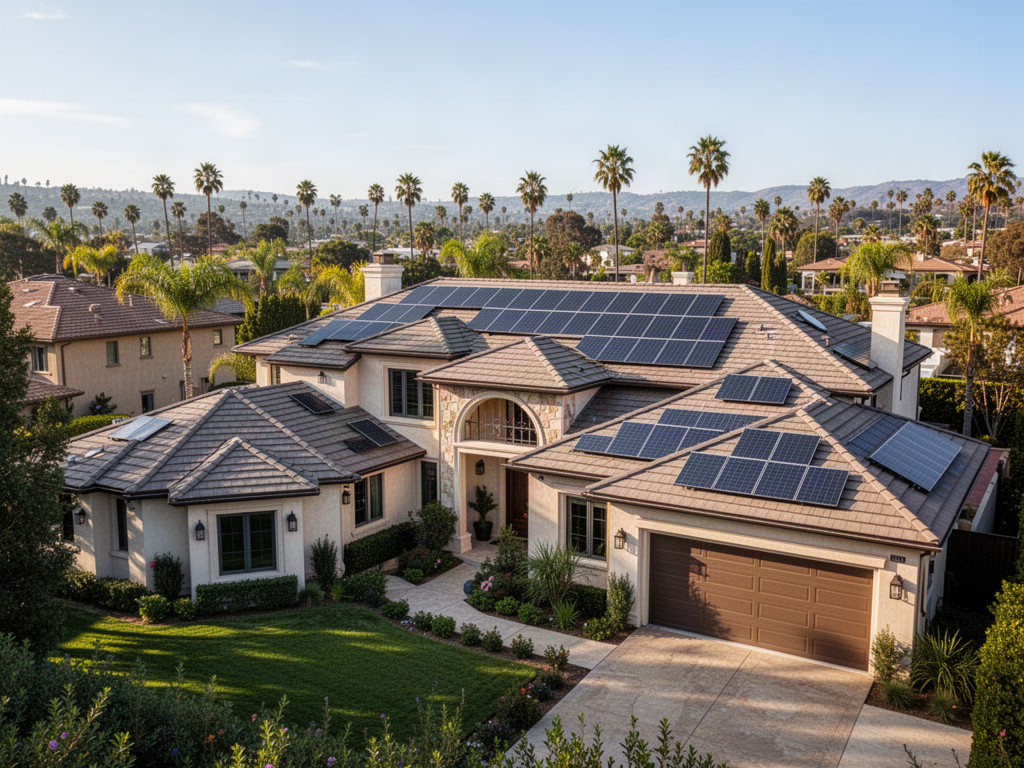
Rolling Hills projects can involve estate lots, large loads, ground-mount potential and long service runs. Those conditions can change system size, equipment placement, construction scope and price. Begin with 12 months of electricity use and note future loads such as EV charging, heat pumps, pool equipment, guest houses or an ADU.
How to evaluate high household loads and future electrification
Require a written cash price, system size in kW DC, estimated first-year production in kWh, exact panel and inverter models, battery specifications when applicable, workmanship coverage and stated exclusions. Compare the same fields across every proposal.
Do not use monthly payment as a substitute for project price. If financing is offered, record the amount financed, APR, term, scheduled payments and total of payments separately.
Higher-value homes need a construction-quality review
Review roof material, roof age, structural conditions, electrical-service capacity, conduit routing, equipment locations and any HOA or architectural requirements before approving a final design.
A premium-looking proposal should still explain who performs the installation, who handles permits and utility interconnection, who provides service later and what can trigger a change order.
Production and savings are forecasts
Ask which shading, weather, degradation, utility-rate and export-credit assumptions support the production and savings estimate. Compare a conservative scenario with the sales scenario rather than treating a long-term savings chart as guaranteed.
Solar normally reduces grid purchases rather than eliminating the utility relationship. Fixed charges, imports, exports and time-of-use periods can remain relevant after activation.
Before you sign
Read the installation contract and any financing, lease or PPA agreement separately. Confirm cancellation provisions, transfer terms, roof responsibilities, equipment substitutions and the process if permits or interconnection require a redesign.
Keep the final plans, contract, permits, utility approval, warranties, monitoring credentials and service contacts together for future maintenance, reroofing or resale.
Questions specific to a high-consumption household
Larger Southern California homes can have several HVAC zones, pools or spas, multiple refrigerators, home offices, EV charging and outdoor equipment. Ask the designer to show how these loads appear in the annual usage model and whether future electrification is included.
For battery storage, ask for both power and energy figures. Usable kWh estimates duration; continuous and surge kW affect which loads can operate at the same time. A large battery number alone does not prove that central air conditioning or several heavy loads can run together.
Use the quote as a due-diligence document
A serious quote should be detailed enough that another qualified contractor could understand what is being proposed. It should identify equipment, layout, production model, construction assumptions, warranty responsibilities and the path from permit to permission to operate.
If a salesperson says a detail will be decided later, write it down as unresolved. The goal is not to eliminate every uncertainty before a site survey; it is to know which uncertainties can change price, appearance, performance or schedule.
Questions worth asking
- What is the complete cash price before incentives?
- What exact equipment is specified?
- Who installs and services the system?
- Which assumptions drive the production and savings estimate?
Related guides
Compare solar quotes / Compare cotizacionesSolar financing / Financiamiento solarSources and further reading
U.S. Department of Energy — Homeowner's Guide to Going SolarCalifornia Public Utilities Commission — Solar Consumer Protection GuideIRS — Residential Clean Energy CreditExplore more for your home
Home Solar Simplified
Explore solar education, battery planning and home energy tools to prepare for your next decision.
Explore Home Solar SimplifiedConnectPoint ISP
Visit ConnectPoint ISP to explore home internet options and ask about service availability at your address.
Visit ConnectPoint ISP