
Solar Financing to Avoid: 5 Red Flags Before You Sign
A surprisingly low solar payment can conceal a costly loan. Watch for inflated financed prices, payment resets and savings assumptions before signing.
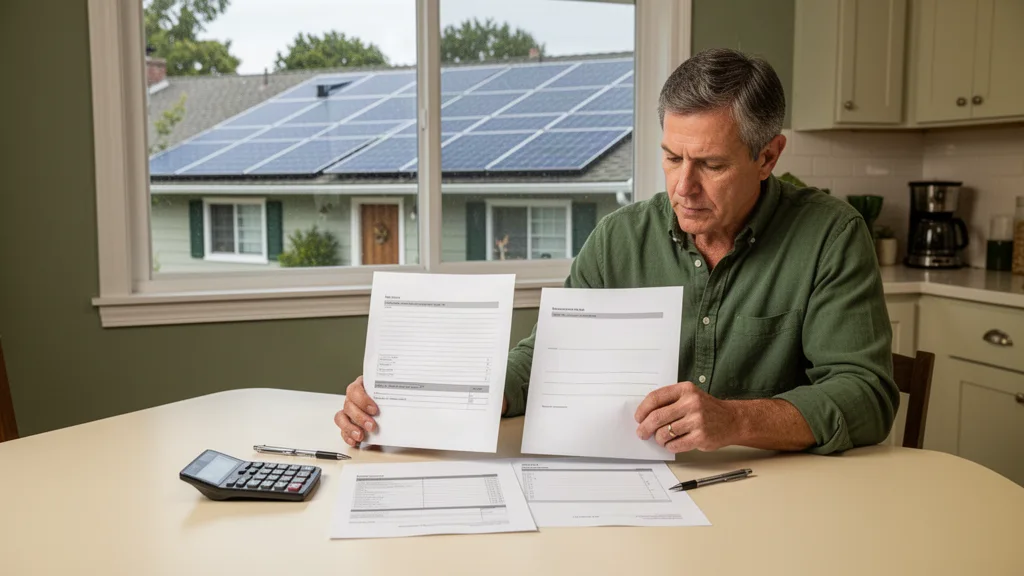
A solar financing offer can look inexpensive when the sales pitch focuses on the monthly payment. The more important figures are the cash price, financed principal, APR, fees, repayment schedule and total amount paid.
Request the written loan disclosures and a separate cash-price quote. Check for dealer fees, payment changes tied to assumed tax benefits, prepayment provisions and any lien or property-related obligation. If the explanation depends on guaranteed savings or a benefit you have not qualified for, verify it before signing.
A warning sign is a reason to stop and verify
The most dangerous solar offer is one whose obligations you cannot explain from the documents. A product name alone does not determine whether an agreement is suitable. A transparent loan may help a household buy an appropriate system; an apparently inexpensive agreement may create excessive debt or transfer costs. Start by identifying what you are signing: an equipment purchase, a loan, a lease, a power-purchase agreement, or a property assessment. Then identify every company responsible for installation, lending, servicing, ownership and maintenance. The salesperson may represent only one part of that chain.
Treat a refusal to provide complete documents as decision information. You should be able to read the proposal away from a sales meeting, compare alternatives and obtain corrections before committing. A utility logo, government-themed mailing or electronic signature screen does not establish government sponsorship. California's CPUC consumer guide specifically warns about rushed signing, supposedly free solar and claims that utility bills disappear. These are prompts to verify the actual contract and eligibility for any assistance program, rather than evidence that a financing offer has already been independently approved.
Red flag 1: the loan price cannot be reconciled with the cash price
Ask for equivalent cash and financed installation offers. Match the equipment, system size, roof work, electrical upgrades, permitting, warranties and exclusions. Some installer-arranged loans incorporate financing-related markups into a larger starting balance. The CFPB has documented this practice and cautions that an attractive rate can obscure the difference. A quoted APR remains important, but the buyer also needs to know what the installed system would cost without that financing. If the explanation focuses only on a low monthly installment, the purchase-price question remains unanswered.
Consider an invented $28,000 cash project offered at $35,000 financed. The $7,000 difference must be understood before comparing interest rates. It might include financing adjustments, different scope or other changes; do not assume a specific explanation without a reconciliation. Ask for each difference in dollars. If you expect to sell or repay in a few years, calculate payments made plus the projected payoff at that date. A higher opening balance may remain costly even if the loan allows early repayment without a penalty. A low note rate does not automatically compensate a short-term borrower for upfront pricing.
Red flag 2: affordability depends on a future lump sum
An opening payment can be lower than the payment required later. Ask whether the agreement assumes a voluntary principal reduction, when it must arrive, and what happens without it. Read the actual schedule showing both periods. A fixed interest rate does not necessarily mean a fixed installment throughout the loan. Also ask what a smaller-than-assumed prepayment would accomplish and whether the lender recalculates payments automatically. A verbal promise that you can refinance later is not a repayment plan; future approval, rates and home values are uncertain.
For a new residential installation completed after December 31, 2025, do not use the former section 25D Residential Clean Energy Credit to fund that lump sum. Current IRS guidance ends eligibility for new qualifying installations after that date. If an offer subtracts a former 30% credit from a 2026 purchase, ask for a corrected proposal. Prior eligible credits and other incentives require their own analysis. Test affordability with zero unverified tax proceeds and zero speculative bonus income. A contract that becomes unaffordable under that ordinary scenario requires changes before signing.
Red flag 3: collateral and property-tax consequences are minimized
A HELOC borrows against the home, and failure to repay can put the home at risk. A dedicated solar loan may have different collateral or may be unsecured; read the agreement rather than assuming. PACE financing is another structure, repaid through a property-tax assessment. California DFPI's homeowner materials warn that its property-related obligations can complicate sale or refinancing. Calling an assessment a public program does not make it a grant. Ask what gets recorded, who can enforce it and what must happen when the property changes hands.
Keep three separate questions in the file: what you owe, what property secures that obligation, and what paperwork clears the obligation at closing. Ask a prospective mortgage or title professional about a proposed arrangement before relying on automatic transfer. A buyer may like the system yet decline the debt, and a lender may require payoff. For a HELOC, also investigate rate variability, line closure and repayment after the draw period. The relevant concern is whether the household understands and can carry the complete obligation, including its impact on home equity.
Red flag 4: a lease or PPA is described as ownership
A lease generally charges for use of equipment; a power-purchase agreement generally charges for electricity produced. In a typical third-party arrangement the provider owns the system. Buying with a loan creates a different ownership relationship, even though all three can involve monthly payments. Ask who owns the panels, receives applicable incentives, controls monitoring and handles repairs. If a salesperson alternates between saying you own the system and saying the provider maintains its asset, require the ownership provision to be identified in the actual agreement.
Read the complete price schedule, including any annual increase, rather than multiplying the first payment by the term. Ask whether production changes the bill, what happens when equipment fails, and whether a production promise creates a refund or only a limited remedy. Request buyout timing and pricing, home-sale transfer standards, roof-removal costs and end-of-term removal or purchase terms. A promise that the system adds home value does not settle these contractual issues. Compare the agreement's expected obligations through a realistic sale date as well as through its full term.
Red flag 5: savings claims replace the repayment analysis
Solar generation, utility savings and loan payments are different quantities. A production estimate forecasts energy; the utility tariff determines its financial value; the finance contract determines what you owe. Exported energy may have a different value from energy used at home. Request the household usage data, tariff, export assumptions, system production, degradation and battery behavior underlying a savings forecast. A large system does not automatically eliminate fixed utility charges or the cost of power drawn when panels are not producing. The remaining utility bill belongs in the affordability calculation.
Also ask what happens when reality differs from the forecast. If the installer closes, a performance estimate alone may not provide a remedy and the lender may still expect payment. Review actual warranty providers, labor coverage and dispute procedures. Separate a binding guarantee from a sales projection, and ask how any guarantee is measured and enforced. Run a conservative case with lower production and slower utility-rate growth. If that case cannot support household payments, reduce project cost, change financing or postpone the purchase rather than expecting the lender to absorb the forecasting risk.
Turn concerns into document requests
Before signing, reconcile the proposal, installation contract and financing documents line by line. Confirm total price, down payment, amount financed, payment schedule, applicable fees, security provisions and cancellation instructions. Verify the installer through the relevant licensing authority and identify the actual lender independently. CSLB's Solar Smart materials also emphasize controlling contractor payments and keeping promises in writing. Do not approve work completion that you have not verified merely to release funding. A financing approval establishes the lender's decision, not that the roof, system design or savings forecast has passed your review.
If you already signed, preserve the full document set, messages, screenshots and payment records promptly. Ask the company in writing to explain the exact disputed term and the remedy you want. Cancellation rights depend on transaction type, jurisdiction, timing and exceptions; do not rely on a universal deadline copied from another household's case. Check your own notice and seek qualified help quickly if a deadline may be running. Continue distinguishing a service complaint from the debt obligation while obtaining advice. Stopping payments without understanding the consequences can create a second problem.
Frequently asked questions
Does a low APR prove the offer is inexpensive?
No. Compare the equivalent cash price, financed balance, fees, payment schedule and payoff at your expected holding period. An attractive rate can accompany a larger purchase price.
What is the fastest way to test affordability?
Ask for the contractual payment path without an unconfirmed lump sum, then add a conservative remaining utility bill and known ownership expenses. If the budget works only with optimistic savings or an unavailable tax credit, request a revised offer.
Questions worth asking
- Which companies install, lend, own and service the system?
- What changes between equivalent cash and financed quotes?
- What is the required payment if I make no voluntary lump sum?
- What collateral or assessment affects my home?
- Which savings claims are contractual guarantees and what remedy applies?
Related guides
Compare long-term costs before choosing a solar payment agreementAsk these contract questions before committingCompare solar proposals using the same cash price and scopeCompare solar financing optionsSolar loan vs. cash purchaseSolar planning in Los Angeles County
Electric utility rules, roof conditions and household electricity use vary by address. Explore regional guidance before relying on a statewide solar savings estimate.
Los Angeles County solar education San Fernando Valley: LADWP, panels and batteries Northridge solar planning Van Nuys solar quotes and utility questions Pacoima solar financing and contract checklistStill researching solar?
Search homeowner guides by topic, electric utility, or location.
Sources and further reading
Sources reviewed: 2026-10-26. Confirm changing details with the official sources.
These links identify documents and resources used for this guide. Listing a source does not mean it was independently checked today. Utility rates, incentives, product specifications and program availability may change; confirm the latest version and effective date with the source.
CFPB — Issue Spotlight: Solar Financing (2024 research; current tax rules checked separately)IRS — Residential Clean Energy Credit: installation deadlineCPUC — California Solar Consumer Protection GuideCSLB — Solar Smart: contractor payment and written contract protectionsCFPB — What is a home equity line of credit? (reviewed August 2026)California DFPI — PACE homeowner informationStart with a home energy checkup
Organize your usage, home details and goals before comparing proposals.
Try the home energy checkupReady to compare companies?
Explore provider options when you are ready to request quotes.
Explore provider options