Solar Microinverters Explained: Pros, Cons, and How They Compare
Microinverters give each panel its own power conversion, but that doesn't make them better for every roof. Compare shade performance, maintenance and price.
What a microinverter changes
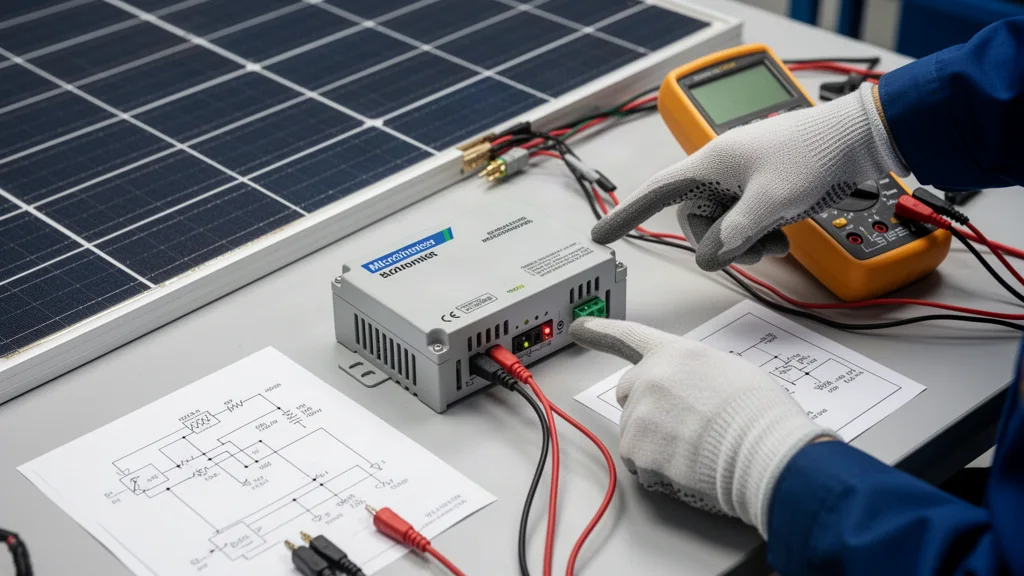
Solar modules produce direct-current electricity. A microinverter converts that electricity to alternating current near the module, while a conventional string inverter performs conversion centrally for connected panels. The Department of Energy identifies independent panel operation as a microinverter benefit. This equipment choice affects system layout and maintenance, but it does not change how much sunlight reaches the roof. Start with the property and a complete design before deciding on an inverter architecture.
A power optimizer is different. It works with DC electricity at the module while a separate inverter still converts the electricity to AC. Sales presentations sometimes group both technologies under panel-level electronics, which can obscure what is actually included. Ask for a diagram showing the path from modules to the home, with exact equipment models. A proposal describing only premium electronics does not give enough information to compare designs or plan future repairs.
Shade performance requires a roof-specific model
Independent module operation can be useful when panels experience different shade or face different directions. However, an inverter cannot recover sunlight blocked by a tree or chimney. A heavily shaded roof might benefit more from putting fewer panels on its best area than adding expensive equipment to poorly productive locations. Ask how the designer evaluated each roof plane rather than assuming that microinverters solve every shade problem.
Request a shade assessment that accounts for changing sun angles through the year. Have the designer identify which panels lose production, when the loss occurs and which alternative layouts were modeled. For an architecture comparison, keep weather, panel count, roof area and equipment assumptions consistent. A microinverter proposal with extra panels does not establish that its inverter technology alone produced the additional energy. Ask for the modeled difference and the uncertainty around it.
Understand panel ratings and inverter clipping
Module nameplate power is usually expressed in DC watts under standardized test conditions. Inverter output is rated in AC power. Neither rating alone is annual production in kilowatt-hours. A larger panel may be paired with an inverter whose maximum output is lower, but the pairing must satisfy electrical compatibility requirements. Ask for the selected panel and inverter data sheets and the designer’s reason for that combination.
Clipping occurs when available panel power exceeds the inverter’s output capability. A flat top on a sunny-day production curve can be consistent with clipping, although operating data and a qualified diagnosis are needed to explain a particular system. Some clipping can be an intentional economic trade-off. Ask for modeled annual clipping loss and the cost of the next inverter option. Capturing a brief midday peak is worthwhile only if the extra energy and other benefits justify the premium.
Compare complete installed costs
Obtain itemized prices for technically suitable alternatives. Include modules, inverters, gateways, monitoring hardware, wiring, roof work, permits and commissioning. An equipment-only internet price cannot be compared directly with a complete installation. Where one proposal includes stronger workmanship coverage or a different service plan, ask the contractor to explain and price those differences separately. Otherwise, an apparent technology premium may partly reflect unrelated scope.
Consider a fictional comparison: one design costs $900 more and is modeled to produce 150 additional kWh annually. Those numbers are arithmetic assumptions, not a market benchmark or a promised result. To value the gain, determine when the additional electricity occurs, whether it offsets purchases or becomes exports, and the applicable tariff value. Then include service costs and uncertainty. Multiplying every extra kWh by the highest retail rate can overstate the financial benefit.
Reliability includes rooftop access and labor
A distributed design may allow unaffected modules to continue operating when one inverter fails, depending on the fault and configuration. It also places multiple electronic devices at the array. A central inverter concentrates conversion in fewer devices and may be easier to reach. Neither description alone proves which design will have lower lifetime maintenance costs. Ask the installer how access, troubleshooting and replacement would work at this house.
Read the warranty for the exact model rather than relying on its headline duration. Determine whether it covers replacement parts, diagnostic labor, shipping, travel, panel removal and rooftop access. Ask who submits a claim if the original installer closes. A long parts warranty can still leave a homeowner with service expenses. Distinguish the manufacturer’s equipment warranty from installer workmanship coverage and from any separate production guarantee.
Make monitoring useful after installation
Panel-level reporting can help identify an underperforming location, but a missing icon does not establish that an inverter failed. Communications issues can interrupt reporting, and aggregate generation can look normal while a smaller problem remains unnoticed. Agree on who receives alerts, who investigates them and whether investigation is included in the service agreement. A dashboard is most useful when someone has a clear responsibility to respond.
Get homeowner administrative access, the module map, serial numbers and instructions for exporting production history. Ask whether communications depend on home internet, a paid subscription or a cellular connection with an expiration date. Compare similar seasons before interpreting a production decline. Weather, soiling, new shade and gaps in reporting can all affect the evidence. Preserve screenshots and dated records before authorizing a repair or replacement.
Battery compatibility and outage operation
Microinverters do not automatically keep household circuits powered during an outage. DOE explains that solar-plus-storage systems need an appropriate inverter design to operate without grid support. A complete backup installation also needs compatible controls and safe isolation from the utility. A salesperson’s statement that panels operate independently is not a specification for backup power. Obtain the actual outage configuration and the supported loads.
If storage may be added later, request the intended architecture now. Ask which batteries and controllers are supported, what wiring would need to change, and whether solar can recharge storage during an outage. Separate bill-management operation from backup operation. A system supporting a refrigerator, communications and lights has different requirements from one expected to run air conditioning, electric water heating and vehicle charging simultaneously.
Plan expansion and document the final choice
A modular architecture can make adding panels sound simple, but expansion depends on roof area, branch-circuit capacity, service equipment, permits and utility approval. Modifying a system can also raise tariff questions. Ask for a written expansion scenario, including likely additional equipment and approvals, rather than relying on a promise that more panels can always be plugged in later. Future availability of identical replacement models should not be assumed.
Choose the design whose documented benefits fit the property. A simple sunny roof and a roof with several shaded planes can lead to different decisions. Before signing, keep the production model, equipment list, warranty exclusions and service obligations together. At handover, verify installed model numbers, monitoring access, inspection records and utility permission. These records make the choice reviewable and give the homeowner a starting point if performance or service later becomes disputed.
Frequently asked questions
Are microinverters always better than string inverters?
No. Roof geometry, shade, installed price, service access and storage plans determine the useful trade-offs. Request comparable site-specific designs. A general preference for one technology cannot replace an energy model, and a higher price does not demonstrate higher lifetime savings. Ask what measurable benefit justifies the additional installed cost for your property.
Will microinverters eliminate shade losses?
No. Independent module operation can reduce some mismatch effects, but blocked sunlight remains unavailable. Ask how shade was assessed and how much annual production each proposed design is expected to deliver. A smaller array on a better roof area may deserve consideration alongside a more complex design using the shaded area.
Does every missing panel icon mean equipment failed?
No. Communications and account configuration can also interrupt reporting. Save screenshots and compare total system production, then contact the service provider. A qualified technician should distinguish a data problem from an electrical failure before replacing equipment. Homeowners should not climb onto the roof to investigate a dashboard alert.
Can a battery be added later?
Potentially, with compatible equipment and the required approvals. Get the battery, controller and electrical requirements in writing before assuming the conversion will be inexpensive. Ask separately about normal bill management and outage support. Adding storage does not automatically mean every household load will run during a blackout.
Questions worth asking
- Are microinverters always better than string inverters?
- Will microinverters eliminate shade losses?
- Does every missing panel icon mean equipment failed?
- Can a battery be added later?
Related guides
Compare solar equipment and quotesPlan battery compatibility and installationStill researching solar?
Search homeowner guides by topic, electric utility, or location.
Sources and further reading
Sources reviewed: 2026-10-26. Confirm changing details with the official sources.
These links identify documents and resources used for this guide. Listing a source does not mean it was independently checked today. Utility rates, incentives, product specifications and program availability may change; confirm the latest version and effective date with the source.
U.S. Department of Energy — Solar Photovoltaic System Design BasicsU.S. Department of Energy — Inverters and Grid Services BasicsStart with a home energy checkup
Organize your usage, home details and goals before comparing proposals.
Try the home energy checkupReady to compare companies?
Explore provider options when you are ready to request quotes.
Explore provider options