Zero Down Solar: What Will You REALLY Pay Over 25 Years?
Zero down does not mean free. Compare 10-, 15-, 20- and 25-year solar loan payments, total interest, leases and PPAs before signing.
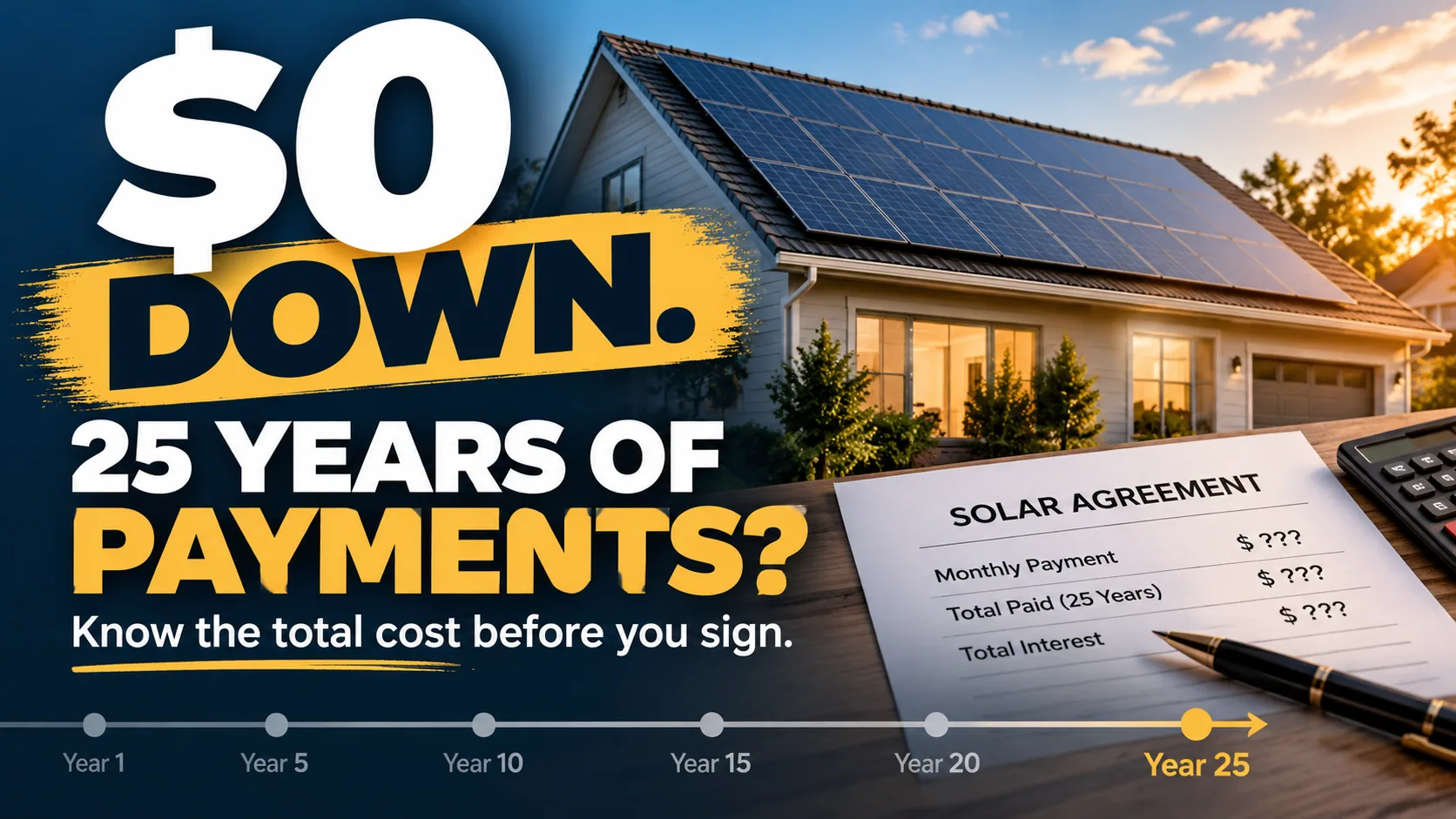
Zero down does not mean zero cost. A solar loan can require no upfront payment while still financing equipment, installation and potentially substantial lender or dealer fees. A lease or power-purchase agreement may also start without a down payment, but it has a different ownership and payment structure.
Compare the written cash price with the financed amount, APR, monthly payment schedule and total payments over the full term. For a simple illustration, $200 per month for 25 years totals $60,000 before any remaining utility bills or additional charges; a contract with escalating payments can cost more. Check who owns the equipment, whether payments change and what happens when you sell your home.
Quick answer: does zero-down solar mean free solar?
No. Zero down describes the amount due at signing, not the full financial obligation. A loan may involve principal, interest and dealer fees; a lease may involve recurring payments and escalators; a power purchase agreement charges for contracted electricity. Compare the total projected payments, remaining utility bills, transfer or buyout obligations and service responsibilities across the entire agreement.
Request a year-by-year payment schedule and a scenario for selling the home early. A 25-year illustration should distinguish contractually fixed amounts from uncertain assumptions such as future utility rates, production and incentives. California's 2026 Solar Consumer Protection Guide also directs homeowners to the completed CSLB disclosure showing total system costs and other financial information before signing.
$0 today can become a very large obligation tomorrow
A solar proposal promises no upfront payment and a monthly amount that looks manageable. But what happens when you multiply that payment by 240 or 300 months? The number that matters is not just what you pay this month. It is the total contractual cost, what your utility will still charge, and what you will own when the agreement ends.
Zero down describes the initial payment, not the financing cost or the savings. Some zero-down arrangements are reasonable; others can be costly. The contract—not the slogan—decides.
The numbers: same $30,000 loan, four repayment terms
Consider a hypothetical $30,000 fully amortizing fixed-rate loan at 6.99% APR with monthly payments, no upfront payment and no additional fees. For 10 years, the calculated monthly payment is about $348.17 and total payments about $41,780.50. For 15 years, about $269.48 per month and $48,506.54 total. For 20 years, about $232.41 per month and $55,778.31 total. For 25 years, about $211.84 per month and $63,552.73 total. These are arithmetic illustrations, not offers or savings projections.
Loan term | Monthly payment | Total paid | Interest paid: 10 years | $348.17 | $41,780.50 | $11,780.50; 15 years | $269.48 | $48,506.54 | $18,506.54; 20 years | $232.41 | $55,778.31 | $25,778.31; 25 years | $211.84 | $63,552.73 | $33,552.73. Calculations use the standard fixed-payment amortization formula and unrounded payments internally before displaying cents. The actual total depends on the exact APR, fees, amount financed, compounding and payment schedule. A longer loan lowers the required payment but raises lifetime interest when other terms are unchanged.
Ask for the cash price and the financed price—side by side
A $30,000 cash quote does not necessarily mean the lender finances $30,000. Some loans include dealer or origination fees embedded in the principal. For example, if the financed principal rises to $39,000 and the 25-year APR is 6.99%, the monthly payment would be roughly $275 and total payments roughly $82,600. The $9,000 difference at signing compounds into a much larger repayment difference over time.
Request the itemized cash price, amount financed, APR, all fees, total of payments, prepayment rules and any required balloon or re-amortization payment. Do not confuse the interest rate with the APR.
A loan, a lease and a PPA are not the same thing
With a solar loan, you generally own the system and repay debt, subject to the lender's security interests and contract terms. With a lease, a third party typically owns the system and you pay to use it. Under a power purchase agreement (PPA), a third party typically owns the equipment and charges for the electricity it generates. Leases and PPAs may include annual payment or per-kWh price escalators.
For a lease or PPA, ask for the payment schedule for every year, expected production, minimum payments, escalation rate, buyout terms, transfer rules and end-of-term removal or renewal options. A PPA's total cost depends on actual kWh production and the contract price, so it cannot be evaluated as if it were a fixed loan.
Your solar payment may not replace your electric bill
Even with solar, you may still pay utility fixed charges, imported electricity charges and other applicable costs. Storage, roof repairs, maintenance and inverter replacement may also affect the economics. Compare the combined solar payment plus expected remaining utility bill against a realistic no-solar baseline—not against a single unusually expensive month.
Request annual production estimates and a conservative scenario with lower generation, higher consumption or different export credits. California utility billing rules differ by utility; LADWP assumptions should not be replaced with Southern California Edison assumptions.
What if you sell the house before year 25?
Ask whether a buyer can assume the financing, lease or PPA, what approval is required, whether a payoff or buyout is needed, and whether any lien or recorded notice must be addressed. Get the answers in writing before signing. An agreement that looks inexpensive over a full term may be much less attractive if you move in five years.
The tax-credit claim deserves extra scrutiny in 2026
Do not rely on sales materials promising the former federal residential clean energy credit for a newly installed homeowner-owned system placed in service after December 31, 2025. Confirm current tax law and your own eligibility with a qualified tax professional. Third-party-owned solar has different tax treatment; do not assume a credit belongs to the homeowner.
Seven questions to ask before signing
What is the full cash price? What is the financed principal and APR? How much will I pay over the entire term? Are there dealer fees, escalators or balloon payments? What utility charges will remain? What happens if the system underproduces or needs service? What will it cost to sell the house, transfer the contract or pay off the agreement early?
Compare at least three written offers on the same equipment, production assumptions and contract length. A provider willing to explain the total obligation is more useful than one who only repeats a monthly-payment promise.
Bottom line: judge the lifetime economics, not the $0 headline
Zero-down solar can preserve cash, but that convenience has a price that must be measured. For some households the numbers work; for others a shorter loan, a cash purchase, efficiency improvements or waiting will be better. You do not need to decide during a sales visit. Ask for the full payment schedule and compare total costs before committing.
Check the unpaid balance inside the 25-year picture
A long-term illustration should also show what happens before the final year. Ask for the unpaid balance at years five, ten and fifteen alongside cumulative payments. A low installment can leave a large balance when the household wants to move, replace the roof or retire. Compare cash paid plus payoff at each date. That reveals a different risk from the full-term total: the need to produce money at an intermediate event rather than over decades of ordinary payments.
Keep contract payments separate from optional assumptions. If the illustration includes extra principal, identify when it is paid and where the cash comes from. If it assumes a refinance, request a case without refinancing. If it assumes a buyer accepts the agreement, request the payoff case too. None of these events is guaranteed merely because the opening payment is zero. A useful 25-year analysis therefore has both a full-term view and practical exit dates, with future balances visible rather than hidden behind an average monthly savings figure.
Finally, distinguish financing term from equipment service life. Ending payments does not promise that every component will operate without replacement until then, and a long warranty does not necessarily cover every labor or roof-related expense. Budget those uncertainties separately instead of assuming that zero down also means zero future cash requirements.
Frequently asked questions
Is zero-down solar free?
No. It usually means no upfront payment. Loans, leases and PPAs can still create long-term payment obligations, financing costs, escalators or transfer requirements. Compare total payments and the expected remaining electric bill.
Does a lower solar-loan payment mean a lower total cost?
No. Extending the repayment term can reduce the required monthly payment while increasing total interest. Compare the cash price, amount financed, APR, fees and total scheduled payments using the same equipment and assumptions.
Can a homeowner count on the federal residential solar credit for new 2026 expenses?
No. Current IRS guidance says the Residential Clean Energy Credit is not allowed for expenditures made after December 31, 2025. Verify the expenditure date and individual tax facts with current IRS guidance and a qualified tax professional before counting any credit.
Questions worth asking
- What is the cash price compared with the amount financed?
- What are the APR, fees, total scheduled payments and prepayment terms?
- Does the agreement have annual escalators or a balloon payment?
- What utility bill will remain after solar?
- What happens if I sell the home or the system underproduces?
- Who owns and maintains the system?
- Which assumptions and tax benefits are actually available in 2026?
- Is zero-down solar free?
- Does a lower solar-loan payment mean a lower total cost?
- Can a homeowner count on the federal residential solar credit for new 2026 expenses?
Related guides
Understand APR, dealer fees and the actual loan paymentSpot zero-down solar financing warning signsCompare 25-year costs of loans, leases and PPAsCompare the full cash price against financed offersStill researching solar?
Search homeowner guides by topic, electric utility, or location.
Sources and further reading
Sources reviewed: 2026-10-29. Confirm changing details with the official sources.
These links identify documents and resources used for this guide. Listing a source does not mean it was independently checked today. Utility rates, incentives, product specifications and program availability may change; confirm the latest version and effective date with the source.
CFPB — Solar financing consumer guidanceCalifornia Public Utilities Commission — Solar Consumer Protection GuideU.S. Department of Energy — Homeowner's Guide to Going SolarIRS — 2026 home energy credit expirationsCPUC — 2026 California Solar Consumer Protection GuideStart with a home energy checkup
Organize your usage, home details and goals before comparing proposals.
Try the home energy checkupReady to compare companies?
Explore provider options when you are ready to request quotes.
Explore provider options