
Curious About Solar Estimators? How “Instant Quotes” Really Work
Learn how instant solar estimates calculate costs and savings, what their assumptions leave out, and what to verify before relying on a quote.
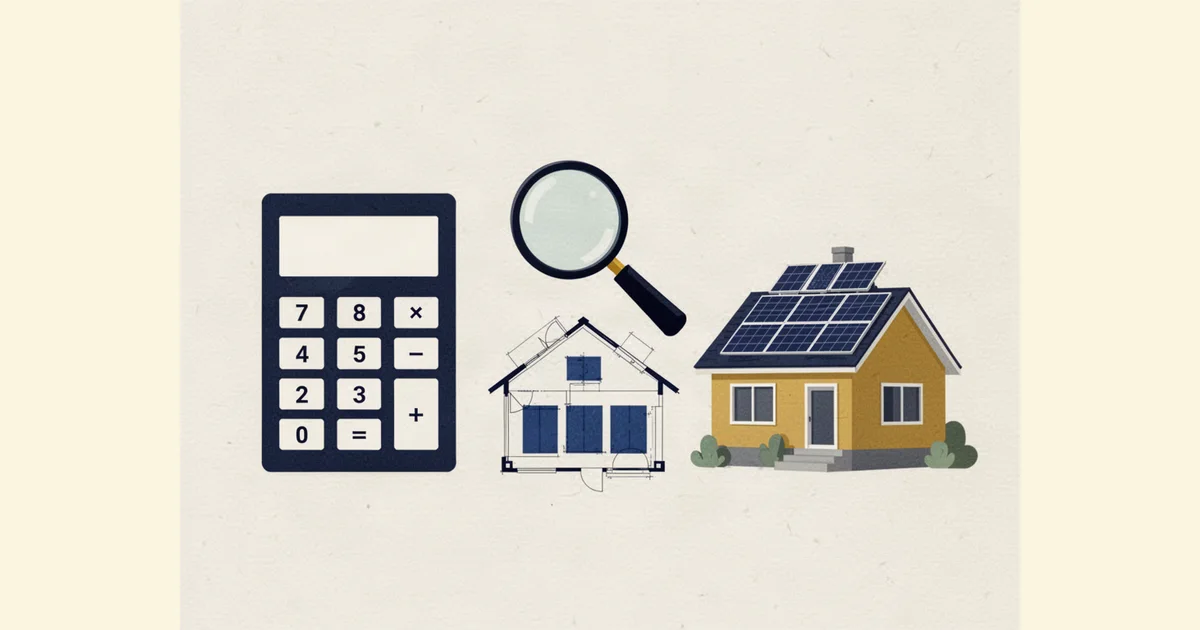
What happens after you enter your address?
Depending on the service, a solar estimator may combine your electricity consumption, roof characteristics, expected sunlight, utility rates, and installation pricing. Your bill helps it approximate energy needs; roof information helps it estimate how many panels could fit. The software then connects an assumed system size to projected production and cost.
Solar-Estimate.org says its calculator considers roof geometry, shading, panel placement, utility rate plans, and average local system costs. That describes its advertised methodology. It does not mean every calculator uses the same information, or that we have independently validated its results.
When completing a form, distinguish information you supplied from information the website supplied. Did you enter annual electricity consumption, or only one bill amount? Did you choose your rate plan, or did the software infer one? Write down any defaults you cannot verify. They are questions to resolve before treating the output as a project budget.
How can a website evaluate your roof remotely?
Some services use aerial imagery and building models to assess solar potential. Google’s Solar API is one example of technology available to developers: it provides building dimensions and solar potential, plus data such as imagery, surface models, sunlight maps, and hourly shade information. This explains how a website can quickly display suggested panels. It does not establish which technology a particular estimator uses.
A remote model still needs to match the home that exists today. Ask whether the displayed roof is yours and whether additions, nearby trees, or other visible features are represented. A convincing graphic is useful for discussing a layout, but it is not evidence that every construction requirement has been checked.
The Department of Energy’s homeowner guide notes that roof age and tree cover can affect solar suitability. Before relying on a proposed layout, ask the installer what roof and electrical checks remain and whether any resulting work is included in the price.
The math behind an instant price
A simplified installation estimate can start with estimated system size multiplied by an assumed installed price per watt. For illustration only, an 8-kilowatt system equals 8,000 watts. Multiply 8,000 watts by a hypothetical $3 per watt and the result is $24,000. These figures demonstrate arithmetic; they are not current market prices, a quote, or a recommended system for your home.
The calculation is fast because the software does not need to negotiate an installation or inspect a roof to multiply two inputs. The harder questions are whether the system size fits your needs and whether the assumed unit price covers your project’s scope.
Even within this hypothetical example, changing an assumption changes the answer: 8,000 watts at $3.50 per watt would be $28,000. That $4,000 difference is a sensitivity example, not a predicted price increase. It shows why a precise-looking result should be accompanied by its inputs, exclusions, and an explanation of what could change.
Ask whether the displayed amount includes batteries, roofing, electrical upgrades, permits, and financing charges. Compare like-for-like scope before deciding that one result is less expensive. An estimate for solar panels alone cannot be fairly compared with a proposal including storage and roof work.
An estimate, a proposal, and a contract
An online estimate helps you explore a possible budget, system size, or savings projection. An installer proposal should describe a particular system and proposed price. An installation contract sets out the agreed scope, payment obligations, warranties, exclusions, and conditions for changes. Read each document for what it actually promises.
An installer proposal can still be conditional. The California Solar Consumer Protection Guide discusses matters such as unexpected shading discovered during a site visit. Ask which findings could change the design, price, or ability to proceed.
Keep dated copies of the estimate and later proposal. If the price changes, request a written explanation connecting the difference to equipment, project scope, financing, or revised assumptions. A higher final number is not automatically evidence of wrongdoing; an unexplained difference is a reason to ask more questions.
Estimated production is not guaranteed production
Two units help you read the results. Kilowatts (kW) describe rated power capacity. Kilowatt-hours (kWh) measure electricity produced or consumed over time. An 8 kW system does not continuously deliver 8 kW. Sunlight and operating conditions change its output.
PVWatts, a widely used solar modeling tool, warns that predictions contain assumptions and uncertainties. Site characteristics affect the calculation only to the extent that the inputs represent them. Treat modeled production as a projection rather than a guaranteed reading from a future meter.
Compare a proposed system’s annual kWh production with your actual annual kWh consumption. Avoid confusing a claim about offsetting annual energy use with a promise to eliminate every utility charge. If future EV charging or other new equipment is included, ask to see that additional consumption separately from your current household use.
Producing electricity and saving money are different calculations
A financial estimate must calculate both how much electricity solar could produce and what that electricity would be worth to the household. The Department of Energy identifies usage, system size, sunlight, roof direction, purchase or lease arrangements, utility rates, and surplus-energy compensation as relevant factors.
Under the CPUC’s Net Billing Tariff for applicable PG&E, SCE, and SDG&E customers, exported electricity is generally credited below the retail electricity rate, although values vary by time. Electricity used directly at home and electricity exported to the grid can therefore have different financial values. Storage can shift when energy is used or exported.
For Los Angeles and Ventura County homeowners, ask which utility and rate plan the estimate actually models. A result labeled California solar savings does not prove that it represents your bill. Do not apply the rules described for those three utilities automatically to another utility account.
Ask for projected remaining grid purchases and utility charges alongside the savings figure. If a battery is included, request a comparison with and without storage using the same household assumptions. Outage protection and bill reduction are different benefits; decide which you are buying and whether the quoted configuration serves that purpose.
Why can two calculators give different answers?
Different outputs can reflect different system sizes, roof layouts, equipment, pricing, utility assumptions, or battery inclusion. A useful comparison starts by recording those inputs. The highest savings figure is not necessarily the best-supported forecast.
Use a small worksheet with one column per estimate. Record the system size in kW, first-year production in kWh, included equipment, cash price, financing terms, assumed incentives, and remaining utility bill. Mark any unknown field as unknown rather than filling it with a guess.
Then change one assumption at a time when the calculator allows it. Compare the same system with a different price, or the same price with a different production estimate. This makes the source of the difference easier to understand. It is more informative than comparing two monthly payments that may describe very different projects.
For longer-term savings, ask what future electricity-price increases, equipment performance changes, and ownership costs are assumed. Request a conservative scenario alongside the main forecast. A range with clear assumptions can be more useful than a single dollar amount presented without explanation.
A low monthly payment does not explain total cost
If a result highlights a payment, ask for the cash price and financing terms separately. In its August 2024 solar-financing report, the Consumer Financial Protection Bureau documented embedded markups and fees in some loans, along with payment structures that could increase required payments unless borrowers made a substantial prepayment. This is historical evidence of issues to investigate, not a statement that every current offer has those terms.
Request the amount financed, APR, loan term, total scheduled payments, and any required or assumed lump-sum payment. Check whether the advertised payment can change and what utility charges are expected to remain.
Any incentive deducted from a displayed price should be verified under the rules applicable to your project. Ask to see the price before incentives as well. An older article or calculator setting is not enough to establish current eligibility, and an assumed benefit should never silently become money you are expected to contribute.
Before sharing your contact information
Check whether you are requesting only a calculation, a consultation, or contact from participating installers. Read the wording beside the submit button and the privacy policy. Identify who receives your details and what follow-up you are requesting.
An address helps locate the property being modeled. Contact information serves a different purpose: it allows someone to follow up. If a form requires both, understand that exchange before submitting. Save the result and any consent wording you want to refer to later.
An online estimator can help you begin with better information. Use it to explore possibilities, question the assumptions, and prepare for a detailed proposal. Home Solar Simplified helps homeowners understand solar options and ask informed questions before making a decision.
| Result | Useful for | What to verify |
|---|---|---|
| Online estimate | Preliminary budget and production projection | Inputs, defaults, exclusions, and limitations |
| Installer proposal | Specific equipment and proposed price | Scope, financing, and site-verification conditions |
| Installation contract | Agreed work and obligations | Payment terms, warranties, exclusions, and changes |
Frequently asked questions
Is an instant solar quote always a final price?
No. Read whether it is a preliminary calculator estimate or an installer-specific offer. Ask what remains conditional on site inspection, equipment selection, financing, and project scope.
Does a realistic roof image guarantee an accurate estimate?
No. The image helps explain a proposed layout, but the result still depends on the underlying roof, shading, usage, pricing, and utility assumptions.
What should I compare first between two solar estimates?
Start with system size, projected annual production, equipment, included work, and cash price. Then compare financing and utility assumptions so the monthly payments describe comparable projects.
Questions worth asking
- What information came from my home, and what was assumed?
- Does the estimate use my actual utility and rate plan?
- Which equipment and installation work are included?
- Are batteries included, optional, or excluded?
- Is this a cash price, financed price, or cost after assumed incentives?
- How were production and savings calculated?
- What must be verified before the price is confirmed?
Related guides
Compare solar quotes fairlyUnderstand solar system sizingUnderstand hidden solar financing feesUnderstand solar net metering and export creditsStill researching solar?
Search homeowner guides by topic, electric utility, or location.
Sources and further reading
Updated: November 2026. Confirm changing details with the official sources.
These links identify documents and resources used for this guide. Listing a source does not mean it was independently checked today. Utility rates, incentives, product specifications and program availability may change; confirm the latest version and effective date with the source.
Solar-Estimate.org — stated calculator methodologyGoogle — Solar API overviewU.S. Department of Energy — Homeowner’s Guide to SolarPVWatts — calculator assumptions and limitationsCPUC — California Solar Consumer Protection GuideCPUC — Net Energy Metering and Net BillingCFPB — Solar Financing Issue Spotlight, August 2024Start with a home energy checkup
Organize your usage, home details and goals before comparing proposals.
Try the home energy checkupReady to compare companies?
Explore provider options when you are ready to request quotes.
Explore provider options