Net Metering and Solar Export Credits Explained
As of October 26, 2026, net metering is not one universal credit formula. Separate solar production, self-consumption, imports and exports, then verify the utility and tariff on the bill.
Published by Home Solar Simplified · Editorial standards
https://homesolarsimplified.org/solar-guides/solar-net-metering-explained
Published by Home Solar Simplified. Includes 13 linked sources. Documented editorial date: .
A citation or editorial date does not guarantee a tariff, incentive or program remains unchanged today.
Quick answer: net metering is not one universal credit formula
Net metering is a broad name for utility billing arrangements that measure electricity a home takes from the grid and electricity its solar system sends back. The credit method, timing and charges depend on the utility, tariff and interconnection vintage.
Start by separating solar production, self-consumption, grid exports and grid imports. Then confirm the exact tariff on the utility account before estimating savings or comparing a battery. A neighbor's rate or a statewide average is not a substitute for the account's actual rules.
Learn the four energy flows before reading the bill
Solar production is all electricity made by the array. Self-consumption is the portion used immediately in the home. Grid exports are surplus solar sent through the meter. Grid imports are electricity supplied by the utility when household use exceeds available solar or stored energy.
The inverter may report total production, while the utility meter usually records imports and exports at the service point. Those measurements answer different questions and should not be expected to match.
A simple example shows why production is not the export
Suppose the array produces 30 kWh during a day while the home uses 18 kWh of that solar as it is produced. The remaining 12 kWh is exported. If the home later imports 10 kWh, the meter can show 12 kWh exported and 10 kWh imported even though the array produced 30 kWh.
Do not turn that example into a dollar credit by subtracting 10 from 12. The import price, export-credit method, timing, fixed charges and eligible bill components come from the account's actual tariff.
For that hypothetical day, assume no battery and use matching AC-energy measurements: total home consumption is 30 kWh production + 10 kWh imports − 12 kWh exports = 28 kWh. That also equals 18 kWh of solar used directly + 10 kWh imported. Net export is only 2 kWh; neither 2 kWh nor 12 kWh is total production. Battery charging, discharging, losses and different measurement boundaries require a more complete balance.
Identify the utility, electricity provider and tariff
Read the bill for the serving utility, rate plan and solar program. In parts of California, a community choice aggregator or other provider may supply generation while the investor-owned utility delivers electricity, so both delivery and generation terms can matter.
Keep the interconnection application date, permission-to-operate date and any tariff confirmation. These records help distinguish a legacy Net Energy Metering account from a newer net-billing account and can prevent an installer from modeling the wrong rules.
Pasadena solar customers need PWP's own billing rules
PWP's official solar FAQ says the CPUC's recent NEM updates do not apply to Pasadena Water and Power. It describes annual billing as an alternative to existing residential bimonthly billing and says PWP currently does not offer a residential TOU rate for solar customers. Confirm the account's elected billing option and current compensation rules instead of importing SCE's Solar Billing Plan or peak-hour assumptions.
The meter and inverter still answer separate questions under either utility. SCE's Solar Billing Plan FAQ explicitly says it tracks exported surplus rather than total solar production. Compare the same dates and measurement boundaries before interpreting a difference as lost production.
Net Energy Metering and net billing are not interchangeable
Under a simplified net-energy-metering concept, exported kWh can offset imported kWh under the tariff's rules. Net billing instead values exported electricity separately from imported electricity, so a kWh sent out does not automatically cancel a later kWh bought from the grid at the same price.
Real tariffs add time-of-use periods, non-bypassable or fixed charges, monthly billing choices, annual settlement rules and eligibility limits. Use the official utility bill guide and tariff for the account rather than treating either label as a complete calculation.
California investor-owned utilities use the Net Billing Tariff for newer applications
The California Public Utilities Commission says the Net Billing Tariff applies to new eligible interconnection applications submitted to PG&E, SCE or SDG&E on or after April 15, 2023. The utilities commonly call it the Solar Billing Plan; it is also informally called NEM 3.
Legacy systems can remain under different NEM terms based on their eligibility and interconnection history. This guide explains the vocabulary and bill-reading sequence; use the separate California NEM 3 guide for the policy framework and the hourly export-credit guide for schedule-level analysis.
How SCE Solar Billing Plan export credits work
SCE says an Energy Export Credit is calculated from the exported kWh and the applicable hourly export-credit price. A bill may show delivery and generation components, and the value can change with the time the energy reaches the grid.
SCE also describes a 12-month Relevant Period and settlement process. Unused credits do not necessarily become cash or offset every charge, so review the current bill guide, account rate and settlement rules rather than relying on one high-credit hour.
Legacy SCE NEM bills use different settlement language
SCE's legacy NEM materials describe net energy, annual settlement and monthly-versus-annual billing choices. Customers can still owe delivery, non-bypassable or other set charges even when energy credits accumulate.
Do not apply Solar Billing Plan Energy Export Credit rules to a legacy NEM bill, or legacy true-up arithmetic to a Solar Billing Plan bill. The plan name and billing-cycle details on the account control.
LADWP has separate municipal-utility net-metering rules
LADWP is a municipal utility and does not use the CPUC investor-owned-utility Solar Billing Plan simply because the property is in California. LADWP publishes its own Net Energy Metering guidelines, rate provisions and interconnection process.
An LADWP customer should use the current LADWP bill, rate and solar-program records. An SCE explanation cannot be copied onto an LADWP account, and an address or city name alone does not reliably identify the serving utility.
Why a solar customer can still owe the utility
A home can import at night, during cloudy periods or whenever loads exceed solar output. Bills may also include fixed, minimum, delivery, non-bypassable or program charges that exports cannot fully offset.
A low production month, changed usage, a different rate plan, missing interval data or a billing adjustment can also change the amount due. Reconcile the same billing dates across the utility bill, inverter data and battery data before concluding that the system failed.
Self-consumption and batteries are separate decisions
Using solar in the home at the time it is generated can avoid some grid purchases at the applicable import rate. A battery can move some energy to later hours, but round-trip losses, reserve settings, degradation, installed cost and tariff rules affect the result.
Request solar-only and solar-plus-storage models that use the same load profile, production forecast and tariff. Treat outage resilience separately from bill savings, and do not accept a guaranteed payback based on an export-credit headline.
Audit a proposal with an import-export worksheet
Ask for twelve months of usage, the exact utility and electricity provider, rate plan, tariff or program name, interconnection vintage, hourly or interval production, self-consumption, grid imports, grid exports, export-credit assumptions and remaining charges.
Require the proposal to identify the official source and effective date for each volatile rate or credit assumption. Compare the model with the first operating bills and preserve the signed proposal, permission-to-operate record, tariff confirmation and interval data.
Bottom line: verify the account before valuing exports
The useful question is not simply whether a home has net metering. Ask which utility and provider serve the account, which tariff and vintage apply, how imports and exports are measured, what each export interval earns, which charges remain and how settlement works.
Once those facts are documented, a homeowner can compare system size, load timing and storage using the same rules. Without them, a savings estimate is only a guess.
Illustrated explanation
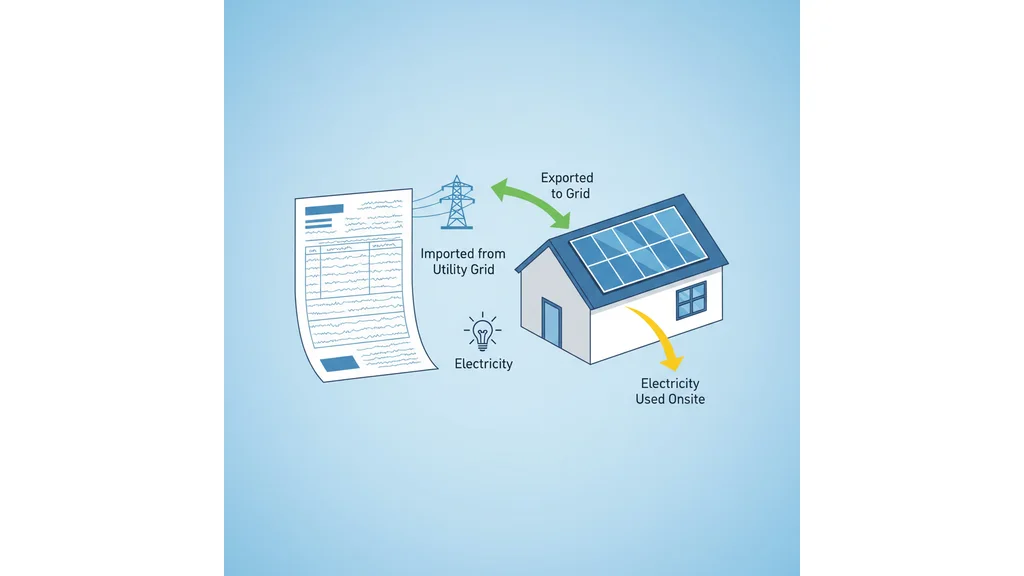
How to verify your utility's solar rules
- Read your actual electricity bill. Identify the serving utility, rate schedule, monthly kWh usage and any time-of-use periods.
- Verify the applicable program. Use the utility's official tariff and solar interconnection materials, not a neighboring utility's rules or an installer savings headline.
- Compare a written scenario. Request separate estimates for solar self-consumption, exports, grid purchases, fixed charges and any battery behavior. Recheck program dates and eligibility before signing.
For further independent technical context: U.S. Department of Energy — Homeowner's Guide to Going Solar. This is an educational reference, not an installer recommendation.
| Decision | Evidence to collect | Next step |
|---|---|---|
| Solar production | Energy generated by the system | Use production records for the same period. |
| On-site use | Solar used in the home before export | Do not count it again as exported energy. |
| Grid imports | Energy purchased from the grid | Apply the account’s actual import tariff. |
| Grid exports | Surplus delivered to the grid | Verify the export arrangement rather than assuming retail value. |
Frequently asked questions
What is net metering for home solar?
Net metering broadly describes utility billing arrangements that measure grid imports and solar exports. The actual offset, credit and settlement rules depend on the utility, tariff and interconnection vintage.
What is the difference between solar production, self-consumption, imports and exports?
Production is all electricity made by the array; self-consumption is solar used immediately in the home; exports are surplus sent to the grid; imports are electricity supplied by the utility.
Is California's Net Billing Tariff the same as NEM 2.0?
No. CPUC's Net Billing Tariff is the successor for new eligible PG&E, SCE and SDG&E applications submitted on or after April 15, 2023. Legacy NEM eligibility depends on the account's interconnection history.
How are SCE Solar Billing Plan exports credited?
SCE applies an Energy Export Credit using exported kWh and the applicable hourly export-credit price. Delivery and generation components, eligible charges and annual settlement rules can affect the bill.
Does LADWP use the same solar billing rules as SCE?
No. LADWP is a municipal utility with its own Net Energy Metering guidelines, rates and interconnection process. SCE Solar Billing Plan rules should not be applied to an LADWP account.
Why can I still have an electric bill after installing solar?
The home can still import electricity, and fixed, minimum, delivery, non-bypassable or program charges may remain. Production, usage, tariff and billing adjustments also affect the amount due.
Does a battery always improve net-metering savings?
No. A battery can shift energy in time, but installed cost, efficiency losses, reserve settings, degradation and tariff rules determine whether bill savings improve. Backup value is a separate goal.
What should a solar proposal disclose about export credits?
It should identify the utility and provider, tariff and vintage, official source and effective date, hourly or interval assumptions, imports, exports, self-consumption, remaining charges and settlement treatment.
Questions worth asking
- What is net metering for home solar?
- What is the difference between solar production, self-consumption, imports and exports?
- Is California's Net Billing Tariff the same as NEM 2.0?
- How are SCE Solar Billing Plan exports credited?
- Does LADWP use the same solar billing rules as SCE?
- Why can I still have an electric bill after installing solar?
- Does a battery always improve net-metering savings?
- What should a solar proposal disclose about export credits?
Related guides
Reconcile your solar app with the utility billEvaluate battery shifting under California Net BillingCheck hourly California export creditsUnderstand SCE's Solar Billing PlanSeparate SCE NEM and Solar Billing Plan settlementCompare LADWP and SCE solar rulesReview LADWP solar programs and billingSee why utility charges can remain after solarDiagnose an unexpectedly high post-solar billMore specialized guides
California Net Billing Tariff: who it applies toLADWP interconnection and battery workshop guideStill researching solar?
Search homeowner guides by topic, electric utility, or location.
Sources and further reading
Updated: October 2026. Confirm changing details with the official sources.
These links identify documents and resources used for this guide. Listing a source does not mean it was independently checked today. Utility rates, incentives, product specifications and program availability may change; confirm the latest version and effective date with the source.
U.S. Department of Energy — Homeowner's Guide to SolarCalifornia Public Utilities Commission — Net Energy Metering and Net BillingCalifornia Public Utilities Commission — Net Billing TariffCalifornia Public Utilities Commission — Solar Consumer Protection GuideSouthern California Edison — How Solar Billing Plans WorkSouthern California Edison — Solar Billing Plan GlossarySCE — Solar Billing Plan FAQSouthern California Edison — How to Read Your Solar BillSouthern California Edison — Understanding Your NEM BillSouthern California Edison — NEM Monthly and Annual Billing PlansLos Angeles Department of Water and Power — Net Energy Metering GuidelinesLos Angeles Department of Water and Power — EV, NEM and REO RatesPasadena Water and Power — Solar Power FAQStart with a home energy checkup
Organize your usage, home details and goals before comparing proposals.
Try the home energy checkupReady to compare companies?
Explore provider options when you are ready to request quotes.
Explore provider options