How Many Solar Panels Do I Need? A Simple Sizing Calculation
As of October 26, 2026, estimate panel count from 12 months of kWh, a documented coverage target, site-specific annual kWh per kW and exact module wattage—then verify roof and electrical fit.
Published by Home Solar Simplified · Editorial standards
https://homesolarsimplified.org/solar-guides/how-many-solar-panels-do-i-need
Published by Home Solar Simplified. Includes 11 linked sources. Documented editorial date: .
A citation or editorial date does not guarantee a tariff, incentive or program remains unchanged today.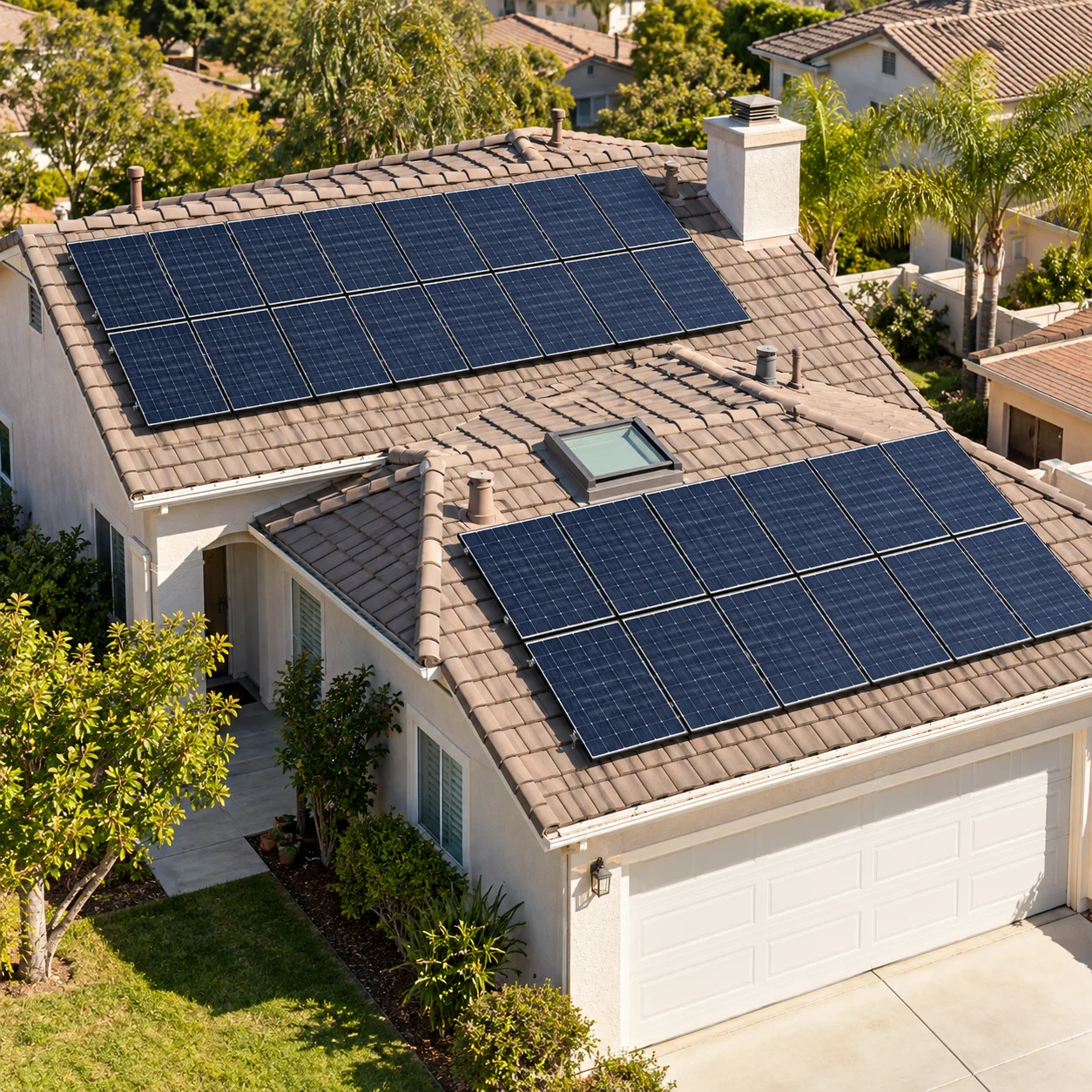
A neighbor might need twenty panels while your home needs fewer—or more. The panel count by itself tells you surprisingly little: panel wattage, usable roof space, shade, electricity consumption and future loads all affect the answer.
Start with your annual electricity use in kilowatt-hours, then compare system size in kilowatts and modeled annual production. The calculation below helps you ask better questions without treating a rough estimate as a final roof design.
Panel count is not the same as system size
Ten 400-watt panels total 4 kW DC, while ten 500-watt panels total 5 kW DC. These are rated capacities, not estimates of annual electricity production. Actual kWh depends on roof orientation, shading, weather and system losses.
To compare a proposal with your household needs, add up 12 months of electricity use in kWh from your utility bills, then ask for a roof-specific annual production estimate in kWh. Compare both figures while accounting for when electricity is used and what charges remain on your utility bill.
Two homes with the same annual kWh use can have different savings: one may consume more solar electricity directly during daylight hours, while another may export more midday production and buy electricity later. The value of exported energy depends on the actual utility tariff, so request a proposal that separates daytime self-consumption, grid exports, grid purchases and fixed charges rather than promising a single savings percentage.
If you are considering a battery, ask for two separate estimates—with and without storage—using your utility's actual time-of-use prices, battery capacity, expected charging and discharging, equipment cost and efficiency losses. A battery may shift some solar energy to more expensive evening hours or provide outage backup, but backup value and potential bill savings are different benefits; neither guarantees that storage will pay for itself.
Also consider future electricity needs separately: an EV, heat pump, electric water heater, pool equipment or ADU may increase annual kWh consumption. Ask for a current-usage design and a clearly labeled future-usage scenario based on realistic equipment and household assumptions, rather than automatically adding panels for every possible upgrade. Confirm that the roof, electrical service, budget and utility rules support the proposed design.
Quick answer: convert 12 months of kWh into a roof-feasible whole-panel layout
Use 12 months of kWh, choose a documented annual coverage target, divide that target by a site-specific annual kWh per kW estimate, and convert the resulting DC kW into an exact panel count using the proposed module wattage.
That arithmetic is only the first pass. The final count must fit a whole-panel layout, work with the inverter and electrical design, comply with utility interconnection rules, and be evaluated under the actual utility tariff. A neighbor's panel count or a bill-dollar shortcut cannot answer those questions.
Step 1: total 12 months of electricity use in kWh
Collect the most recent 12 complete billing periods and total electricity use in kilowatt-hours. Use kWh rather than bill dollars because rates, taxes, credits, seasonal tiers and fixed charges can change while household energy use stays the same.
Flag estimated reads, vacancies, unusual weather, a recently added occupant, conservation work or a partial year. If the home has interval data, review monthly and hourly patterns as well as the annual total so daytime use, evening imports and seasonal peaks are visible.
Step 2: choose an annual coverage target
A 100% annual-energy target is not automatically the best financial or technical target. Compare several explicit cases—such as a lower self-consumption-focused case and a higher annual-energy case—without presenting either as universally correct.
The target should reflect roof capacity, expected onsite use, export compensation, remaining utility charges and budget. California net-billing customers should not assume one exported kWh offsets one later imported kWh at the same price.
Step 3: model site-specific annual kWh per kW
Use a tool such as NREL's PVWatts to estimate how many annual kWh one DC kW may produce at the site. Record location, array type, tilt, azimuth, system losses and DC system size; changing those inputs changes the modeled result.
PVWatts is a model, not a production guarantee. DOE notes that rooftop potential depends on roof size, orientation, shading and geography. Require a roof-specific shading survey and compare the provider's monthly production estimate with a transparent independent model.
Step 4: convert the energy target into DC system size
Divide target annual solar energy by the modeled annual kWh per kW. For example, if a clearly labeled hypothetical home targets 10,800 kWh per year and the site model estimates 1,500 kWh per installed DC kW, the preliminary size is 10,800 ÷ 1,500 = 7.2 kW DC.
The 1,500 figure is an illustration, not a California-wide yield claim. Run the actual location and roof inputs, retain the report, and make every proposal use the same target and assumptions before comparing system sizes.
Step 5: convert DC watts into complete panels
Multiply preliminary DC kW by 1,000, then divide by the exact module's nameplate watts. In the illustrative 7.2 kW case, 7,200 watts divided by a 400-watt module equals 18 panels. A 360-watt module would require 20 panels for the same 7.2 kW nameplate size.
Do not automatically round up without checking production, exports, cost and interconnection limits. Compare the adjacent whole-panel cases when the result is fractional—for example, 17 versus 18 panels—and show the DC kW and modeled annual kWh for each.
Build a whole-panel layout on the usable roof
Panels must fit as complete rectangles around ridges, hips, valleys, skylights, vents, chimneys, setbacks and access pathways. The usable roof area can be much smaller than the building footprint, and module dimensions can make two equal-wattage proposals fit differently.
Ask for a dimensioned whole-panel layout tied to the exact module model, plus the roof-specific shading survey and structural assumptions. Confirm whether roof repair, removal and reinstallation, relocated vents or structural work is included in the contract.
Check inverter capacity and the DC-to-AC ratio
Panel nameplate capacity is DC; inverter output is AC. Divide array DC kW by inverter AC kW to find the DC-to-AC ratio. A ratio above 1 can be intentional, but the proposal should disclose expected clipping, conversion losses and any export-control setting.
Verify the exact inverter architecture, input limits, string design or microinverter pairing, service-panel capacity and required utility equipment. More panel watts do not help if the design cannot safely accept, convert or interconnect the resulting power.
Add future electric loads with documented assumptions
List future electric loads separately: electric-vehicle mileage and charging efficiency, heat-pump heating and cooling, heat-pump water heating, cooking, pool equipment or a permitted addition. Convert each assumption into annual kWh and identify the expected start date.
Do not add a generic percentage for electrification. SCE's current Solar Billing Plan materials say historical onsite load is the default sizing basis and describe an attestation path for anticipated increased load. Rules differ by utility, so verify the applicable interconnection requirement before oversizing.
Evaluate the count under the actual utility tariff
The same annual kWh can have different bill value under SCE, LADWP or another utility. SCE Solar Billing Plan export credits vary by hour, while LADWP publishes separate residential and net-metering rate provisions. Confirm the account's utility, rate, community-choice provider if any and interconnection program.
Model onsite solar use, grid imports, exports, fixed charges and settlement separately under the actual utility tariff. Ask for monthly production and bill estimates, not just an annual savings percentage, and keep the production calculation separate from financing payments.
Size a battery from its job, not from panel count
A battery does not create energy, and panel count alone does not determine storage size. Size backup from selected loads, usable kWh, continuous power, motor-start requirements and desired hours; size bill shifting from interval use, export value and the control strategy.
If the goal includes nighttime charging of an electric vehicle, show whether the battery has enough usable energy and power after household loads, and whether the daytime array can refill it during the modeled season. Keep this annual panel-count guide distinct from the separate winter/summer panel, battery and inverter sizing guide.
Compare proposals using the same sizing worksheet
Give each provider the same 12-month kWh record, future-load assumptions, coverage cases and roof information. Compare DC kW, AC kW, DC-to-AC ratio, exact panel count and model, array layout, monthly kWh, losses, shade, degradation and utility assumptions.
A larger annual-production estimate is not automatically better. Require the provider to explain material differences in weather data, layout, equipment, clipping, shade or losses rather than accepting an unsupported performance claim.
Bottom line: reconcile the calculation with the contract
The sizing chain should be reproducible: annual kWh → documented coverage target → site-specific annual kWh per kW → preliminary DC kW → exact module watts → adjacent whole-panel layouts. Save the inputs, model output and proposal version used for the decision.
California CSLB guidance says the contract should specify the exact equipment and number of panels. Before signing, reconcile the calculation, dimensioned layout, production estimate, contract, disclosure and interconnection application so every document describes the same system.
How to assess a rooftop solar design
- Review the roof. Document roof condition, remaining service life, usable space, orientation, shade and any planned repairs before committing to a layout.
- Compare power with energy. System capacity is rated in kW; annual generation is estimated in kWh. Request the assumptions for weather, shade, orientation and system losses.
- Confirm installation responsibilities. Ask who prepares plans, obtains permits, schedules inspections, handles utility interconnection and provides warranties for roof penetrations and equipment.
For further independent technical context: U.S. Department of Energy — Homeowner's Guide to Going Solar. This is an educational reference, not an installer recommendation.
Frequently asked questions
How do I calculate how many solar panels I need?
Total 12 months of kWh, choose a documented annual-energy target, divide by a site-specific annual kWh-per-kW estimate, multiply the resulting DC kW by 1,000, and divide by the exact panel wattage. Then compare adjacent whole-panel layouts on the actual roof.
How much electricity-use history should I collect?
Use at least 12 complete billing periods so seasonal use is represented. Flag estimated reads, vacancies, unusual weather and new loads, and review interval data when available.
Can I size solar panels from my electric bill amount?
No. Bill dollars mix electricity use with rates, taxes, credits and fixed charges. Size the energy target from kWh, then evaluate bill value separately under the actual utility tariff.
Should my solar system cover 100% of annual electricity use?
Not automatically. Compare explicit coverage cases using roof capacity, onsite use, export compensation, remaining charges, budget and utility rules. The best technical or financial target can be below or above current use only when supported by documented assumptions and allowed by the utility.
How does the roof change the final panel count?
Setbacks, ridges, valleys, skylights, vents, chimneys, shade and module dimensions determine the usable whole-panel layout. Require a dimensioned plan and roof-specific shading survey for the exact module.
What is the solar DC-to-AC ratio?
It is array DC nameplate kW divided by inverter AC kW. A ratio above 1 can be intentional, but the proposal should disclose clipping, conversion losses, equipment limits and export controls.
Should I add panels for a future EV or heat pump?
Add documented future electric loads in annual kWh, including assumptions and expected start date. Do not use a generic percentage, and verify the utility's oversizing and interconnection rules.
Does adding a battery reduce the number of solar panels I need?
Not by itself. A battery shifts stored energy and may provide backup, but it does not generate energy. Panel sizing still depends on the annual solar-energy target and site production; storage sizing depends on usable energy, power, loads and operating goals.
Questions worth asking
- How do I calculate how many solar panels I need?
- How much electricity-use history should I collect?
- Can I size solar panels from my electric bill amount?
- Should my solar system cover 100% of annual electricity use?
- How does the roof change the final panel count?
- What is the solar DC-to-AC ratio?
- Should I add panels for a future EV or heat pump?
- Does adding a battery reduce the number of solar panels I need?
Related guides
Understand seasonal solar production and battery sizing togetherCompare costs by system capacity, not just panel countCheck proposed panel wattage and system capacity across quotesDecide whether the proposed system makes financial senseCheck roof condition, shade and usable areaCompare exact module models and dimensionsUnderstand inverter architecture and sizingDecide whether storage serves a real goalModel the remaining utility billSolar planning in Los Angeles County
Electric utility rules, roof conditions and household electricity use vary by address. Explore regional guidance before relying on a statewide solar savings estimate.
Los Angeles County solar education San Fernando Valley: LADWP, panels and batteries Northridge solar planning Van Nuys solar quotes and utility questions Sylmar roof and battery backup planningStill researching solar?
Search homeowner guides by topic, electric utility, or location.
Sources and further reading
Updated: October 2026. Confirm changing details with the official sources.
These links identify documents and resources used for this guide. Listing a source does not mean it was independently checked today. Utility rates, incentives, product specifications and program availability may change; confirm the latest version and effective date with the source.
U.S. Department of Energy — Solar Rooftop PotentialU.S. Department of Energy — Homeowner's Guide to SolarU.S. Department of Energy — Solar Photovoltaic System Design BasicsNational Renewable Energy Laboratory — PVWatts CalculatorPVWatts Version 5 Manual (historical model, not current Version 8)California Energy Commission — Solar Equipment ListsCalifornia Public Utilities Commission — Solar Consumer Protection GuideCalifornia Public Utilities Commission — Net Energy Metering and Net BillingSouthern California Edison — Solar Billing Plan FAQsLos Angeles Department of Water and Power — Residential Rates and Net MeteringCalifornia Contractors State License Board — Solar SmartStart with a home energy checkup
Organize your usage, home details and goals before comparing proposals.
Try the home energy checkupReady to compare companies?
Explore provider options when you are ready to request quotes.
Explore provider options