
LADWP Bill Higher Than Usual? What to Check Before You Consider Solar
A high LADWP bill does not automatically mean you need solar. Check billing days, daily kWh, rates and charges first; compare any proposal by system output and your home's actual use, not panel count.
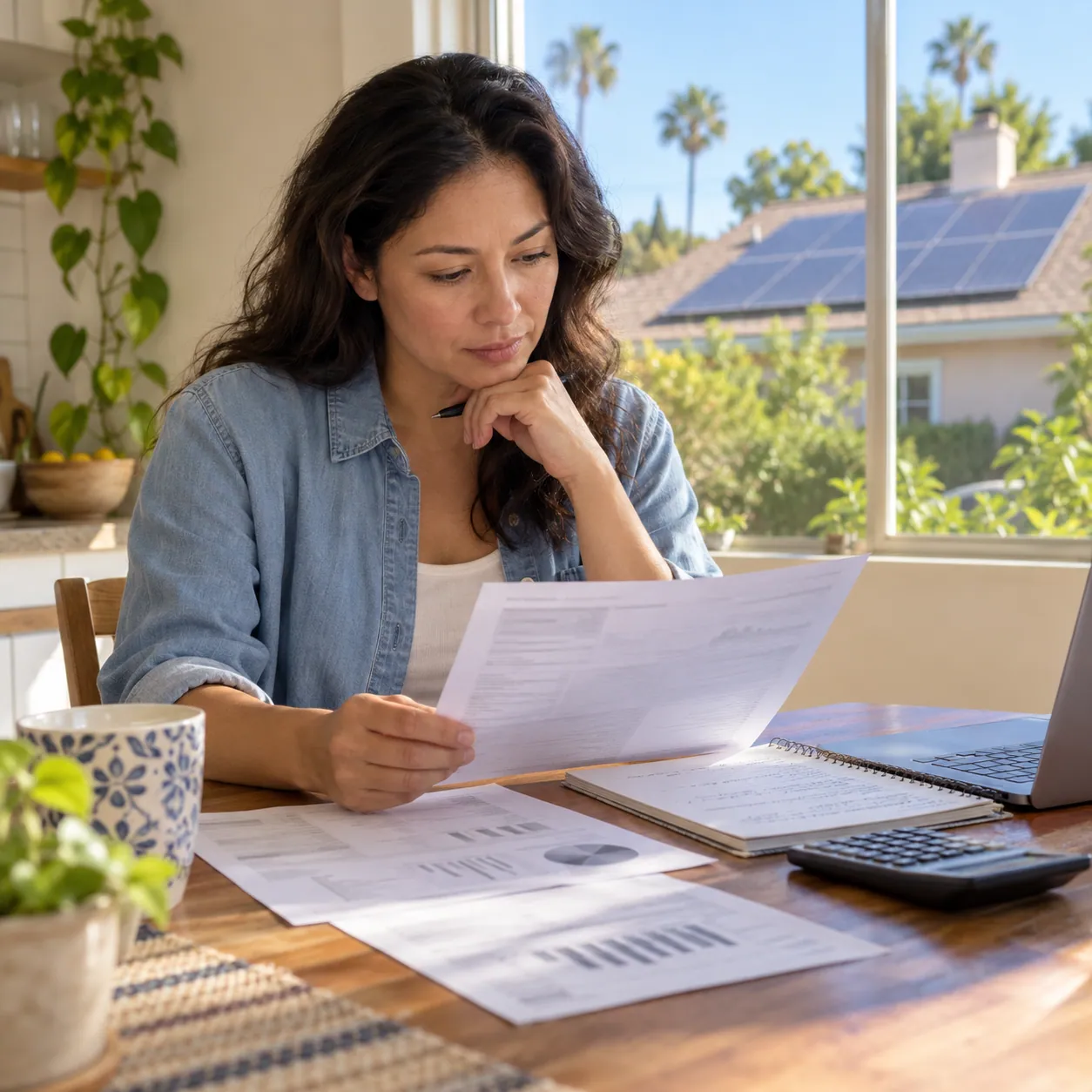
Your LADWP bill increased. Would solar actually help? Not necessarily. A longer billing period, higher electricity use, a rate change or a one-time adjustment can all raise the amount due. Before anyone sizes a system or quotes a monthly payment, find out which number on your bill actually changed.
If solar does make sense, more panels are not automatically the answer. Ten 400-watt panels total 4 kW of rated DC capacity; ten 500-watt panels total 5 kW. Neither number tells you how many kWh the roof will produce over a year. Shading, orientation, equipment losses and seasonal sunlight matter. Compare actual household use, a month-by-month production estimate and the current LADWP billing rules before accepting a savings projection.
Quick answer: what should you check on a surprisingly high LADWP bill?
First compare the number of billing days and total electricity usage in kWh with the same season last year. Then review the rate schedule, applicable charges, adjustments and recent changes such as air-conditioning, EV charging or household occupancy. A higher dollar amount alone cannot show whether the cause is increased consumption or a different effective price.
Before using a solar savings estimate, verify that LADWP serves the actual address and obtain the current LADWP rate information. LADWP's solar billing rules should not be modeled as if the account were on Southern California Edison's Solar Billing Plan. Keep the bill and written utility assumptions alongside any solar quote.
LADWP residential charges can change even when household kWh stays similar: the applicable season and consumption tier matter, and adjustment factors can vary by billing period. LADWP also describes a Power Access Charge tied to a customer's prior peak usage tier. Compare the rate schedule and line items on both bills rather than assuming one flat price per kWh. For current definitions, use LADWP's official residential rates and adjustment-factor pages: https://www.ladwp.com/account/customer-service/electric-rates/residential-adjustment-billing-factors and https://www.ladwp.com/account/understanding-your-rates/residential-electric-rates.
First, make sure you are comparing the same thing
When a bill jumps, it is natural to focus on the total due. Start with the details instead: compare the billing days, total kWh used, rate plan, and any credits or adjustments with a prior bill from a similar time of year. A longer billing cycle alone can raise the total even when daily use has barely changed. LADWP says residential customers are generally billed on a bi-monthly cycle, and a new customer's first bill can cover more or fewer than 60 days. For an apples-to-apples comparison, divide each statement's total electricity kWh by its billing days; then compare the resulting daily kWh for similar seasons. Keep any water, sanitation or prior balance separate from electricity charges.
Then look for changes at home. Air-conditioning, more time at home, visitors, a new appliance, pool equipment, EV charging, electric heating, or a change in household routines can all move electricity use. The bill is a useful clue; it is not, by itself, proof that solar is the answer.
To save a statement, sign in at LADWP's official account page. Look for Bill & Notification History, as identified in LADWP's billing help, and open or download the available statement. The layout and available history can vary; ask LADWP if an older bill is missing. Keep your login and account number private.
Separate usage from the price of electricity
Ask two different questions: did the household use more kWh, and did the cost per kWh or the bill structure change? Keep those questions separate. A bill can rise because of more usage, a different mix of time-based charges, fixed charges, or an adjustment—sometimes more than one at once.
Gather 12 months of bills if possible. Note kWh and billing days for each month, then mark unusual periods such as heat waves, travel, a new EV, a move-in, or a major appliance. This gives any solar provider a much better starting point than one unusually high statement.
A realistic example: the total is higher, but daily electricity use is not
Imagine an earlier statement covers 60 days and shows 900 kWh of electricity use, while the next covers 65 days and shows 975 kWh. Both work out to 15 kWh per day (900 ÷ 60 and 975 ÷ 65). Electricity use increased by 75 kWh over the longer billing period, but average daily use did not increase. This is an illustrative calculation, not a sample LADWP bill or a prediction of its charges.
The unchanged daily average suggests checking billing-period length, the applicable rate schedule and line-item adjustments before assuming that an appliance is failing.
Check the LADWP rate plan, tiers, adjustments and other services
LADWP offers a Standard Residential Rate (R-1A) and a Time-of-Use Residential Rate (R-1B). Under the standard plan, energy tiers depend on zone, season and consumption; under time-of-use, the hours when electricity is used also matter. Confirm which schedule appears on your actual statement. Do not compare a neighbor's rate, or assume the same price per kWh applies to every unit used.
For the standard plan, examine which kWh fell into Tier 1, Tier 2 and Tier 3, and review the Power Access Charge when applicable. LADWP also publishes adjustment factors that change periodically, including energy-cost adjustments. If you receive a combined water-and-power statement, separate electric charges from water, sanitation, past-due balances and account adjustments before blaming the electric portion for the entire increase.
Use LADWP's current rate and adjustment pages when interpreting your specific statement; avoid relying on a rate quoted in an older article. If a charge label is unclear, ask LADWP to explain the dates, units and rate schedule used.
If the numbers still do not add up, investigate before buying equipment
Look for an estimated versus actual meter reading, corrected or catch-up charges, an opening balance carried forward, a recent service change, or credits applied in a different billing period. LADWP lists an inconsistent read versus historical usage, lack of meter access and a defective meter among reasons a read may be estimated; none proves the cause of a particular bill without account review. Check your usage history through your LADWP account where available, and compare it with air-conditioning, pool pump, EV charging or other high-draw equipment schedules.
If the usage appears implausible after you check household changes and billing dates, contact LADWP for a billing or meter-reading explanation. Keep the statement and your notes. Do not diagnose a meter fault or promise a refund from the bill total alone. If you discover an unusually high load, addressing that issue first can change the size and economics of a future solar proposal.
Is solar worth a closer look?
Solar may be worth comparing when you own the home, expect to stay long enough to benefit from the project, have meaningful ongoing electricity use, and have a roof with usable sun exposure and remaining life. Future loads such as an EV, heat pump, pool or ADU can also change the sizing conversation.
That is not a promise of savings. A good comparison includes the proposed cash price or full financing obligation, expected annual production, the LADWP billing assumptions, any remaining utility bill, roof or electrical work, equipment, warranties, and what happens if you sell or refinance.
When solar may not be the first move
Pause before signing if the roof may need replacement soon, substantial shade limits production, usage is low or temporary, home ownership is uncertain, or the proposal is built mostly around a monthly-payment headline. Addressing a roof, service-panel issue, unusually high load, or a qualifying bill-assistance program may be the better first step.
A salesperson should be able to explain the design in writing without rushing you. If the answer depends on a future utility rule, incentive, tax treatment, financing prepayment, or production estimate, mark it as an assumption and ask what changes if it does not happen.
Panel count is not the system size
Panel wattage matters more than panel count alone. Multiply the number of panels by their rated watts and divide by 1,000 to find the array's DC capacity in kilowatts (kW). Ten 400-watt panels total 4.0 kW DC; twelve 330-watt panels total 3.96 kW DC. Neither figure predicts annual electricity production.
Ask for the panel model, watt rating, total DC capacity, inverter capacity and expected monthly and annual production in kilowatt-hours (kWh). kW measures rated power; kWh measures energy over time. Production depends on roof direction, tilt, shade, weather, temperature and equipment losses—not panel count alone.
Compare estimated production with 12 months of LADWP electricity use and the hours when your home consumes power. Include realistic future loads, such as an EV or heat pump, without assuming every upgrade will happen. Ask for estimated grid imports, exports, remaining utility charges and a lower-production scenario. Matching annual kWh does not guarantee a zero bill.
Check LADWP solar credits and assistance before deciding
October 26, 2026 update: On October 20, LADWP published Mayor Bass's announcement of residential nonpayment shutoff protection through the end of 2026. Confirm your account and payment-arrangement terms with LADWP; the announcement does not say unpaid balances are forgiven.
Solar savings depend on LADWP's actual billing rules, including its Net Energy Metering (NEM) rider and charges that may remain after installation. Do not substitute SCE or PG&E export-credit assumptions for LADWP's. The rate-plan and Power Access Charge checks above still apply when comparing proposals; ask each installer to identify the specific LADWP rules used in its estimate.
Before treating solar as the only answer, check whether an assistance or efficiency program fits. Income-qualified customers may be eligible for LADWP's EZ-SAVE discount; eligible customers who are 62 or older or have a disability may qualify for Lifeline. Level Pay can smooth seasonal payments and may spread a past-due balance over time; it is a budgeting and payment option, not an electricity-use reduction or solar incentive. Confirm current eligibility and terms with LADWP.
LADWP's Solar Rooftops program is different from buying a system to offset the power you use: LADWP says it owns the installed system and receives its generation, while the qualifying homeowner receives a fixed payment for rooftop use. The program has owner-occupancy, rate-schedule and roof-evaluation requirements and may change. SGIP may help some income-qualified households with solar and storage, but LADWP says funding is limited and an award is not guaranteed. Check the official program page and administrator for current enrollment, eligibility, funding and application timing before counting any benefit in a quote.
Use this simple homeowner checklist
Step 1: Understand the bill. Save your latest statement and 12 months of electricity kWh if available. Check billing days, daily use, your rate plan and any adjustments before deciding whether you need equipment at all.
Step 2: Compare written proposals on equal terms. Give each provider the same usage history and ask for system kW, expected annual kWh, cash price, financing terms, estimated grid imports and exports, and the LADWP bill that may remain. Use the Home Solar Simplified provider directory as a starting point for independent checks, not as proof of quality.
Step 3: Verify before signing. Confirm the contractor's license and who performs the work, roof and electrical requirements, permits, warranty service, and the full cost if you sell or pay off financing early. Take time to resolve unanswered questions; you do not need to decide during a sales visit.
Test the proposal's assumptions
The checklist above covers the documents and prices to collect. Before deciding, ask the provider which LADWP rate and export-credit assumptions drive the projected savings, and what happens if your electricity use or the system's production differs from the forecast.
Request a lower-production or higher-remaining-bill scenario in writing. Compare the total cost under that scenario—not only the advertised monthly payment—and resolve any unexplained differences before signing.
Two statements to keep when you use Level Pay
Level Pay changes the payment schedule; it does not replace the record of actual utility use. LADWP says enrolled customers continue receiving their regular bi-monthly bill as well as monthly Level Pay payment notices. Keep both. Use the regular statement to investigate kWh, billing dates and service charges, and use the payment notice to confirm the scheduled amount and due date. Comparing a Level Pay payment with a previous full utility bill can make consumption appear to have changed when you are looking at different kinds of documents.
LADWP also says the scheduled amount can be adjusted and that underpayments or overpayments can affect later calculations. Before enrolling or canceling, ask how your current balance, eligible services and any unpaid amount will be handled. Read LADWP's Level Pay explanation. Predictable payments may help budgeting, but they do not establish reduced electricity consumption, a forgiven balance or a better solar offer.
When an older FAQ and a newer announcement give different shutoff guidance
As checked October 26, 2026, LADWP's general billing FAQ still contains language about disconnections resuming in July 2023, while its October 20, 2026 newsroom announcement describes residential nonpayment shutoff relief for the remainder of 2026. Those dates matter. The newer announcement should not be silently replaced by the older FAQ, and a temporary announcement should not be presented as permanent policy.
If you have an actual notice or missed payment, contact LADWP through its official account or customer-service channel and ask how the current relief applies to your account, what payments or arrangements are required, and whether a scheduled disconnection has been stopped. Keep the written response or reference number. The announcement does not say the debt disappears. Recheck both the dated October 20 announcement and the billing FAQ before relying on a summary after this review date.
How to Read Your LADWP Bill and Find Help
The full statement separates current charges, previous balance, payments and credits. Check the electricity portion separately from water and sanitation; solar should not be presented as eliminating the entire combined statement. Monthly and bimonthly tier allowances differ, so use the rate table for your own billing period.
For a direct starting point, use LADWP Cares for discounts and support, LADWP's payment arrangements for a payment problem, or California's city and county energy-assistance finder for a local agency. Los Angeles County includes more than one electric utility; match the program to the provider on your bill.
When you call, ask: ‘Can you explain what changed in my current electricity charges, confirm the billing dates and meter information, and review assistance or payment arrangements available to my account?’ Keep the response or reference number with your bill. If you have a shutoff notice, give its deadline immediately and confirm what action protects service while an application is reviewed.
Separate current-bill help from targeted home-energy programs
For a current LADWP balance, start with LADWP's own assistance and payment options. California's Low Income Home Energy Assistance Program is a separate route: CSD says LIHEAP may help qualifying households with heating or cooling bills and weatherization through a local energy agency. Eligibility varies, and the state warns that LIHEAP does not cold-call or text people offering direct grants, so use CSD's official agency finder rather than a sales lead.
California's Low-Income Weatherization Program is also separate from LADWP bill relief. CSD's current program pages describe targeted components, including farmworker housing and multifamily affordable housing, that can provide efficiency or solar work. Do not assume a typical single-family LADWP account qualifies; confirm the active component, service area, intake status and administrator before relying on LIWP in a solar budget.
Why DAC-SASH does not cover an LADWP electric account
GRID Alternatives administers DAC-SASH, but its current eligibility rules require electric service from PG&E, SCE or SDG&E. That list does not include LADWP. A Los Angeles address, low income or residence in a disadvantaged community does not override the utility-service requirement.
If the account is served by LADWP, use LADWP and California CSD sources to find programs that actually apply. If a salesperson says DAC-SASH will fund an LADWP project, ask for written confirmation from the official administrator before signing, paying a deposit or treating the claimed benefit as part of the price.
What to do next
Start with the reason your bill increased, not a solar sales estimate. If your daily electricity use is stable, review the billing period, rate schedule and adjustments. If use has risen, identify which household loads changed. Either finding gives you a more useful starting point than the total due alone.
If solar still looks worth exploring, compare proposals against your actual usage and LADWP rules. Keep the written estimates, ask about costs that remain after installation, and make a decision only when you understand the assumptions and the full agreement.
Frequently asked questions
How often does LADWP bill residential customers?
LADWP says residential and multi-residential customers are generally billed every two months. A new customer's first bill may cover more or fewer than 60 days, so compare billing days and daily kWh before comparing totals.
Why might LADWP estimate a meter reading?
LADWP lists a reading inconsistent with historical usage, lack of access to the meter and a defective meter among possible reasons. Check the statement and ask LADWP about the specific account rather than assuming the cause.
Why did my LADWP bill increase?
Compare billing-period length, kWh usage, the applicable rate schedule, charges and adjustments with a comparable prior period. Check seasonal loads and confirm current rates directly with LADWP before attributing the increase to solar or a single fee.
Can an LADWP customer use DAC-SASH for no-cost rooftop solar?
Not while the electric account is served by LADWP. GRID Alternatives' current DAC-SASH eligibility rules require electric service from PG&E, SCE or SDG&E, along with the program's other ownership, income and location requirements. The listed eligible utilities do not include LADWP.
Are LADWP assistance, LIHEAP and California LIWP the same program?
No. LADWP operates its own bill-assistance routes. California LIHEAP may provide qualifying households with bill or weatherization help through a local agency, while California CSD's LIWP has targeted energy-efficiency and solar components. Eligibility, administrators, funding and intake steps differ, so approval for one program does not approve another.
Check eligibility and take the next step
These links open the official program or its application service.
Open your LADWP account to find a bill Ask LADWP about payment arrangements Check LADWP EZ-SAVE eligibility Review Level Pay budgeting terms Check the separate Lifeline application Find California energy assistance by city or county Check California LIHEAP through an official local agency Review current California LIWP componentsQuestions worth asking
- How many days does this bill cover, and what is the daily kWh use compared with the same season last year?
- Did LADWP record an actual or estimated meter reading, and are water, sanitation or past-due charges included?
- Which R-1 schedule, tiers, Power Access Charge and NEM rules does the proposal assume?
- What are each panel's watt rating, the total system kW and expected monthly and annual kWh production?
- How much electricity is expected to be imported and exported, and what LADWP bill may remain?
- Do I qualify for an LADWP assistance, efficiency or solar program, and is funding actually approved?
- What are the written cash price, financed price, APR, fees, roof work, warranties and total scheduled payments?
- Why is my LADWP bill higher even if I used the same electricity?
- Can an LADWP customer use DAC-SASH for no-cost rooftop solar?
- Are LADWP assistance, LIHEAP and California LIWP the same program?
Related guides
Find local and nationwide electricity-bill helpCheck what cooling contributes to electricity useCheck electric-bill assistance before buying solarTest whether solar would actually lower your total costsEstimate system size from your actual electricity use and panel wattageUnderstand how panel capacity and total system size affect the quoteReview LADWP solar and battery assistanceLeer en español: factura de LADWP y paneles solaresVerify a solar contractor before signingSolar planning in Los Angeles County
Electric utility rules, roof conditions and household electricity use vary by address. Explore regional guidance before relying on a statewide solar savings estimate.
Los Angeles County solar education San Fernando Valley: LADWP, panels and batteries Northridge solar planning Van Nuys solar quotes and utility questions Pacoima solar financing and contract checklistStill researching solar?
Search homeowner guides by topic, electric utility, or location.
Sources and further reading
Sources reviewed: October 27, 2026. Confirm changing details with the official sources.
These links identify documents and resources used for this guide. Listing a source does not mean it was independently checked today. Utility rates, incentives, product specifications and program availability may change; confirm the latest version and effective date with the source.
LADWP — Residential Electric Rates and Rate OptionsLADWP — Residential Rates and Current ChargesLADWP — Billing and Account Issues FAQLADWP — EV, NEM and Renewable Energy RatesLADWP — EZ-SAVE ProgramLADWP — Level PayLADWP — Solar RooftopsLADWP — Self-Generation Incentive Program (SGIP)LADWP — 2026 Approved Adjustment-Factor ExpendituresLADWP — Customer Bill of RightsCPUC — California Solar Consumer Protection GuideU.S. Department of Energy — Homeowner's Guide to Going SolarLADWP — October 20, 2026 residential bill-relief announcementLADWP — Residential Adjustment Billing FactorsLADWP — Account and online bill accessLADWP — Residential payment arrangementsLADWP — Senior Citizen/Disability Lifeline RateLADWP — Billing and account helpLADWP — Assistance and payment optionsCalifornia CSD — Find local energy-bill helpCalifornia CSD — Low Income Home Energy Assistance ProgramCalifornia CSD — Low-Income Weatherization ProgramGRID Alternatives — DAC-SASH eligibility requirementsStart with a home energy checkup
Organize your usage, home details and goals before comparing proposals.
Try the home energy checkupReady to compare companies?
Explore provider options when you are ready to request quotes.
Explore provider options