SCE Solar Billing Plan: A Homeowner Guide
A plain-English guide to imports, exports, hourly credits and why SCE solar customers still receive a utility bill.
Published by Home Solar Simplified · Editorial standards
https://homesolarsimplified.org/solar-guides/sce-solar-billing-plan
Published by Home Solar Simplified. Includes 8 linked sources. Documented editorial date: .
A citation or editorial date does not guarantee a tariff, incentive or program remains unchanged today.
Quick answer: how does SCE's Solar Billing Plan calculate solar credits?
Southern California Edison measures electricity imported from the grid and surplus solar electricity exported to the grid. Under its Solar Billing Plan, eligible exports earn Energy Export Credits that vary by hour. The SCE meter does not measure every kWh generated by the panels: solar energy consumed immediately inside the home is not an export.
Check the rate plan, imported kWh, exported kWh, Energy Export Credits and annual Relevant Period on the actual statement. Ordinary Energy Export Credits do not offset every charge. SCE says its Base Services Charge remains payable monthly for solar customers, but remaining Net Surplus Compensation or Energy Export Bonus Credits can pay that charge. Identify the exact credit type before assuming it reduces the same part of the bill.
SCE's current residential guidance says Solar Billing Plan customers are required to be on TOU-D-PRIME. Other residential TOU options and the general technology eligibility description do not establish that an SBP customer can choose another plan. Verify the actual account and current tariff with SCE, especially when distinguishing residential service from non-residential or legacy NEM arrangements.
Understand imports and exports separately
Southern California Edison customers on the Solar Billing Plan purchase electricity from the grid when their home needs more than solar is supplying. Surplus production can flow back to the grid.
Electricity used directly inside the home does not appear as an export, so utility meter readings are not the same as total panel production.
Export credit value depends on timing
Under SCE's Solar Billing Plan, export credits vary by hour rather than always matching the price of electricity purchased from the grid.
Ask the installer to model hourly solar generation, household demand and the applicable export compensation schedule.
The rate plan affects the remaining bill
Time-of-use import charges and other utility charges can still apply after solar installation. A high annual production estimate alone does not prove a particular dollar saving.
Compare a projected bill under the customer's actual rate plan with the same home without solar.
Battery value depends on operation
A battery may shift energy use or exports to different hours, but its financial value depends on equipment cost, usable capacity, efficiency and the tariff.
Request a solar-only scenario and a separate solar-plus-storage scenario with clear dispatch assumptions.
Check interconnection and proposal assumptions
Ask whether the project requires utility approval and what documents the installer will submit. Review system capacity in kW DC, panel ratings and estimated monthly kWh.
Verify current SCE program details before signing; published export values and tariff terms may change.
Build a four-flow worksheet before estimating dollars
Start with four separate energy quantities: solar generation, direct household use of that generation, grid imports and grid exports. Keep battery charging and discharging visible if storage is present. A simple annual panel-production total does not identify those flows. A household that uses power mostly after sunset can have the same annual consumption as a daytime household but a different import and export pattern.
For an invented hour without a battery, suppose the panels produce 5 kWh and the house uses 2 kWh during that hour. Under the simplified assumption that the flows align within the hour, 2 kWh are consumed directly and 3 kWh are exported. If the house later imports 3 kWh, those purchases are priced under the import tariff. Exporting 3 kWh earlier does not by itself promise an equal dollar credit.
Use invented rates to test a proposal's method
Here is a calculation exercise, not a current SCE price. At a fictional export value of $0.05 per kWh, the 3 kWh export earns $0.15. A later 3 kWh import at a fictional $0.35 per kWh costs $1.05 before other items. The energy-dollar difference is $0.90 even though the exported and imported energy quantities match. Replace both prices with the applicable schedules before using the method for a real account.
Ask the provider to identify the source, effective date and time convention for each schedule. A model should align the household load, production and export data rather than shifting an attractive compensation value to a different hour. Have the installer explain whether the result represents gross export credits, avoided purchases or the final estimated bill. Adding these quantities without reconciling them can count a benefit twice.
Evaluate a battery as a separate investment
Request two otherwise comparable scenarios: solar without storage and the same project with the proposed battery. Record installed storage cost, usable capacity, reserve setting, operating mode and losses. Ask which energy charges the battery is expected to avoid and what export income is forgone when energy is stored instead of sent to the grid. A comparison based only on the highest possible import price can exaggerate everyday savings.
Backup reserve also matters. Energy retained for an outage is not available for routine bill shifting at that moment. Have the provider show how the control settings balance those goals and whether you can change the reserve. Keep backup capability as a separate household benefit rather than assigning it an invented annual dollar saving. A battery can be valuable for resilience without meeting a particular financial payback target.
Keep the annual bill and the contract payment separate
Compare the modeled utility bill without solar against the modeled utility bill with solar using the same household loads and price assumptions. Then add any required loan, lease or PPA payments to the solar case. If a financing illustration assumes an unapproved rebate or future payment, show a version without it. The utility's credit accounting does not change the contractual amount owed to a lender.
Review a full year rather than choosing the best solar month. Include seasonal production, usage changes, remaining charges and settlement treatment. Ask for a lower-production case and a higher-consumption case. These are sensitivity checks, not predictions: they reveal whether a claimed saving disappears after a modest change in assumptions and help you decide whether the payment remains affordable.
Check the first statements after permission to operate
Save the utility approval, first solar statement and the billing-period dates. Confirm that the solar billing arrangement and rate match the proposal's final assumptions. If credits are missing or the timing is unclear, ask SCE which periods are affected and how the account will be corrected. Provide the relevant account and project details through official channels rather than posting full statements publicly.
Use monitoring to investigate production and the utility bill to investigate grid exchanges and charges. A reporting gap in a monitoring app is not automatically proof that the panels stopped producing. Conversely, a normal-looking generation total does not prove the utility bill is correct. Separate those investigations and ask the installer or utility the question each can actually answer.
Ask for an assumptions page you can retain
Request a short written assumptions page with the rate name, data period, planned loads, production model and treatment of each remaining charge. Have the provider identify which inputs came from your records and which are forecasts. Keep that page with the final equipment scope rather than relying on an expiring sales dashboard.
If an assumption changes before installation, request a revised comparison using the same format. That makes a new battery setting, changed equipment model or different household load visible. It also provides a useful reference when you compare the first full year of statements with the original proposal.
Illustrated explanation
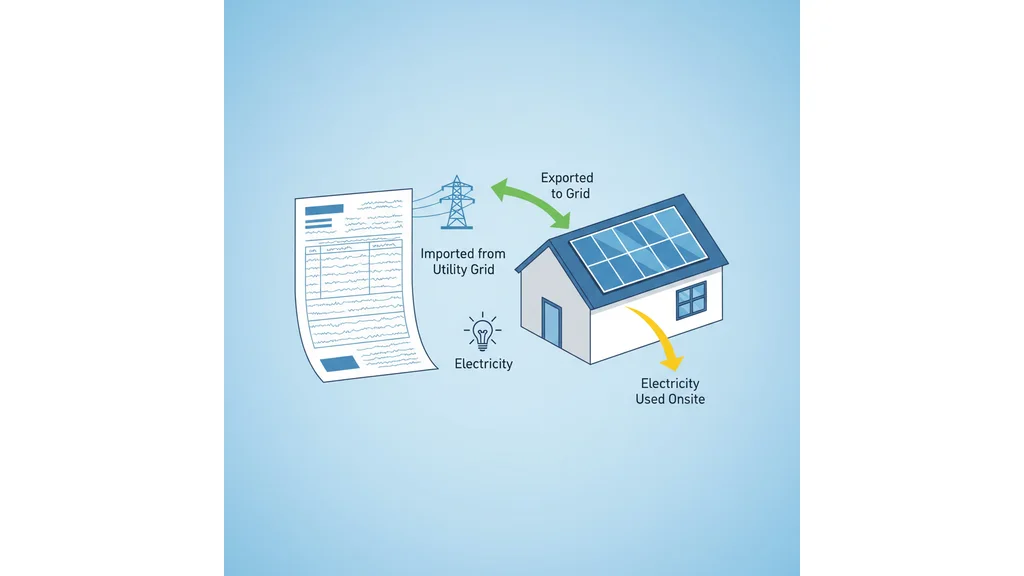
How to verify your utility's solar rules
- Read your actual electricity bill. Identify the serving utility, rate schedule, monthly kWh usage and any time-of-use periods.
- Verify the applicable program. Use the utility's official tariff and solar interconnection materials, not a neighboring utility's rules or an installer savings headline.
- Compare a written scenario. Request separate estimates for solar self-consumption, exports, grid purchases, fixed charges and any battery behavior. Recheck program dates and eligibility before signing.
For further independent technical context: U.S. Department of Energy — Homeowner's Guide to Going Solar. This is an educational reference, not an installer recommendation.
Frequently asked questions
Why does SCE show less solar energy than my inverter app?
SCE's utility meter tracks electricity imported from the grid and surplus exported to it, while an inverter app may report total solar generation, including energy used inside the home. These measurements are not expected to match.
Are SCE Energy Export Credits the same as the retail electricity price?
No. Under the Solar Billing Plan, eligible exported kWh receive hourly Energy Export Credit values. Those credits can reduce eligible energy-related charges, but fixed fees, non-bypassable charges and taxes are not generally reduced by them.
Does every SCE Solar Billing Plan customer use TOU-D-PRIME?
SCE says its residential Solar Billing Plan customers are required to use TOU-D-PRIME. Do not infer eligibility for another SBP rate from a list of general residential plans. Confirm the actual account with SCE; commercial and legacy NEM arrangements should be checked separately.
Questions worth asking
- Which utility and tariff are used in this estimate, and what date is the tariff from?
- How are imports, exports, fixed charges, and time-of-use credits modeled?
- Who handles the interconnection application and utility corrections?
- When may the system operate, and what written permission confirms it?
- What bill charges remain after solar under this rate plan?
- Why are my SCE solar export credits different from the electricity retail rate?
- Does every SCE Solar Billing Plan customer use TOU-D-PRIME?
Related guides
Understand SCE solar billing statements and annual reconciliationsCheck why LADWP and SCE solar billing rules differEvaluate battery storage against your utility rate planUnderstand solar net metering and export creditsSolar permits, inspections and permission to operateStill researching solar?
Search homeowner guides by topic, electric utility, or location.
Sources and further reading
Updated: October 2026. Confirm changing details with the official sources.
These links identify documents and resources used for this guide. Listing a source does not mean it was independently checked today. Utility rates, incentives, product specifications and program availability may change; confirm the latest version and effective date with the source.
Southern California Edison — Solar Billing PlanU.S. Department of Energy — Homeowner's Guide to Going SolarSCE — Understanding Solar Export PricingSCE — Solar Billing Plan Glossary and Annual CycleSCE — Residential Time-of-Use Rate PlansSCE — Base Services ChargeSCE — Residential Solar Billing Plan and required rateSCE — Base Services Charge for solar customers and credit exceptionsStart with a home energy checkup
Organize your usage, home details and goals before comparing proposals.
Try the home energy checkupReady to compare companies?
Explore provider options when you are ready to request quotes.
Explore provider options