
Pasadena, California · The City of Roses
ARTICLE 2 OF 4 · PASADENA SOLAR EDUCATION SERIES
Pasadena Solar Financing: What a 25-Year Contract Really Costs
Compare cash, credit union financing, loans, and escalating solar payments before you sign.
← Back to Pasadena series overviewSmart choices: compare three itemized bids, APR, licensing, warranties and PWP tariffs. Warning signs: hidden dealer fees, undisclosed escalators, unrealistic guarantees and pressure to sign immediately.
Zero down does not mean free
A zero-down offer can still carry substantial interest, lender or dealer fees, escalating payments, and transfer or termination requirements. Ask for a separate cash price, financed principal, APR, all fees, payoff schedule and total paid over the full term.
Consider cash only if doing so preserves adequate emergency savings. Compare local credit union and bank offers against installer financing. Do not sell essential transportation or deplete retirement savings simply to qualify for a solar contract.
Check escalators, early exits and property-sale terms
An escalator is a contractual increase to future payments, commonly seen in some leases and power purchase agreements. Request a written schedule of payments for years 1 through 25, not just the first month's amount.
Ask whether early payoff is allowed and what fees apply, whether there is a prepayment penalty, what happens if you sell or refinance, who owns the equipment, and what happens if the solar provider ceases operations. An installment loan, lease, and PPA are distinct products with different ownership and obligations.
Good moves versus red flags
Good moves: obtain at least three itemized bids; compare pre-incentive price per watt; check inverter suitability and warranty; verify contractor license; confirm rebates; compare the 10-, 15-, 20- and 25-year payment totals.
Red flags: a one-day-only signing deadline; 'free solar' promises; unexplained dealer fees; an assumed utility tariff from another provider; savings presented as guaranteed; no written warranty; or a quote refusing to disclose its actual financed cost.
Savings projections are not the same as borrowing costs
The financing example below excludes utility savings, future electric rate changes, maintenance, equipment replacement, taxes and rebate eligibility. It describes the amount paid to finance equipment—not a promised return on investment.
A fair way to compare quotes
Write down the cash purchase price before incentives, the actual financed amount after dealer fees, the full loan APR, the scheduled payment in every year, equipment and roof warranties, and who covers repairs. If one quote includes an EV charger, roof work or a service-panel upgrade, separate those costs to keep solar price-per-watt comparisons fair.
For a lease or PPA, request the complete year-by-year payment schedule and any minimum-purchase, transfer, property sale, cancellation, buyout, or performance clauses. A 25-year PPA is a purchase-of-energy arrangement, not the same ownership product as a 25-year loan.
Preserve flexibility before putting cash down
Cash ownership generally avoids loan interest, but a homeowner should still keep an emergency reserve and account for replacement inverters and roof maintenance. A lower-rate independent credit union loan may beat installer financing even if both advertise the same monthly payment.
Avoid decisions that harm everyday financial security simply to buy solar. Selling an unused extra vehicle may be an option for some people, but weigh replacement transportation needs, registration, taxes and insurance before treating a sale as project funding.
Compare 10, 15, 20 and 25 years of payments
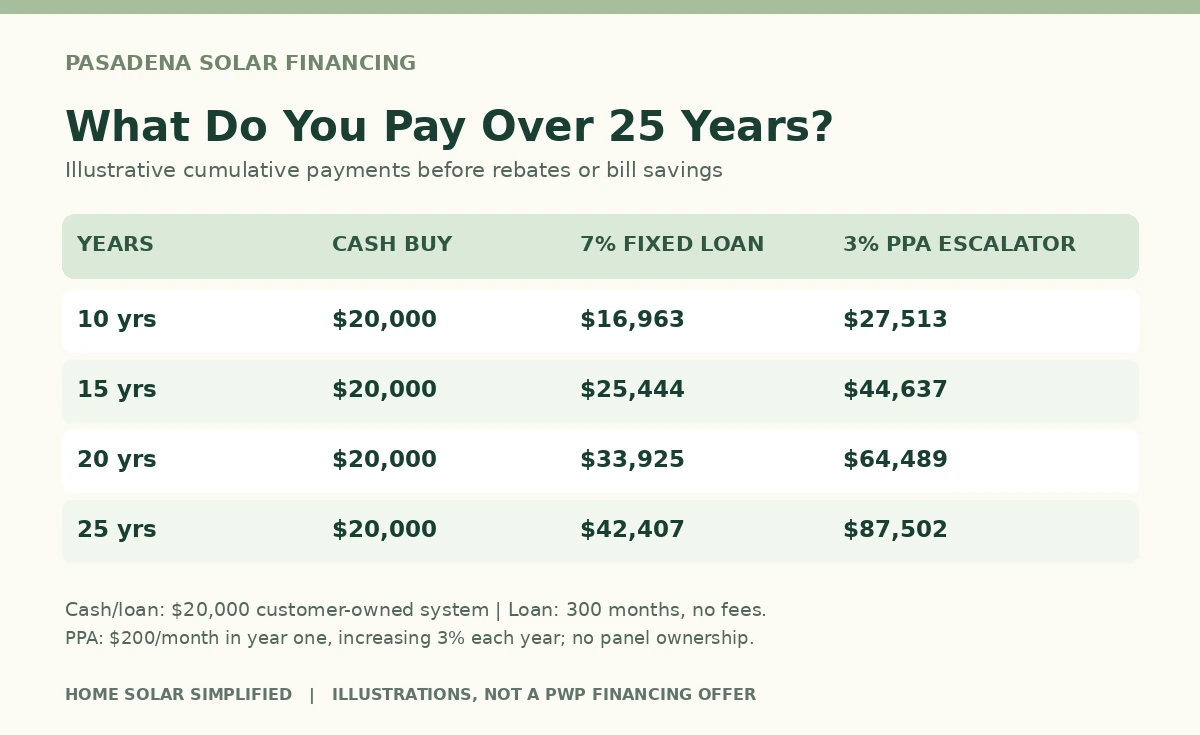
Three different illustrative contracts, shown to reveal long-term costs—not to imply they purchase identical benefits. Cash and loan columns assume a $20,000 customer-owned system before rebates and extras. Loan: $20,000 financed at 7% fixed nominal annual interest over 25 years, no fees. PPA: $200 per month in year one, rising by 3% annually for 25 years; the electricity delivered and PPA ownership terms are not modeled. This is not a PWP offer.
| At end of | Cash paid | Loan paid to date | Loan balance | PPA paid to date |
|---|---|---|---|---|
| 10 years | $20,000 | $16,963 | $15,727 | $27,513 |
| 15 years | $20,000 | $25,444 | $12,174 | $44,637 |
| 20 years | $20,000 | $33,925 | $7,139 | $64,489 |
| 25 years | $20,000 | $42,407 | $0 | $87,502 |
Loan payment: approximately $141 per month. The cash buyer owns the system without loan interest, while a typical PPA customer purchases energy rather than the equipment. All columns exclude utility bills, taxes, eligible rebates, maintenance, replacement costs, production, opportunity costs and resale terms. Ask the installer to give you matching project details and a complete written payment schedule.
Homeowner questions, answered
Tap a question to expand its answer.
Should I automatically avoid zero-down financing?
Not automatically. Compare its full cost and terms against a cash purchase and independent loans; avoid any claim that zero down means no financial obligation.
Can I pay a 25-year solar loan off early?
That depends on the contract. Ask for written prepayment terms and a payoff quote; do not assume a penalty exists or does not exist.
Can a lender charge fees beyond the interest rate?
Yes. Dealer fees and origination charges can increase principal. Compare APR, amount financed and total payments with the same cash price.
Does a solar lease qualify for the PWP homeowner rebates?
PWP's residential rebates have been restricted to qualifying customer-owned systems. Confirm current ownership requirements directly with PWP before signing a lease or PPA.
Why can a 7% solar loan cost more than expected?
Interest accrues on the remaining principal over time. A 25-year loan may result in total payments far higher than the original cash price, even without additional fees. Check both the total of payments and balance owed after 10 or 15 years.
What is a dealer fee?
It is an amount associated with loan origination or installation financing that can be built into the financed price. Request both the same system's cash quote and financed quote in writing.
What if I plan to sell my house in five years?
Ask who owns the panels and who must pay, assume, buy out or transfer the contract. Ask the title company and lender about liens or financing notices when relevant.
Official resources and independent verification
Start with PWP's written terms and ask the utility directly about eligibility and funding. Home Solar Simplified is not a PWP program or endorsement.