
Pasadena, California · The City of Roses
ARTICLE 1 OF 4 · PASADENA SOLAR EDUCATION SERIES
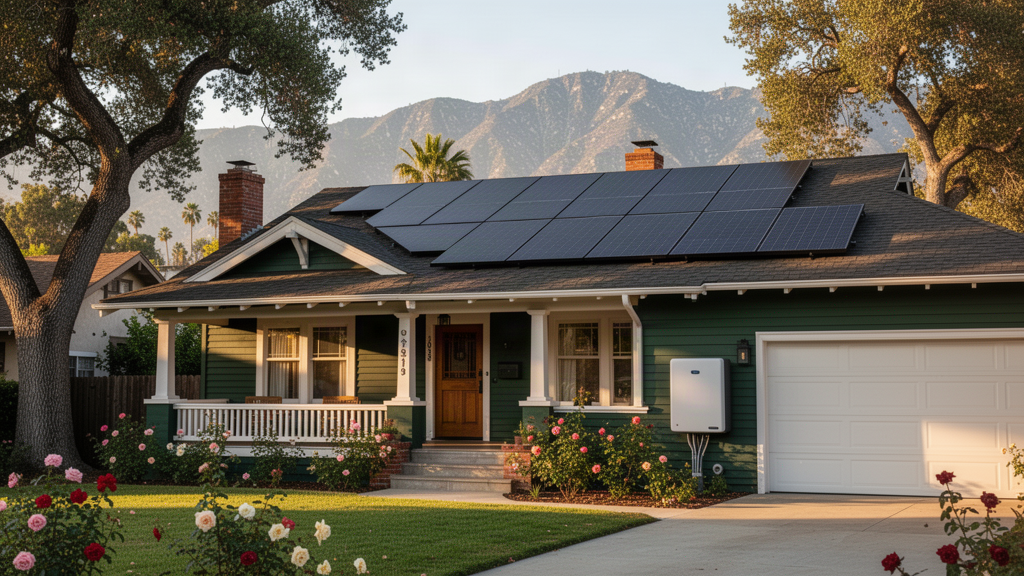
Pasadena Solar & Battery Rebates: What Homeowners Should Know
A City of Roses homeowner guide to Pasadena Water and Power rebates, system sizing, and the questions to ask before signing.
← Back to Pasadena series overviewA City of Roses guide—not a utility sales pitch
Pasadena's historic homes, tree-lined streets and Rose Parade heritage deserve thoughtful solar designs. Pasadena Water and Power (PWP) is a municipally owned utility with its own policies; do not substitute Southern California Edison or LADWP rates when estimating a Pasadena household's savings.
Eligibility follows the actual electric service account, not merely a Pasadena mailing address. Home Solar Simplified is an independent educational publisher and is not affiliated with or endorsed by PWP.
Understand the rebate math before buying
PWP's current published standard incentives are $0.60 per eligible rooftop solar watt and $350 per qualifying battery kilowatt-hour. For solar, PWP specifies CEC-AC system output for rebate capacity, which is not necessarily equal to the panel DC nameplate. PWP currently lists enhanced solar incentives of $1.00 per watt for eligible income-qualified assistance customers and an additional $200 per kWh for battery customers enrolled in eligible assistance programs. Check the separate conditions carefully: medical-assistance status is specifically listed for enhanced battery eligibility.
Illustration only: assuming an approved 6,000-watt CEC-AC solar incentive basis and 10 kWh of eligible storage, the standard rebates would be $3,600 for solar plus $3,500 for storage, totaling $7,100. Qualifying enhanced amounts could total $11,500. These are arithmetic examples, not promised awards. PWP's actual incentives and funding must be checked at purchase and application.
Critical application deadlines are different for solar and batteries
PWP's residential solar rebate page says completed solar applications must arrive within 180 days of interconnection. Its residential battery rebate page says completed battery applications must arrive within 180 days of final permit approval. These are distinct triggers: save both dates and verify which applies to your specific installation.
PWP says approved rebate checks generally arrive in six to eight weeks. Rebate eligibility is subject to the utility's written equipment, installation, ownership and application requirements.
Size the system around your actual needs
Ask for a forecast using the previous 12 months of PWP usage. Consider planned EV charging, heat pumps, and future household changes, but avoid paying for oversized capacity merely to accumulate credits. Compare the PWP-specific net energy metering assumptions in each quote.
Use PWP's WattPlan for an early roof and savings estimate. It is a modeling tool, not a diagnostic test of an existing solar installation.
Historic homes, mature trees, and an older roof
For older Pasadena homes, request a roof-condition review, shade assessment, electrical service inspection and a plan for protecting architectural features. Verify permit and historic-property rules for the specific address rather than assuming every older home has the same restrictions.
Take five questions to any solar contractor
Ask for the proposed CEC-AC output and annual kilowatt-hours of generation, the pre-incentive cash price, the PWP-specific rate assumptions, the precise battery specifications and backup circuits, and a signed list of every permit, meter and inspection charge. Compare all three bids on the same basis.
PWP's limited-time waiver currently concerns its own plan review and inspection charges. The bidirectional meter, structural and Building & Safety charges, and other project costs may still apply. Do not treat the waiver as a promise that permitting and interconnection are free.
What about renters or balcony solar?
PWP staff discussed possible future educational workshops about California plug-in or balcony solar policy. Those comments did not establish a current balcony-solar rebate. Renters and condo residents should verify current state rules, manufacturer safety listings, building permission and PWP's latest written guidance before buying or connecting a plug-in system.
A rooftop homeowner rebate should not be represented as a rebate for portable panels, balcony kits or tenants without an eligible electric account.
Residential energy credits are not the commercial CP3 program
PWP's residential net surplus compensation program credits eligible exported electricity on the utility bill under the household's applicable enrollment rules. PWP describes an option to request cash-out when the surplus compensation value exceeds $50 or the customer closes the account. This is not permission to assume a fixed cash payment for every excess kilowatt-hour or to oversize a home system purely for resale.
The separate Clean Power Pasadena Partnership (CP3) is an RFP-based commercial-scale project opportunity for qualified sites capable of hosting at least 200 kW of renewable generation. Successful bidders may sell electricity to PWP under a different agreement; CP3 sites are not eligible for other PWP solar incentives. Homeowners should not confuse CP3 commercial revenue with ordinary residential net metering.
Homeowner questions, answered
Tap a question to expand its answer.
Does every Pasadena address qualify?
No. Confirm PWP electric service, program eligibility, equipment, dates and funding directly with PWP.
Are rebate checks issued before installation?
Do not assume so. Ask PWP when and how a completed qualifying project is paid, and budget for any temporary out-of-pocket cost.
Does WattPlan test the panels already on my roof?
No. It is a prospective estimating tool; use existing system monitoring and a qualified technician for troubleshooting.
Can my separately metered ADU qualify?
An ADU with its own meter can have different utility usage and interconnection treatment. Confirm its individual account and applicable rebate rules with PWP.
What are the deadlines for applying?
PWP's solar page specifies 180 days from interconnection, while its battery page specifies 180 days from final permit approval. Keep both dates and check the exact program rules.
Are plan review, meter and permit fees all waived?
No. PWP says its own plan review and inspection fees are waived for a limited time, but meter charges and other city or project fees may still apply.
Is the same rebate available for a leased system or PPA?
PWP's homeowner solar and battery rebates require customer ownership. Review the current terms before signing any third-party agreement.
Can I sell power back to Pasadena like a commercial power plant?
Ordinary residential owners may qualify for PWP net surplus credits, including cash-out requests under the program rules. PWP's separate CP3 program is aimed at large properties with projects of at least 200 kW and has distinct bid and ownership requirements.
Official resources and independent verification
Start with PWP's written terms and ask the utility directly about eligibility and funding. Home Solar Simplified is not a PWP program or endorsement.
About the original City of Roses artwork
The previously approved four-panel illustration is preserved as an archival reference, rather than displayed as a combined article image. Its original PPA example understated the 25-year total: $200 per month in year one, escalating 3% annually, totals approximately $87,502, not $58,300. Refer to Article 2's corrected financing comparison.