
How Much Do Solar Panels Really Cost in 2026? A Homeowner’s Guide
The latest official DOE benchmark available is $3.20–$4.20/Wdc for U.S. residential PV in H1 2025. Use it as dated context, not a universal 2026 quote: compare itemized cash prices, system size, production, roof and electrical scope, financing and utility assumptions for your home.

Quick answer: use a dated benchmark, then compare written quotes
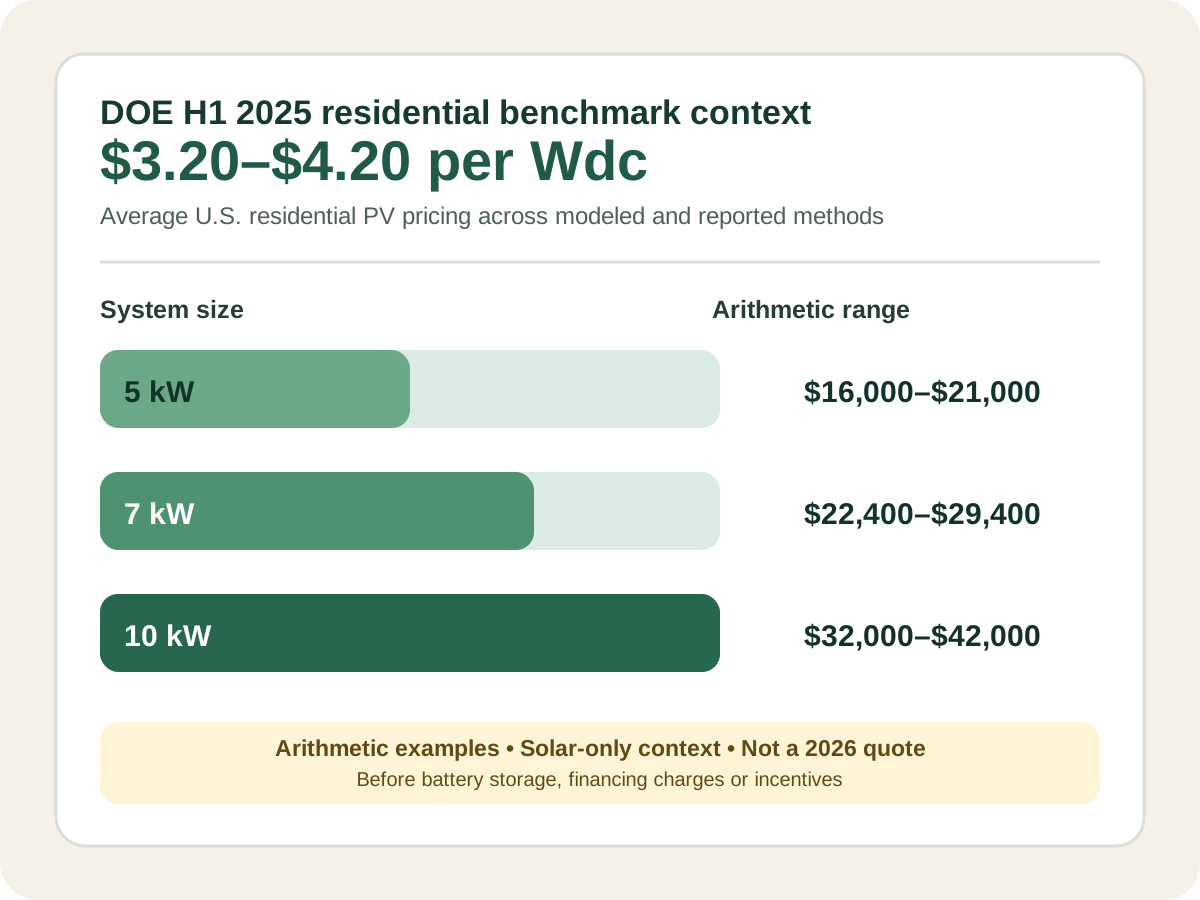
The latest official DOE benchmark available reports average U.S. residential PV system pricing of $3.20–$4.20 per watt DC across modeled and reported methods in H1 2025. That range is dated national context, not a quote for your roof and not a universal 2026 market price.
Use it to check scale, then compare at least three itemized proposals for the same equipment scope, roof work, estimated annual production and contract terms. A home-specific written quote is the relevant price.
Solar cost by system size: arithmetic examples from the DOE range
Multiplying the DOE range by system capacity gives rough solar-only arithmetic: 5 kW (5,000 W) × $3.20–$4.20/W equals $16,000–$21,000; 7 kW equals $22,400–$29,400; and 10 kW equals $32,000–$42,000. These are benchmark examples, not a quote, and they are before battery storage, financing charges or incentives.
Do not choose capacity from a national price table. Size a proposal from twelve months of electricity use, planned load changes, a roof-specific production model and the actual utility tariff.
Compare dollars per watt and expected production
For each proposal, divide the complete cash-installed price by the DC system watts. A $24,500 cash price for 7,000 W is $3.50/W. Use the same scope in every numerator: panels, inverter, racking, permitting, labor, monitoring and required electrical or roof work.
Price per watt measures installed capacity, not output or value. Also compare estimated annual production in kWh, the modeling assumptions, shading, degradation, workmanship coverage and equipment warranties. Use NREL PVWatts as an independent reasonableness check, not a production guarantee.
Why two same-size solar quotes can differ
Lawrence Berkeley National Laboratory reports wide variation in residential installed prices and finds that soft costs remain a major part of the total. Roof complexity, service-panel work, trenching, permitting, interconnection, equipment, installer overhead, new construction and project size can all change a quote.
Ask each installer to itemize roof work, electrical upgrades, main-panel or service changes, permits, interconnection, monitoring, workmanship warranty and any allowance that can change later. An unexplained low price can omit work; an unexplained high price does not prove better quality.
Separate solar and battery scope
If storage is included, request separate solar-only and battery prices. For the battery, compare usable kWh, continuous and surge kW, backed-up circuits, transfer equipment, installation, software or program obligations and warranty terms.
A battery can provide resilience or shift when energy is used, but it changes both cost and system design. Comparing a solar-plus-storage proposal with a solar-only proposal as if they were identical produces a misleading dollars-per-watt result.
Compare cash and financing without hiding the markup
Ask for the cash-installed price, amount financed, APR, term, dealer fees, prepayment assumptions and total of payments. The CFPB reported in 2024 that some solar lenders charged hidden dealer fees of 30% or more above the cash price. That finding does not establish the fee on your proposal; the written cash-versus-financed comparison does.
A lower monthly payment can result from a longer term while increasing total interest. Do not sign based only on a monthly-payment comparison or on an assumed future tax refund used to reduce the loan balance.
Do not subtract an unavailable homeowner tax credit
Current IRS guidance says the Residential Clean Energy Credit is not available for property placed in service after December 31, 2025. Do not reduce a new 2026 homeowner quote by a presumed 30% federal credit. Interest and loan-origination fees were not eligible costs under that credit either.
Third-party-owned or business systems can involve different federal tax rules. Ask the contract owner and a qualified tax professional which rule applies; do not accept a salesperson's tax promise as individualized advice.
Model the remaining utility bill and export rules
Solar usually does not erase the utility account. Model nighttime imports, seasonal use, fixed charges, taxes and non-bypassable charges, plus the utility's export compensation and time-of-use rules. Test at least a lower-production or lower-savings scenario.
In California, verify the serving utility before using a savings model. LADWP is a municipal utility; California's investor-owned utilities, including SCE, PG&E and SDG&E, use different tariffs and net-billing rules. A statewide savings percentage is not a substitute for the account's actual rate plan.
Use the disclosure and contract as a reconciliation test
California's CSLB disclosure is designed to show the total installation cost, financing information and the final contract price without subtracting possible rebates. The CPUC consumer guide says to ask for the total contract cost, upfront and over-time payments and any escalator before signing.
Make the proposal, financing agreement, CSLB disclosure and final contract agree on equipment, price, payments, production assumptions, warranties and change-order rules. Pause when numbers or promises conflict, and independently verify the contractor license and financing provider.
Bottom line: compare complete outcomes, not one headline number
A useful comparison puts every proposal on the same basis: cash-installed price, DC watts, estimated annual production, included work, battery scope, financing, utility assumptions, warranties and total contractual payments. Keep the dated DOE range as a reasonableness check, not a price guarantee.
The best-priced proposal is the one you can reconcile on paper and verify independently—not automatically the lowest dollars per watt or the smallest monthly payment.
Separate a preliminary estimate from a firm project price
An online estimate can help decide whether to investigate solar, but it is not a complete installation commitment. Ask which parts of the price have been verified by a site inspection and which depend on engineering, roof assessment or electrical review. Identify who pays if the preliminary assumptions prove wrong. Keep allowances and exclusions visible rather than adding them mentally to a supposedly final total.
Track revisions by scope. If the final quote is higher, ask whether the change came from equipment, capacity, labor, electrical work, roof conditions or financing. If it is lower, check whether equipment or services were removed. A discount on a smaller project should not be presented as a reduction in the price of the original design. Compare final proposals only after these changes are reconciled.
Use your likely ownership period as a second price lens
The full contract term is useful for total-cost comparison, but also consider the period you realistically expect to keep the property. Ask for outstanding loan principal or applicable contract exit costs at that point. For a cash purchase, consider the amount paid and service costs expected during that period without assuming a future buyer will reimburse the system's original price.
Suppose two hypothetical systems have different initial prices but also different included service coverage. Identify what each owner might need to pay during your comparison period and who would arrange that work. Do not assign an invented repair expense merely to make the offers appear equal; instead, record the uncovered item and obtain a service estimate if it materially changes your decision.
Finally, retain the assumptions behind your chosen price: exact equipment, installed capacity, named utility, modeled annual generation, roof scope and financing terms. That record lets you evaluate a later change without starting from a generic cost-per-watt headline again. The useful result is a defensible project budget with known open questions, not an artificial statewide price that every homeowner is expected to achieve.
Frequently asked questions
What official benchmark can I use for residential solar pricing?
DOE's latest official benchmark available reports $3.20–$4.20/Wdc for U.S. residential PV in H1 2025 across modeled and reported methods. It is dated national context—not a universal 2026 price or a quote for a specific home.
What do the DOE benchmark examples equal for 5 kW, 7 kW and 10 kW systems?
Straight multiplication gives $16,000–$21,000 for 5 kW, $22,400–$29,400 for 7 kW and $32,000–$42,000 for 10 kW. These are solar-only arithmetic examples before batteries, financing or incentives, not market quotes.
How do I compare solar quotes with different system sizes?
Divide each complete cash-installed price by its DC system watts, then compare estimated annual kWh, roof and electrical work, equipment, warranties and exclusions. Dollars per watt is useful only when the project scopes are comparable.
Does solar dollars per watt include a battery?
Not consistently. Ask for separate solar-only and battery prices. Storage adds energy capacity, power, transfer equipment and backup scope that should not be hidden inside a solar-only dollars-per-watt comparison.
Why can same-size solar quotes have different prices?
Roof complexity, electrical upgrades, trenching, permitting, interconnection, equipment, soft costs, warranties and installer overhead can differ. Require itemized scope before treating either price as comparable.
Is the cash price usually the same as the solar-loan price?
Not necessarily. Ask for both in writing, plus amount financed, APR, dealer fees, term and total of payments. A smaller monthly payment does not prove a lower total cost.
Can a homeowner claim the federal residential solar credit for a system placed in service in 2026?
Current IRS guidance says no: the Residential Clean Energy Credit is not available for property placed in service after December 31, 2025. Verify personal tax treatment with current IRS guidance and a qualified tax professional.
Can solar eliminate my utility bill?
Do not assume it will. Nighttime imports, seasonal use, fixed charges, taxes, non-bypassable charges and export-credit rules can leave a balance. Model the actual utility, rate plan and household usage.
Questions worth asking
- What official benchmark can I use for residential solar pricing?
- What do the DOE benchmark examples equal for 5 kW, 7 kW and 10 kW systems?
- How do I compare solar quotes with different system sizes?
- Does solar dollars per watt include a battery?
- Why can same-size solar quotes have different prices?
- Is the cash price usually the same as the solar-loan price?
- Can a homeowner claim the federal residential solar credit for a system placed in service in 2026?
- Can solar eliminate my utility bill?
Related guides
California solar cost in 2026: how to compare real quotesHow to compare solar quotesSolar financing options comparedZero-down solar and 25-year total costHow many solar panels do I need?Is my roof good for solar?Are solar panels worth it?How to verify a California solar companySix questions before signing a solar contractSolar planning in Los Angeles County
Electric utility rules, roof conditions and household electricity use vary by address. Explore regional guidance before relying on a statewide solar savings estimate.
Los Angeles County solar education San Fernando Valley: LADWP, panels and batteries Northridge solar planning Van Nuys solar quotes and utility questions Pacoima solar financing and contract checklist Sylmar roof and battery backup planningStill researching solar?
Search homeowner guides by topic, electric utility, or location.
Sources and further reading
Sources reviewed: October 25, 2026. Confirm changing details with the official sources.
These links identify documents and resources used for this guide. Listing a source does not mean it was independently checked today. Utility rates, incentives, product specifications and program availability may change; confirm the latest version and effective date with the source.
U.S. Department of Energy — Quarterly Solar Industry UpdateU.S. Department of Energy — Choosing a Solar InstallerLawrence Berkeley National Laboratory — Tracking the SunNREL — PVWatts CalculatorIRS — Residential Clean Energy CreditCalifornia Public Utilities Commission — Solar Consumer Protection GuideCalifornia Contractors State License Board — Solar RequirementsConsumer Financial Protection Bureau — Solar Financing Issue SpotlightFederal Trade Commission — Solar Power for Your HomeCalifornia Public Utilities Commission — Net Energy Metering and Net BillingStart with a home energy checkup
Organize your usage, home details and goals before comparing proposals.
Try the home energy checkupReady to compare companies?
Explore provider options when you are ready to request quotes.
Explore provider options