
$54,360 Solar Quote, $35,551 After a Propel Credit: Good Deal or Hidden Catch?
This anonymized SCE quote's arithmetic works, but the advertised reduction is not enough to prove value. Reconcile ownership, total payments, backup limits, utility savings and transfer terms before signing.
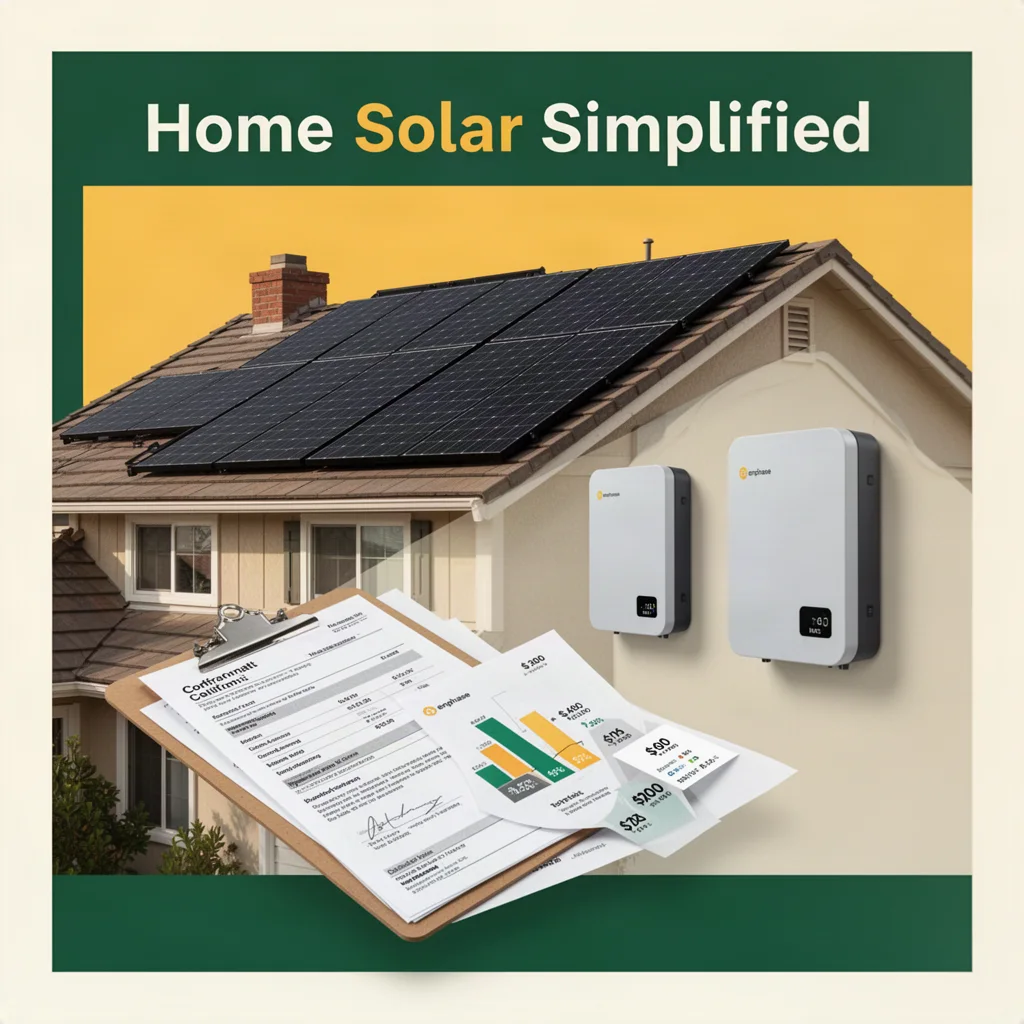
Quick answer: the arithmetic works, but the contract decides whether the offer works.
The quoted $30,360 solar line, $22,500 battery line and $1,500 backup line add to $54,360. Subtracting the stated $18,808.56 Propel reduction produces $35,551.44. That calculation is internally consistent, but it does not establish a fair price, immediate ownership, eligibility for a public incentive or the homeowner's complete cost.
Before calling this a good deal, reconcile the $54,360 gross figure and $35,551.44 advertised figure with a no-Propel cash price, the legal owner in every year, the amount financed, APR, total payments, transfer and buyout terms, equipment and labor coverage, modeled production, backup limits and the remaining SCE bill. The actual signed agreement controls.
This is an anonymized, illustrative quote review—not a provider ranking, recommendation or finding that every household can obtain the branded reduction. The proposal lists 24 REC 460-watt modules, 24 Enphase IQ8X microinverters, two IQ Battery 10C units, an IQ Combiner 6C and an IQ Meter Collar. The planned array is 24 × 460 W = 11,040 W DC, or 11.04 kW, and the two batteries are marketed as 20 kWh of usable storage in total.
A $2.75/W panel-and-inverter line can be compared with competing solar-only bids with the same equipment and scope. Do not divide the post-Propel figure by 11.04 kW and call it the cash price per watt: the total includes storage and backup hardware, and the reduction relates to the financing/ownership structure.
The biggest question: what exactly is the 34.6% Propel Credit?
The provider's public description says Propel is a prepaid third-party-ownership arrangement, not a public rebate paid to the homeowner and not the homeowner's own federal residential clean energy tax credit. SolSource says it owns the equipment during the agreement term; the homeowner prepays through cash or eligible financing, and an option to obtain ownership begins after year five, subject to the actual signed agreement. Treat these as provider claims until the contract states the same terms.
Do not assume the $35,551.44 is an outright cash purchase that makes you the owner on installation day. Ask whether that amount is the entire cash prepayment, the financed principal, or only one part of the obligation. Obtain the actual lease or energy services agreement, all loan disclosures if financing is used, any residual obligations, and the specific transfer-to-ownership provisions.
Ask in writing: Who is the legal owner on day one and in years one through five? What must happen at year five to obtain ownership, and is there any transfer price or fee? What if you sell your house in year three? Are transfer, early termination, service, insurance, roof-access, removal, performance, and default terms acceptable? Is there a recorded security interest or filing? Can the payment change? What total will you pay across all agreements, including interest and fees? Have a qualified adviser review the contract if the rights are unclear.
Federal Section 25D's residential clean energy credit is not available for homeowner-owned equipment first placed in service after December 31, 2025, per the IRS. That change does not automatically make every third-party financing discount valid or available to every household. Verify the transaction structure, exact eligibility and contractual promise rather than equating '34.6%' with a government rebate.
Will the Enphase IQ Meter Collar actually back up the whole house?
Potentially yes. Enphase explains that its IQ Meter Collar supplies microgrid interconnection and isolation, allowing compatible IQ Battery 10C plus IQ Combiner 6C systems to operate during an outage without relocating every circuit into a separate backup subpanel. Enphase reported by September 2026 that major California investor-owned utilities, including SCE, had approved the collar for behind-the-meter use. Site-specific meter configuration and utility requirements still matter.
But 'whole-home backup' means the home's circuits can be connected to the backup system; it does NOT mean all appliances can run simultaneously or indefinitely. Each 10C battery is rated at 10 kWh usable energy and 7.08 kW continuous power; two units are approximately 20 kWh usable energy and up to 14.16 kW combined continuous battery output before system constraints, equipment limits, surge requirements and operating conditions. Air conditioning, EV charging, ovens, pool pumps or other large loads may exceed available power or drain batteries quickly.
Ask for a written backed-up-load schedule, main-panel and meter-socket compatibility assessment, one-line diagram, transfer/islanding arrangement, maximum continuous and startup loads, solar recharging behavior during outages, and an actual backup commissioning test. Because the panel was recently replaced, verify that its meter-main design is compatible with the collar and that the proposed location, service rating, permits and utility authorization all match.
Five to six weeks: installation, inspection or permission to operate?
A five-to-six-week design-to-final-inspection estimate is possible for a straightforward project but not guaranteed. Get a written schedule that separates engineering, permits, utility/meter approvals, equipment availability, installation, city or county inspection, submission of the interconnection package, utility review and final Permission to Operate (PTO). A new roof and electrical panel can reduce some site work, but they do not eliminate the required approvals.
SCE says a complete simple standard solar-only interconnection package may receive PTO within approximately 10 business days. Solar paired with batteries and nonstandard metering can take longer because additional technical review, paperwork, meter work or corrections may be required. Ask whether the promised five or six weeks includes actual SCE PTO—not just the contractor's final inspection. The installer should identify who files the SCE application and provide the tracking information.
Do not energize or export from the system merely because the city signed off. Obtain formal PTO from SCE and confirm the backup mode is tested and commissioned.
Is 11.04 kW plus 20 kWh of batteries the right size?
The number of panels alone cannot establish the right system size. Review the past 12 months of SCE electricity consumption in kWh, hourly load profile, SCE tariff and planned changes such as an EV or heat pump. Compare the installer’s modeled annual solar generation, hourly self-consumption, battery cycling, expected exports and grid purchases. SCE’s Solar Billing Plan values exported electricity differently than legacy NEM 2.0, so the battery dispatch and savings model should match the actual account.
Ask for simulations with no batteries, one 10C and two 10C units, showing how each option changes annual bills and outage duration. The second battery may provide meaningful resilience but need not pay for itself on utility savings alone. Check roof orientation, shade, panel-level optimization, DC/AC equipment compatibility and the exact inverter model against the manufacturer's current approved design.
Since the homeowner already replaced the roof and panel, ask the installer to confirm there is no duplicate upgrade charge and to document roof penetrations, mounting method, flashing, inspection requirements and the interaction with the roof manufacturer's warranty.
Better than a '3 kWh of battery per 1 kW of solar' rule: size storage using your actual SCE data
A Reddit commenter may recommend three kWh of storage for every one kW of solar—for an 11.04 kW array, that suggests about 33 kWh. That is a personal rule of thumb, NOT an SCE, Enphase or engineering requirement. Array kW measures the maximum rated solar power; battery kWh measures stored energy. What matters for the battery is when the home uses electricity, the amount of surplus midday production, the cost of importing electricity later, and the home's actual outage needs.
Step 1: Download a full year of hourly or 15-minute SCE usage data and the household's current tariff. Record summer and winter evenings separately, especially the high-cost 4–9 p.m. period. Include upcoming EVs, heating/cooling upgrades and additional residents as separate future scenarios. Step 2: Request an hourly solar-production model with actual roof orientation and shading, including battery charge/discharge limits and round-trip losses. Step 3: Simulate no storage, one 10C (10 kWh), two 10C units (20 kWh), and—if the installer confirms a supported configuration—three units (30 kWh). Compare annual grid purchases, avoided peak imports, export credits, battery utilization, price and incremental bill savings.
Illustration, NOT an estimate for this house: if the household needs 12 kWh from 4 p.m. until bedtime, a 10 kWh battery might not cover the full period after efficiency losses and operating reserves, while 20 kWh could. If the same household uses 25 kWh overnight, even 20 kWh may leave substantial grid purchases. A battery rated at 20 kWh does not always deliver 20 kWh to appliances after reserve settings and efficiency losses.
The decisive question is the marginal value of the NEXT battery, not whether 30 kWh sounds safer than 20. Ask for a comparison of the second battery's installed cost versus its incremental annual savings and usable outage capacity, then repeat for the third. Ask whether occasional high-value exports or demand-response programs change that economics. Keep a backup reserve scenario separate from a bill-saving scenario: saving more energy for emergencies leaves less available for everyday rate shifting.
Los Angeles County rebates, export bonuses and property-tax rules: what can really reduce the cost?
First determine which company supplies generation on the electric bill. The home may receive electricity delivery from SCE but have energy supplied by Clean Power Alliance (CPA). The specific account, program, installation date and equipment ownership decide eligibility; do not assume every SCE customer can obtain every Los Angeles County incentive.
Clean Power Alliance Sun Storage Rebate: CPA's published current program offers a $2,000 base incentive for eligible CPA residential customers installing qualifying new battery storage paired with solar; an additional $1,250 Reliability+ benefit can apply to qualifying fire-risk areas, plus a possible $250 for Medical Baseline or qualifying CARE/FERA income assistance. The maximum combined rebate is $3,500; medical and income-based $250 additions cannot both be claimed. A customer's application must meet the current contractor, battery, reservation, interconnection and claim rules. A customer who already has an operating battery is generally excluded. Verify the current funding before relying on a quote.
IMPORTANT for the quoted Propel arrangement: CPA's public summary does not establish that this homeowner or a third-party-owned prepaid system automatically qualifies. Ask CPA and the Propel contract administrator in writing whether ownership, applicant identity and rebate assignment are acceptable—and who receives the payment. The same caution applies when combining CPA and SGIP incentives: obtain written confirmation on stacking and avoid subtracting the same benefit twice.
SCE Self-Generation Incentive Program (SGIP): some battery or solar-plus-storage applicants can qualify for incentives subject to equity, income, medical, fire-risk or other program rules and budget availability. Do not assume that any advertised per-kWh award is currently open. Use the SCE SGIP page to check current budget category, waitlist, installer eligibility and application timing BEFORE signing or installing. Ask who holds the reservation and who receives the incentive if a third party owns the batteries.
SCE Solar Billing Plan export incentives: eligible residential new Solar Billing Plan customers who enroll before 2028 may receive an Energy Export Bonus Credit in addition to hourly Energy Export Credits. SCE currently describes a bonus around $0.04/kWh for standard residential customers and around $0.09/kWh for specified income-qualified customers; the amount and vintage are tied to enrollment/PTO terms. This is a BILL CREDIT on eligible exported energy over the applicable period, not a $0.04/kWh rebate on ALL solar generation and not an up-front equipment discount. New construction is excluded from the bonus.
California's active solar energy system property-tax exclusion can prevent a qualifying installation from increasing the assessed value of existing property for property-tax purposes. That is NOT a cash rebate or an exemption from existing property taxes; the California Board of Equalization currently says the exclusion is scheduled to sunset January 1, 2027. Confirm timing, eligibility and any special ownership details with the county assessor.
Federal homeowner credit warning: the IRS says Section 25D is unavailable for new qualifying homeowner installations placed in service after December 31, 2025. A vendor-promoted 'Propel Credit' cannot be described as this personal homeowner credit. Other business-side incentives and contracts require separate verification.
Other possible savings: an SCE CARE or FERA discount, Medical Baseline allowance, or a suitable time-of-use tariff can change the household's ongoing electric bills, but those are NOT discounts on the installation itself. Check SCE eligibility directly. Compare any installer or manufacturer 'promotion' against an ordinary cash quote, exact contract terms and written expiration dates; a promotional label does not prove savings.
A one-page quote-check worksheet to send each installer
Ask every bidder to complete the same columns: (1) 12 months' actual SCE electricity usage in kWh and any separate planned future load; (2) system size in kW DC, equipment model numbers and annual/seasonal modeled production in kWh; (3) rooftop orientation, shading assumptions and loss factors; (4) monthly and 4–9 p.m. import/export projections under the actual SCE generation supplier and tariff; (5) separate cash prices for solar-only, 10 kWh, 20 kWh and 30 kWh storage; (6) backed-up circuits, peak load limits, reserve settings and expected hours during an outage.
The same worksheet should show (7) the pre-credit gross price and EVERY named incentive with administrator, eligibility, recipient, reservation status and approval deadline; (8) who legally owns equipment each year; (9) total cash outlay or financed payments including fees and interest over the full term; (10) buyout, resale/transfer and default provisions; (11) which approvals and inspections are included in the estimated start date and when SCE PTO is expected; (12) separate warranties for product, workmanship, roof penetration, batteries and labor.
For a true comparison, require both a no-PROPel cash purchase and the full Propel third-party ownership option, with the assumptions kept identical. An installer cannot fairly call one the cheaper system merely because the second lists a larger front-page percentage discount.
What to verify about equipment and warranties
Confirm the proposal's exact REC460AA Pure-RX model, IQ8X microinverter SKU, IQBATTERY-10C-1P-NA-DOM battery SKU, IQ Combiner 6C and IQ Meter Collar model. Make sure every piece is available and approved for the final site design; the quote's shorthand is not a substitute for a stamped single-line diagram.
A contractor's 25-year workmanship or roof-penetration promise is separate from manufacturer product and performance warranties. Ask what labor, shipping, diagnostics, roof leaks, battery capacity retention, system monitoring, and installer-business failure are covered, who handles service claims and what happens if ownership transfers under Propel. Enphase has described a 15-year limited warranty for its fourth-generation system, but the actual written warranty and applicable conditions control.
Do's and don'ts before signing this type of solar quote
DO get the Propel agreement, any TriBeam financing terms, and a side-by-side true-cash ownership quote. DON'T treat the $18,808.56 reduction as a cash rebate or a homeowner tax refund.
DO get an SCE-compliant backup electrical diagram and a list of realistic outage loads. DON'T assume 'whole house' means unlimited air-conditioning, EV charging or runtime.
DO ask for a schedule through SCE Permission to Operate, with milestones and contingencies. DON'T assume a contractor's final inspection authorizes operation.
DO compare the solar-only line, battery alternatives, net-cost terms and lifetime financing cost across bids. DON'T compare monthly payments without APR, fees, payoff rules or ownership rights.
DO obtain warranty documents, roof attachment details and service responsibility in writing. DON'T rely on verbal promises about transfer or protection if the installer closes.
Three costly mistakes hidden in an attractive quote
Mistake 1 — Comparing the discounted third-party deal to a cash-owned purchase as if they were identical. Ownership timing and resale terms can make the economics very different.
Mistake 2 — Paying for whole-home backup without confirming load limits, electrical compatibility and commissioning. Battery storage capacity and instantaneous power are not interchangeable.
Mistake 3 — Accepting a five-to-six-week timeline without separating final inspection from SCE PTO. Solar-plus-storage interconnection can require extra technical review.
Bottom line: what would make this a strong offer?
The equipment list is credible on its face and the arithmetic adds up, but no one can responsibly call the quoted $35,551.44 a bargain without the full Propel contract, complete financing cost, actual legal ownership path, expected SCE bill savings, backup design and installer scope.
If the customer is comfortable with a documented third-party ownership structure and gets a satisfactory written exit/ownership path, the economics may be compelling. If they want ownership immediately, request an apples-to-apples cash purchase and ordinary loan alternative. Compare the complete cost and rights, not the percentage printed next to the word 'credit'.
Frequently asked questions
Is a 34.6% Propel Credit a homeowner tax credit?
No. Propel is described by SolSource as a prepaid third-party-ownership financing product that incorporates qualifying federal tax-credit value into its pricing. It is not the homeowner's own Section 25D credit or a guaranteed cash rebate. Confirm the signed terms.
Can two Enphase IQ Battery 10C units run the house in a blackout?
They may support whole-home backup when combined with the compatible combiner, isolation hardware, approvals and installation. Approximately 20 kWh of usable storage does not mean all large loads can run at once or for an unlimited time.
Is five to six weeks enough to receive SCE permission to operate?
It can be, but it is not assured. SCE says complete standard solar-only requests may be processed within about ten business days, while solar-plus-storage or nonstandard metering may require additional review. Clarify whether the quote's timeframe includes SCE PTO.
Is $2.75 per watt a fair price for this quote?
$2.75/W describes only the $30,360, 11.04 kW solar portion of this example. Compare equivalent cash solar-only equipment and installation scopes, then evaluate batteries and third-party financing separately.
Do I need 33 kWh of batteries for an 11 kW solar system under NEM 3.0?
No fixed ratio determines storage needs. Model the home's actual hourly usage, projected solar production, export credits, battery reserve, nighttime consumption and backup loads. Compare 10, 20 and 30 kWh options on a consistent basis.
Are there Los Angeles County solar battery rebates?
Potentially. Eligible Clean Power Alliance customers may qualify for up to $3,500 through Sun Storage, and some SCE customers may qualify for an SGIP battery incentive depending on program budget and criteria. Eligibility for third-party-owned Propel equipment must be confirmed in writing; do not presume benefits can be stacked.
Questions worth asking
- Is the 34.6% Propel reduction conditional on a third-party-owned prepaid agreement?
- Who owns the panels and batteries during the first five years, and exactly how can ownership transfer?
- What is the all-in cost across the prepayment, loan interest, fees and any other agreement?
- Does the five-to-six-week estimate include SCE Permission to Operate?
- Which specific circuits and heavy loads will two IQ Battery 10C units back up?
- Do we have a site-specific single-line electrical diagram, roof-attachment warranty and battery operating model?
- What happens to the Propel contract and equipment when the home is sold?
- Is the home supplied by CPA or SCE generation, and are any rebates transferable to third-party-owned equipment?
- What do the 10, 20, and 30 kWh battery simulations show for SCE evening usage and outage reserve?
Related guides
Solar lease vs. PPA vs. loan: 25-year costSolar financing red flags homeowners should avoidHow many home batteries do I need?Compare solar quotes line by lineReview a solar proposal over $50,000Check battery sizing and backup before signingStill researching solar?
Search homeowner guides by topic, electric utility, or location.
Sources and further reading
Sources reviewed: October 23, 2026. Confirm changing details with the official sources.
These links identify documents and resources used for this guide. Listing a source does not mean it was independently checked today. Utility rates, incentives, product specifications and program availability may change; confirm the latest version and effective date with the source.
SolSource — How Propel prepaid third-party ownership worksEnphase — IQ Meter Collar approval by 80 utilities (September 2026)Enphase — IQ Battery 10C, Meter Collar and Combiner 6C specificationsSCE — Solar Billing Plan permission-to-operate FAQsSCE — Solar Billing Plan fact sheetIRS — Residential Clean Energy Credit (2025 cutoff)CPUC — 2026 California Solar Consumer Protection GuideCPUC — Solar Consumer Protection GuideCFPB — Solar financing issue spotlightClean Power Alliance — Sun Storage Rebate (up to $3,500)Clean Power Alliance — Sun Storage eligibility and stacking FAQsSCE — Self-Generation Incentive Program eligibility and fundingSCE — Solar Billing Plan and Energy Export Bonus CreditCalifornia Board of Equalization — Solar Property Tax ExclusionStart with a home energy checkup
Organize your usage, home details and goals before comparing proposals.
Try the home energy checkupReady to compare companies?
Explore provider options when you are ready to request quotes.
Explore provider options