
Solar + Battery: What You Really Need Before You Sign
Before accepting a solar quote, compare the real costs, right system size, battery storage, outage backup, incentives, approvals and long-term ownership. Includes a worked homeowner example.
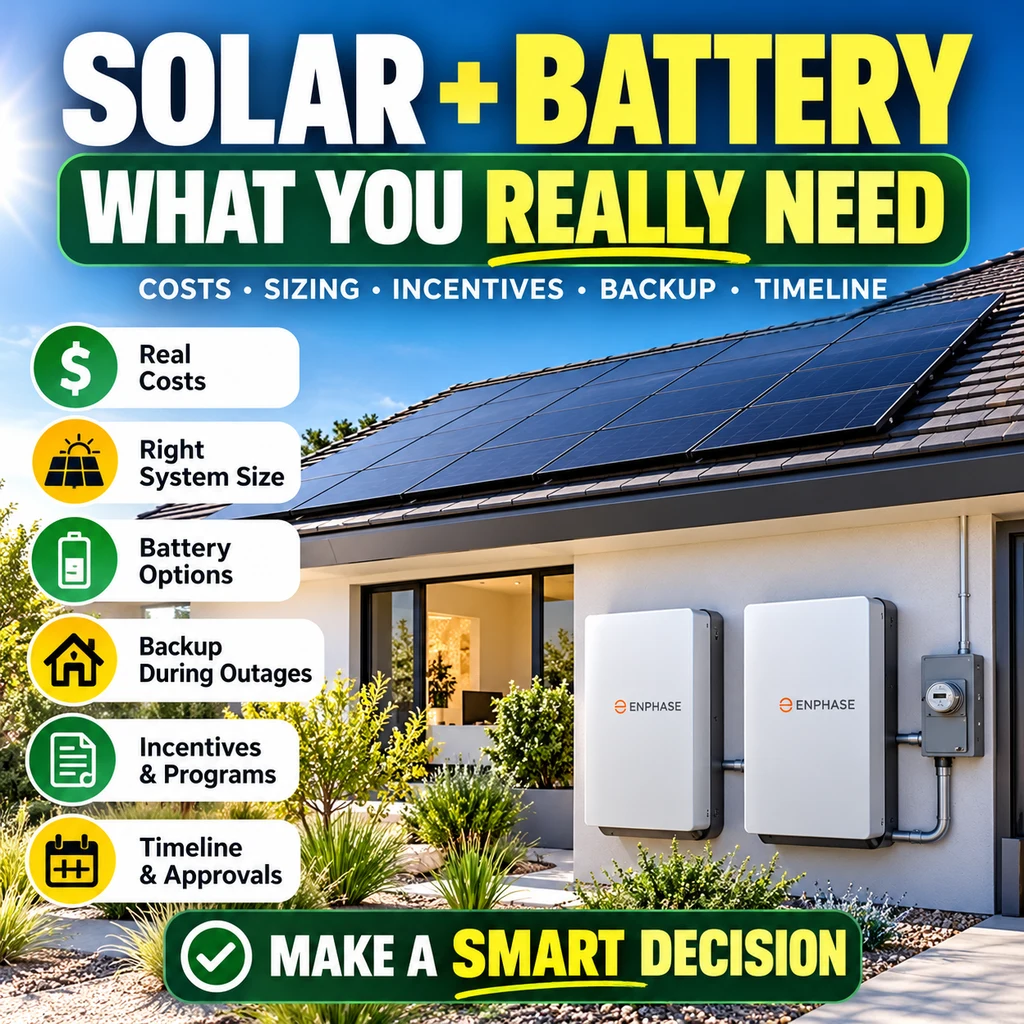
Quick answer: verify the energy math, contract and backup plan before signing
Use 12 months of electric bills or interval data to check the proposed solar production and battery size. Then compare the cash price, total payments, legal ownership, outage loads and runtime, utility tariff, incentives and Permission to Operate in writing. A quote is not ready to sign until you can explain who owns the equipment, what the system is expected to do and what you will pay under the complete agreement.
A quote can look attractive because it lists powerful panels, a home battery, a big discount and a low projected utility bill. Yet the number of panels, battery brand and advertised payment do not show whether the system fits your home or the agreement fits your finances.
Use this guide as a universal checklist. A Southern California quote appears later as an illustrative case study—not a recommended price, not an offer, and not proof that the same equipment or incentive is right for you.
Start here: lower avoidable electricity use before sizing solar
A high electricity bill deserves an explanation before it becomes a reason to buy equipment. Review twelve months of bills and separate electricity consumption in kWh from rates, billing-period length, fixed charges and adjustments. Ask whether a recent increase came from using more electricity, paying more for it, or both.
Then look for avoidable consumption: air-conditioning schedules, pool-pump run times, old appliances and other equipment running longer than needed. A home energy assessment can help prioritize improvements. Check utility efficiency rebates and income-qualified assistance before committing to a project.
Size the proposed solar system around the home you expect to have after planned improvements, while accounting separately for new EV charging or electric appliances. Lower consumption may reduce the amount of solar you need; it does not guarantee a smaller project will meet every future need.
Solar and batteries 101: what each part actually does
Solar panels generate direct-current electricity from sunlight. An inverter converts it into alternating-current electricity used by household appliances. During sunny hours, that energy can supply the home, charge a compatible battery or flow to the grid, depending on the design and operating settings.
A battery stores electricity for later use. It can serve different goals: supplying evening consumption, reducing purchases during expensive hours, or reserving energy for an outage. Ask which goal the proposal prioritizes and what tradeoffs its settings create.
Most ordinary grid-connected solar systems shut down when the grid fails for safety. Panels alone do not establish outage protection. Ask whether the proposed equipment can safely disconnect from the grid, supply the chosen circuits and recharge from solar while an outage continues.
Solar also does not automatically eliminate your utility bill. You may still buy electricity at night or during low-production periods and pay charges that solar does not offset. Request an estimate of the remaining utility bill alongside the solar or financing payment.
1. Know the difference between panel count, watts and real production
Solar panels are rated in watts (W); a complete array is commonly described in kilowatts (kW DC). Twenty-four 460 W panels have a nameplate capacity of 11,040 W, or 11.04 kW DC. That is not the same as producing 11.04 kWh every hour, and it does not mean the house can supply every appliance from solar at once.
Annual production is expressed in kilowatt-hours (kWh) and depends on shade, roof direction and angle, weather, temperature and equipment losses. Ask every installer to provide an annual and monthly production estimate with the assumptions shown.
2. Size solar around twelve months of electric bills
Collect a year's bills or interval data and note annual kWh, monthly changes and the utility tariff. Then create a separate scenario for planned EV charging, heat pumps, electric cooking, an accessory dwelling unit or other future loads.
Ask the installer to distinguish energy used directly in the home from electricity exported and purchased later. A system that produces more than your annual usage is not automatically the best economic choice: what an export earns varies by utility plan and time of day.
3. How much battery storage do you really need?
Battery energy is measured in kWh; battery power is measured in kW. A frequently repeated rule of thumb says to buy around three kWh of battery storage for every kW of solar. That is not a universal utility rule or engineering standard. One home with an 11 kW array may use little electricity after sunset; another may run central air conditioning and charge EVs all night.
Request an interval-based simulation for zero batteries, 10 kWh, 20 kWh and—where supported by the selected equipment—30 kWh. Compare each scenario's energy shifted away from expensive grid purchases, avoided export value, usable backup duration, backup reserve and installed price. The right question is whether the next additional battery gives enough financial or resilience benefit to justify its incremental cost.
An illustrative household needing 8 kWh during its expensive evening period might find a 10 kWh class battery useful. Another needing 18 kWh may need more. These are not system designs: usable energy delivered is affected by efficiency losses, state-of-charge reserve, actual loads and battery limitations.
4. Whole-home backup does not mean every appliance can run forever
A correctly designed battery system can isolate the home from the grid and keep approved loads operating during an outage. Some configurations can back up the existing main panel without a separate essential-loads panel. But 'whole-home' refers to connection and supported circuits—not unlimited instantaneous power or unlimited stored energy.
Ask for the documented continuous and surge power limits, expected backup runtime at realistic household loads, and the behavior of air conditioning, EV charging, electric dryers, ovens and pool pumps. Confirm whether rooftop solar can recharge the batteries during a prolonged outage and what happens if batteries reach their reserve level.
The design should identify any isolation equipment, smart-load controls, meter compatibility requirements, utility approval, permits and actual commissioning test.
5. Compare the cash price, financed price and total payments
Always request an outright owned cash-purchase quote—even if you intend to finance—to establish a useful baseline. For a loan, ask for APR, principal, dealer or origination fees, loan term, schedule of payments, prepayment provisions and the total paid if you keep the financing for the full term.
For a solar lease or power-purchase agreement, ask about the starting payment or energy price, annual escalator, production guarantees, maintenance obligations, roof access, homeowner insurance, transfers and end-of-term options. A low monthly payment can become expensive over a long term; a lower upfront price may also change who owns the equipment.
6. A large 'credit' or 'discount' might depend on someone else owning the panels
Ask who legally owns the equipment on installation day and whether the contract involves third-party ownership. Some offers are structured as prepaid leases or similar agreements that incorporate financing or provider-side tax economics into a reduced advertised upfront price. Such a reduction is not automatically a homeowner cash rebate or personal tax refund.
If the offer provides a pathway to later ownership, read the transfer terms: the waiting period, any price or fee, missed-payment terms, sale/refinance obligations, roof-removal responsibilities and what happens if the installer or financing provider changes. Request the signed ownership and financing documents rather than relying on a salesperson's description.
For U.S. homeowners, the former federal Section 25D residential clean energy credit does not apply to qualifying equipment first placed in service after December 31, 2025. Do not count it as a 2026 homeowner discount.
7. Check actual incentives before subtracting them from your quote
Incentives can include a utility battery rebate, a state-administered storage program, a local energy-efficiency offer, a special export-billing credit or a financing promotion. These are different mechanisms. For each, request the official program administrator, amount, eligibility requirements, available budget, application deadline, approval status and the person or company that receives the value.
Verify whether an incentive applies to third-party-owned equipment and whether it can be stacked with other programs. Do not assume a customer served by one utility automatically qualifies for incentives offered by a separate community-choice generation provider. A tax assessment exclusion is not money paid toward installation.
Los Angeles County example, reviewed October 22, 2026: some qualifying Clean Power Alliance generation customers may be eligible for a Sun Storage battery rebate of up to $3,500, subject to program terms and available funding. SCE currently says its ratepayer-funded SGIP budgets are closed to new applicants, while other eligibility categories and program information may differ; verify current status before treating any amount as available. SCE's Solar Billing Plan also describes a time-limited Energy Export Bonus for eligible early adopters. Outside this area, ask your own utility and state energy office about current programs.
8. Understand your utility's rules for using, exporting and storing electricity
Compare the cost of importing power after sunset with the actual credit available for exporting solar energy earlier. Under some net-billing programs, midday exports earn less than electricity purchased during higher-priced evening hours. Under other tariffs, the economics differ. There is no universal claim that every exported solar kWh is worth pennies—or that every battery pays for itself.
An honest savings estimate shows hourly or seasonal production, on-site use, exports, grid imports, unavoidable fixed charges and battery conversion losses, using the tariff that will actually apply after interconnection.
9. Installation, final inspection and permission to operate are separate milestones
A contractor's five-to-six-week estimate may cover engineering, permits and a local final inspection without guaranteeing that the utility has granted Permission to Operate (PTO). The process and durations differ by jurisdiction, utility, equipment and project complexity. Battery backup hardware and a meter collar can introduce additional interconnection review.
Request a written schedule covering design, permit approval, roof and electrical preparation, equipment delivery, construction, city/county inspection, utility interconnection submission, meter work where applicable, PTO and commissioning. Ask who is responsible for each step and who will contact the utility when an application needs corrections. Do not assume a passed inspection authorizes exports to the grid.
10. Check roof and electrical readiness—and what the price excludes
Review the roof's remaining service life, condition, shade, mounting location, flashing details, structural checks, electrical panel and meter-main compatibility. If you recently replaced a roof or service panel, confirm the quote does not charge for unnecessary duplicate work.
Ask whether permit fees, structural engineering, trenching, wiring changes, roof repairs, backup interconnection devices, monitoring subscriptions, utility meter upgrades, sales tax and commissioning are included or potentially charged later.
11. Separate contractor workmanship protection from equipment warranties
A 25-year installation workmanship claim is not necessarily identical to the module product warranty, inverter warranty, battery capacity warranty or roof leak coverage. Obtain each written document and ask who pays for labor, travel, replacement parts, monitoring and repairs when the equipment manufacturer and installer are different.
Confirm battery warranty years and energy-throughput or capacity-retention limits, installer insurance and licensing, required maintenance and what happens if the installer goes out of business.
12. Compare at least three quotes using identical assumptions
Ask each company to use the same annual kWh consumption, future loads, roof constraints, utility rate, projected export values and battery reserve assumptions. Request a clear solar-only base price, each battery option's added price, backup equipment and installation scope, cash-owned total, financed total, and any third-party-owned offer as separate alternatives.
Review credible recent references and the contractor's state licensing or registration requirements. Ask who will actually install and service the equipment, not just who sold the contract. Negotiate clearly documented scope or pricing differences rather than chasing an unexplained percentage discount.
How to check the installer behind the proposal
In California, use the Contractors State License Board's official lookup to verify the contracting business and its active license for the proposed work. Match the license number and legal business name to the agreement. Check the salesperson's Home Improvement Salesperson registration where required; a company logo or utility name on a brochure is not verification.
Ask who will perform the roof, electrical and battery work, whether subcontractors will be used, and who is responsible for service afterward. Request current insurance information and recent references for comparable installations in your utility territory. Ask those homeowners about change orders, leaks, delays, monitoring access and response to service requests.
Compare at least three written proposals. Each should identify the exact equipment, installation scope, price, responsibilities for permits and utility approvals, and warranty contacts. Put promised production, backup capability and included work into the agreement. A directory listing or attractive review score cannot replace these checks.
A battery rebate can come with operating commitments
Before counting a rebate as savings, read the participation agreement as carefully as the equipment quote. Some programs require enrollment in demand response or a virtual power plant, allowing coordinated battery operation under the program's terms.
Ask who can control charging and discharging, what backup reserve remains available, which data are shared, how long enrollment lasts and whether leaving early can require repayment. Confirm whether participation payments are guaranteed, variable or absent, and how a home sale or equipment failure is handled. These conditions vary by program; no single utility's rules apply to every homeowner.
A rebate can improve affordability, but a rebate application is not an approval or a funding reservation. Request written confirmation of eligibility, application responsibility and any approval required before purchase or installation.
Before the installer leaves: get a usable system and a complete handover
Request the approved plans, final inspection records, utility operating authorization, equipment model and serial numbers, warranty documents and an itemized final invoice. Keep them with the contract and any rebate or financing records.
Have the installer demonstrate monitoring and explain the difference between solar production, home consumption, grid imports and exports. If battery backup is included, request a safe commissioning demonstration by the installer, a list of supported circuits and instructions for changing reserve settings. Do not test grid isolation by opening electrical equipment yourself.
Agree on who will answer service calls and how you will report a problem. Ask what normal seasonal production looks like and when to contact the installer if performance differs. The project is easier to manage when you understand both the equipment and the paperwork.
Worked example: a Los Angeles homeowner's 11.04 kW solar-plus-storage quote
One publicly discussed quote listed 24 REC 460-watt solar panels and 24 Enphase IQ8X microinverters ($30,360); two Enphase 10C batteries totaling about 20 kWh of storage ($22,500); and an IQ Meter Collar/backup item ($1,500). Gross proposed project cost: $54,360. A stated 34.6% 'Propel Credit' of $18,808.56 reduced the advertised project amount to $35,551.44.
Those figures add up. But before calling the proposal a bargain, the homeowner should compare true cash ownership against the complete Propel agreement, including who owns the equipment during the agreement and how ownership could transfer. The homeowner should also request SCE hourly modeling to justify 20 kWh versus 10 or 30 kWh, and confirmation that the planned backup arrangement is compatible with the meter, main panel and utility rules.
For Los Angeles County incentives, confirm who supplies the home's electric generation—not merely the name on the delivery bill—and whether any program permits equipment held under a third-party arrangement. Ask the contractor whether its timeline includes the utility's formal PTO, not only the city inspection. This case is an example of the questions every homeowner can ask; its quoted amounts should not be treated as national benchmark prices.
Your solar quote checklist: twelve questions to send the installer
1. What are my past 12 months of kWh consumption, and what efficiency improvements and future loads does your design assume?
2. What annual and monthly kWh production is modeled for the exact equipment and my roof, including shade and equipment losses?
3. What utility tariff, import prices, export credits and remaining utility charges did you use to calculate savings?
4. Why is this array size recommended, and what would a smaller system change?
5. What do solar-only and different battery-capacity options cost, and how much additional value does each provide?
6. Which appliances can operate during an outage, for how long, and can solar recharge the battery while the grid is down?
7. What is the itemized cash-owned price, including permits, electrical work, backup hardware and all exclusions?
8. What are the loan principal, APR, fees, payment schedule and total payments over the full term?
9. Who legally owns the equipment, and what happens if I sell, refinance, need roof repairs or want to end the agreement?
10. Which incentives are confirmed, who receives them, and what enrollment, control, data-sharing or repayment obligations apply?
11. Who is the licensed installer, who handles permits and utility Permission to Operate, and which milestones are included in the schedule?
12. Who services the system, what do equipment and workmanship warranties cover, and which documents and monitoring access will I receive?
Make the decision when the answers are clear
The strongest solar proposal is not necessarily the cheapest-looking one. It is the proposal that uses your own electricity data, clearly identifies the legal owner, explains the full cost, justifies the battery size, documents backup limits, verifies eligibility for actual incentives, and includes a realistic utility approval timeline.
Don't choose solar because someone tells you to hurry. Understand your options, compare them on the same basis, and make the decision on your time and your terms.
Frequently asked questions
Is a bigger solar system always better?
No. System value depends on household usage, roof production, utility billing, future loads, installed price and whether extra exports have substantial value.
Do you need three times as many battery kWh as solar kW?
No universal ratio applies. Size batteries from hourly load, production, economics and backup goals. Compare multiple storage configurations.
Does whole-home battery backup mean I can use everything in a blackout?
No. Even an electrically whole-home backup configuration is limited by battery power output, stored energy, loads and other equipment constraints.
Is a solar financing 'credit' the same as a rebate?
No. Some credits reflect third-party ownership or promotional pricing rather than a government rebate. Read the legal ownership and full financial terms.
Do solar panels start operating when city inspection passes?
Not necessarily. The utility may still need to grant Permission to Operate and the system must be commissioned.
Questions worth asking
- What is the true cash price and total financed cost?
- Who owns the panels and battery on installation day?
- How much energy will my home use when the panels are not producing?
- How were the battery size and backup loads calculated?
- Which incentives are actually approved for my property and equipment ownership?
- Who secures permits and utility Permission to Operate?
Related guides
Real-world solar and battery quote reviewSolar financing red flagsHow many home batteries do I need?Size a battery from loads and runtimeSolar-plus-battery cost guideSix questions before signingSolar warranties explainedSolar planning in Los Angeles County
Electric utility rules, roof conditions and household electricity use vary by address. Explore regional guidance before relying on a statewide solar savings estimate.
Los Angeles County solar education San Fernando Valley: LADWP, panels and batteries Northridge solar planning Van Nuys solar quotes and utility questions Sylmar roof and battery backup planningStill researching solar?
Search homeowner guides by topic, electric utility, or location.
Sources and further reading
Sources reviewed: 2026-10-22. Confirm changing details with the official sources.
These links identify documents and resources used for this guide. Listing a source does not mean it was independently checked today. Utility rates, incentives, product specifications and program availability may change; confirm the latest version and effective date with the source.
California Contractors State License Board — Solar Smart: licensing, bids and written scopeU.S. Department of Energy — Permitting and inspection for rooftop solarCalifornia Public Utilities Commission — Power shutoff FAQs and solar backupPWP — Battery rebate participation terms (local program example)U.S. Department of Energy — Homeowner's Guide to Going SolarU.S. Department of Energy — Financing: loans, leases and PPAsConsumer Financial Protection Bureau — Solar financing issue spotlightIRS — Residential Clean Energy CreditCalifornia Public Utilities Commission — 2026 Solar Consumer Protection GuideClean Power Alliance — Sun Storage battery rebateSCE — Self-Generation Incentive Program statusSCE — Solar Billing PlanCalifornia Board of Equalization — Active solar energy property tax exclusionStart with a home energy checkup
Organize your usage, home details and goals before comparing proposals.
Try the home energy checkupReady to compare companies?
Explore provider options when you are ready to request quotes.
Explore provider options