Do I Need an Electrical Panel Upgrade for Solar?
As of October 26, 2026, not every solar project needs a main-panel or service upgrade. Audit the existing equipment, load calculation, interconnection design, approvals and itemized scope before authorizing work.
Published by Home Solar Simplified · Editorial standards
https://homesolarsimplified.org/solar-guides/solar-panel-upgrade
Published by Home Solar Simplified. Includes 12 linked sources. Documented editorial date: .
A citation or editorial date does not guarantee a tariff, incentive or program remains unchanged today.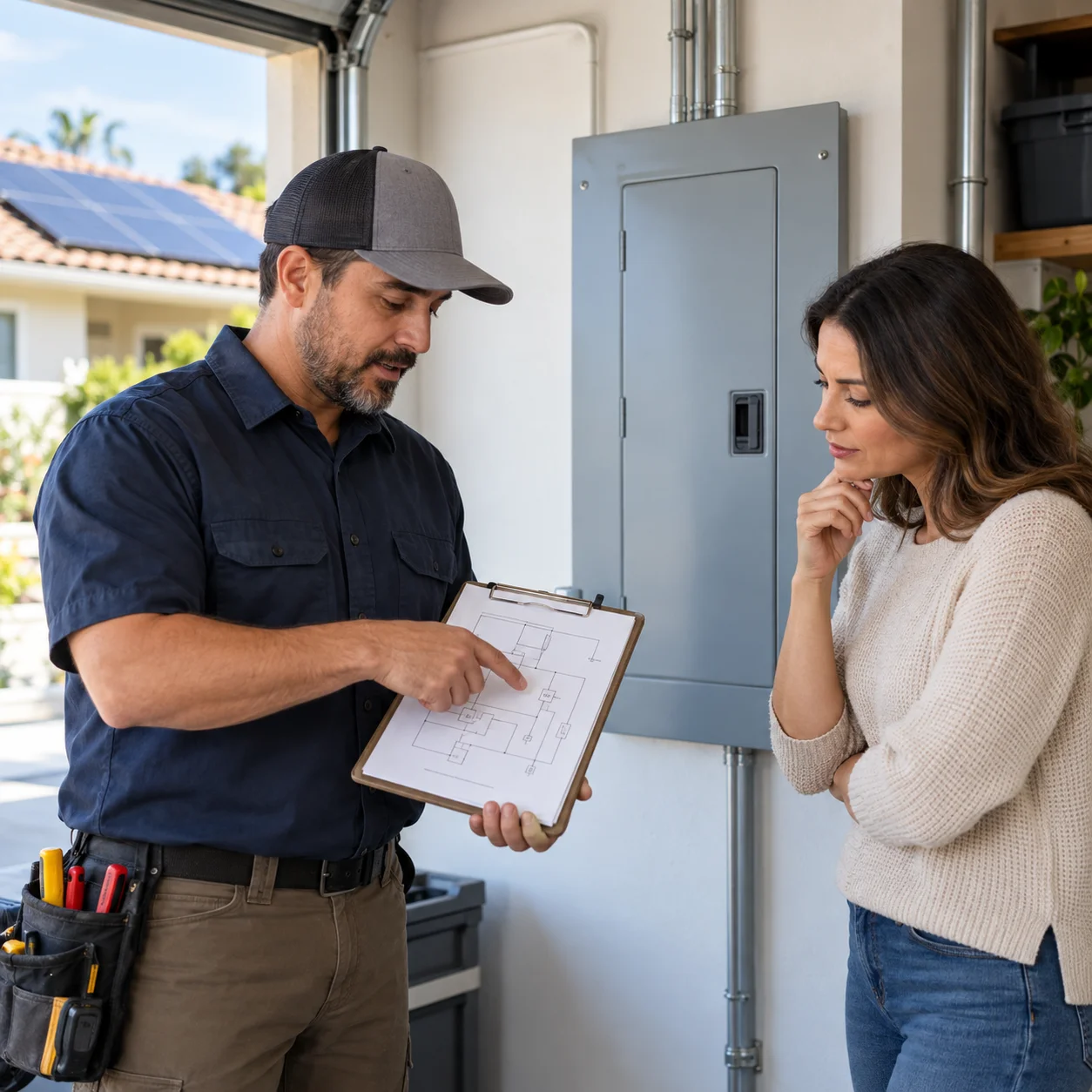
Quick answer: not every solar project needs a panel upgrade
As of October 26, 2026, not every solar installation requires a main electrical panel replacement or a larger utility service. The answer depends on the home's existing equipment, the proposed interconnection design, the current electrical code, and the utility and authority having jurisdiction.
Require the contractor to name the exact constraint, show it on the approved design, and separate panel work from the solar price before authorizing an upgrade.
Use the right names for different equipment
Service equipment is the point where the premises can disconnect from the utility supply. A main distribution panel contains the main breaker and branch-circuit breakers; a subpanel distributes circuits downstream; the meter socket holds the utility meter.
These parts can be combined in one enclosure or split among several. Ask the designer to mark the exact component that would change instead of calling every electrical enclosure the panel.
Separate a panel replacement from a service-capacity increase
Replacing damaged, obsolete or unsuitable equipment can leave the home's service capacity unchanged. Increasing service capacity can also require utility-side work beyond the customer-owned panel.
The proposal should say whether it changes only the panel, the main breaker, the meter socket, service conductors, the service rating or several of those items. Do not treat these scopes as interchangeable.
Document the existing equipment before designing
The site record should identify the equipment nameplate, service rating, bus rating, main breaker rating, available breaker space, panel condition, meter arrangement, grounding and bonding, and the proposed point of connection.
Photographs and a one-line diagram should agree with the equipment at the home. If a label is missing or unreadable, the contractor should document how the rating was verified rather than inventing it.
Old equipment is a reason to inspect, not an automatic verdict
Age alone does not prove a panel must be replaced for solar. Physical damage, overheating, corrosion, an unsafe condition, unavailable compatible components, insufficient ratings or an unapproved connection design may support work, but the reason should be specific.
Ask for the cited code, equipment limitation, inspection finding or utility requirement and keep it with the proposal. A verbal claim that the panel is too old is not a complete design record.
Do not confuse solar-array size with household service load
Solar array kilowatts, inverter output and household peak load describe different things. A home's load calculation evaluates the loads the service must supply; the interconnection review evaluates how generation will connect.
A larger solar array does not translate directly into a larger household service rating. Require the calculation and the proposed electrical ratings rather than converting kilowatts into a guessed panel amperage.
The interconnection path must be approved
DOE explains that main-panel requirements and interconnection agreements vary by utility and authority having jurisdiction. The permit set and utility application should use the same system ratings and connection design.
SCE and LADWP publish their own service and generation-interconnection procedures. The contractor should identify the controlling utility process for the actual address and should not apply another provider's shortcut by analogy.
Treat load-side and supply-side connections as design options
A qualified designer may evaluate a load-side connection, a supply-side connection or an approved utility-specific alternative. Which options are available depends on the equipment listing, adopted code, conductor and bus ratings, utility rules and local approval.
Do not rely on a universal percentage or social-media diagram. Ask for the one-line drawing, calculations, equipment data and written approval that apply to this home.
Plan future electric loads with a real load calculation
An EV charger, heat pump, induction range, electric water heater, ADU or battery can change the household plan even when solar alone does not require a service upgrade. List likely additions before final equipment is selected.
Have a qualified professional perform the applicable load calculation and show assumptions. Right-sized equipment and staged projects can produce a different answer than simply adding every nameplate load.
Evaluate listed load management only where approved
A listed energy-management or load management system may limit coincident demand in some designs, and an approved alternative connection may avoid replacing otherwise serviceable equipment. Neither option is automatic.
Require product listings, the control strategy, fail-safe behavior, installer responsibilities and acceptance by the authority having jurisdiction and utility. Do not assume a smart panel by itself guarantees approval or avoids upstream work.
Utility-side work can control scope and timing
A service change can involve meter placement, service conductors, clearances, trenching, poles, transformer capacity or relocation rules. LADWP advises obtaining a meter spot before installing a new panel, and SCE directs customers to its service-planning process for panel upgrades.
Ask which work belongs to the homeowner, contractor and utility; which deposits or engineering charges may apply; and which milestone must occur before demolition. Preserve the utility work-request number and written instructions.
Price the electrical work as an itemized scope
The contract should identify the panel or service equipment, ratings, breakers, surge protection if included, grounding work, trenching, wall repair, permit, inspection, utility coordination, equipment relocation and restoration.
Separate the cash price, exclusions, allowances and change-order rules from the solar-array scope. Never accept a savings claim or incentive assumption as proof that an unspecified electrical upgrade is necessary.
Keep permit, inspection and utility milestones distinct
Plan review, electrical permit issuance, utility service approval, construction, local inspection, interconnection review, meter work and permission to operate are separate events. The order can vary by project and provider.
Do not energize generation merely because installation is mechanically complete. Keep the final permit approval and utility permission to operate notice with the approved drawings.
Use qualified professionals and keep the equipment closed
Residential service equipment can remain hazardous even when some breakers are off. Homeowners should not open, probe or modify energized service equipment to verify a sales claim.
Use a properly licensed contractor or qualified electrician for the site assessment and electrical work, verify the California contractor license, and ask the local permitting authority which permits and inspections apply.
Bottom line: require a traceable panel decision
Keep one worksheet with the existing ratings and condition, load calculation, future loads, connection method, code or listing constraint, utility requirement, approved one-line diagram, itemized scope, price and schedule.
A defensible recommendation connects the observed equipment to a specific approved design. If the contractor cannot show that chain in writing, pause before approving a panel replacement or service upgrade.
Reconcile the electrician's scope with the utility's work
Ask for an itemized boundary between work the electrician performs and work the utility must approve or complete. Mark the equipment to be replaced, any conductor or meter work, inspection responsibility, application fees and restoration work. A quote for a new distribution panel does not necessarily include a larger service or every utility dependency. Request a written explanation of exclusions before comparing bids.
Plan for any proposed interruption of power, including refrigeration, medical needs and access for occupants. The contractor should coordinate a safe sequence rather than having the homeowner improvise disconnection or reconnect equipment. Keep approvals, inspection records and the final equipment schedule with the solar documents so later battery, EV or heat-pump work can be evaluated against what was actually installed.
How to assess a rooftop solar design
- Review the roof. Document roof condition, remaining service life, usable space, orientation, shade and any planned repairs before committing to a layout.
- Compare power with energy. System capacity is rated in kW; annual generation is estimated in kWh. Request the assumptions for weather, shade, orientation and system losses.
- Confirm installation responsibilities. Ask who prepares plans, obtains permits, schedules inspections, handles utility interconnection and provides warranties for roof penetrations and equipment.
For further independent technical context: U.S. Department of Energy — Homeowner's Guide to Going Solar. This is an educational reference, not an installer recommendation.
Frequently asked questions
Does every solar installation need a main electrical panel upgrade?
No. The decision depends on the existing equipment, proposed connection, adopted code, equipment listings, utility rules and local approval. Require a project-specific written reason.
What is the difference between a panel replacement and a service upgrade?
A panel can be replaced without increasing service capacity. A service upgrade changes the capacity or utility connection and may involve the meter, conductors or other utility-side work.
What should a solar contractor document before recommending an upgrade?
Document the nameplate and service rating, bus and main-breaker ratings, breaker space, condition, meter arrangement, grounding and bonding, load calculation and proposed point of connection.
Does a larger solar array automatically require a larger electrical service?
No. Solar output, inverter rating and household peak load are different measurements. The approved interconnection design and applicable load calculation determine the work.
Can a load-side or supply-side connection avoid a panel replacement?
Sometimes, but there is no universal answer. The option must comply with the adopted code, equipment listings and ratings, utility rules and the authority having jurisdiction.
Can load management avoid a service upgrade?
A listed energy-management or load-management system can be part of some approved designs, but it does not guarantee approval or eliminate utility-side constraints.
Who approves a solar panel or service-upgrade design?
The local authority having jurisdiction reviews the permit, and the serving utility reviews interconnection and any service work. Both processes can affect the final design.
What should an electrical-upgrade quote include?
Require an itemized scope covering equipment ratings, breakers, grounding, meter or service work, trenching or relocation, permits, inspections, utility coordination, exclusions, restoration and change-order rules.
Questions worth asking
- Does every solar installation need a main electrical panel upgrade?
- What is the difference between a panel replacement and a service upgrade?
- What should a solar contractor document before recommending an upgrade?
- Does a larger solar array automatically require a larger electrical service?
- Can a load-side or supply-side connection avoid a panel replacement?
- Can load management avoid a service upgrade?
- Who approves a solar panel or service-upgrade design?
- What should an electrical-upgrade quote include?
Related guides
Understand battery installation and electrical workPlan service capacity for EV chargingCheck how an ADU changes meter and electrical planningUnderstand permits and inspectionsMap the solar installation timelinePlan solar with heat pumpsSize the solar arrayCompare complete solar quotesCheck the contract before signingMore specialized guides
Electrical planning for small-business solarStill researching solar?
Search homeowner guides by topic, electric utility, or location.
Sources and further reading
Updated: October 2026. Confirm changing details with the official sources.
These links identify documents and resources used for this guide. Listing a source does not mean it was independently checked today. Utility rates, incentives, product specifications and program availability may change; confirm the latest version and effective date with the source.
U.S. Department of Energy — Homeowner's Guide to SolarU.S. Department of Energy — Solar Energy Guide for HomebuildersSouthern California Edison — Power Requests and UpgradesSouthern California Edison — Building, Renovation and Planning ProjectsSouthern California Edison — Solar Interconnection DocumentsSouthern California Edison — Net Energy Metering Interconnection HandbookLos Angeles Department of Water and Power — Guide to Electric ServiceLos Angeles Department of Water and Power — Type 1, 2 and 3 InterconnectionCalifornia Public Utilities Commission — Solar Consumer Protection GuideCalifornia Energy Commission — Residential Electrical Panel Decision Tool WorkshopContractors State License Board — Solar RequirementsContractors State License Board — Solar SmartStart with a home energy checkup
Organize your usage, home details and goals before comparing proposals.
Try the home energy checkupReady to compare companies?
Explore provider options when you are ready to request quotes.
Explore provider options