
Time-of-Use Electricity Rates Explained: Peak Hours and Smarter Scheduling
As of October 26, 2026, California has no universal time-of-use peak schedule. Match interval usage to the home’s exact utility, rate, generation provider, season and day type.
Quick answer: there is no universal peak-hour schedule
As of October 26, 2026, there is no universal peak-hour schedule for California homes. Find the utility, exact rate schedule, generation provider, season and day type on the account before moving any load.
Then map interval data into that plan's periods and compare complete annual bills. A lower advertised off-peak price alone does not prove a different plan, solar array or battery will save money.
Identify the utility, exact rate and generation provider
Copy the exact rate schedule from the bill or online account; do not infer it from a ZIP code. SCE, PG&E, SDG&E and LADWP publish different residential options, and the same utility can offer several time-of-use plans.
Also identify who supplies generation. A community choice aggregator can set the generation rate while an investor-owned utility continues delivery and billing, so both current schedules may be needed.
Build the complete TOU calendar
Record every period for summer and winter, including weekday, weekend and holiday treatment. Some plans use peak and off-peak only; others add mid-peak or super-off-peak periods.
Do not transfer one provider's clock to another. For example, current SCE and PG&E residential offerings include both 4–9 p.m. and 5–8 p.m. designs, SDG&E lists several 4–9 p.m. plans, and LADWP describes high-peak, low-peak and base periods under its own tariff.
Separate delivery from generation before comparing prices
A bill can apply utility delivery charges and a separate provider's generation charges to the same metered usage. Those are complementary components, not duplicate electricity purchases.
For a CCA account, compare the combined bill effect rather than a generation price in isolation. CPUC's electric-rate comparison resource links joint utility-and-CCA information by location and customer type.
Check the Pasadena exception before using a peak-hour worksheet
PWP's solar FAQ currently says Pasadena Water and Power does not offer a residential TOU rate for solar customers. A PWP household should verify its own tariff before using SCE peak-hour advice or claiming a bill saving from moving the same kWh to a different hour. Using solar directly can reduce grid purchases, but that is a separate calculation from a TOU price spread.
For an SCE account that does have TOU service, download the underlying record through My Account → Data Sharing & Download → Green Button Download My Data. SCE documents 15- or 60-minute usage intervals depending on meter type. Check timestamp conventions and missing records before building the rate calendar; interval kWh is energy, not an instantaneous kW reading.
Map interval data into each rate window
Download hourly or sub-hourly interval data for the billing period when the account provides it. Assign each interval to the exact tariff's season, day type and time window, then sum kWh by period.
Keep daylight-saving transitions, holidays, missing intervals and utility rounding visible. Interval data shows when the meter recorded energy; it does not identify a particular appliance by itself.
Reconcile the worksheet to the bill
Compare the worksheet's period totals with the bill's peak, off-peak, mid-peak or super-off-peak quantities. Use the statement's service dates and the rate effective during those dates.
If the totals differ, preserve the downloaded file and ask the provider to explain its time-zone, holiday and rounding rules. Do not force a match by silently moving unexplained kWh between periods.
Compare annual totals, not one attractive price
A useful rate comparison applies each candidate tariff to a representative year of actual usage. Include seasonal period prices, credits, adjustments and every recurring charge shown by the provider.
SCE's comparison tool uses account history and warns that some changes can involve a commitment period. Provider tools and tariff documents should be checked again immediately before a switch.
Shift flexible household loads first
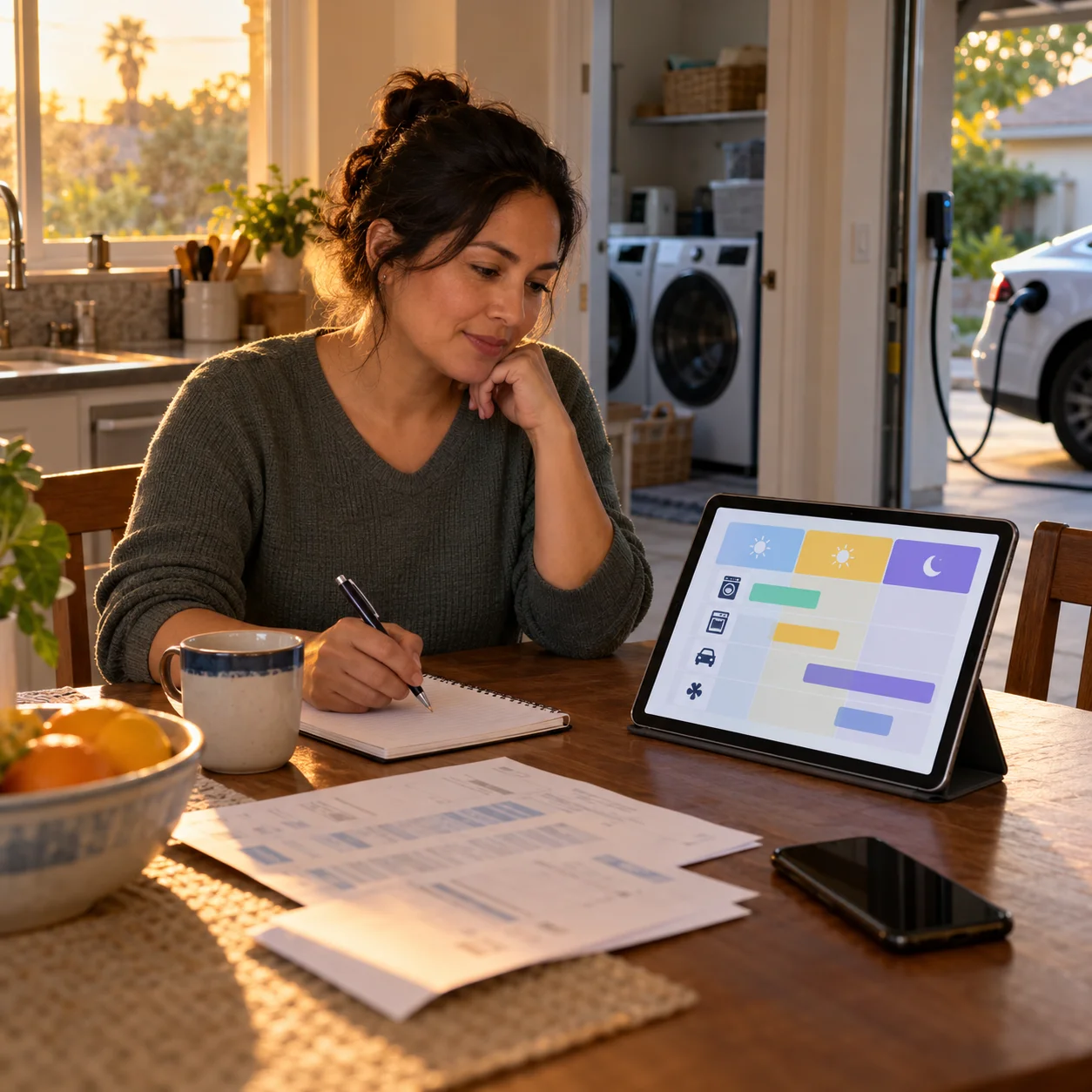
If the exact plan rewards the move, consider scheduling EV charging, a dishwasher, laundry or pool filtration outside higher-priced periods. Follow equipment instructions and avoid creating fire, moisture or noise risks.
Change one schedule at a time and compare interval data over similar days. A successful shift moves kWh out of a costly window without increasing total use enough to erase the benefit.
Treat cooling and medical loads as safety constraints
Pre-cooling can help some buildings but can waste energy in a poorly insulated home or during extreme heat. Test modest thermostat changes and protect occupants, pets, food and equipment.
Never delay medical equipment or essential cooling to meet a rate window. Health or safety comes before a tariff experiment; seek utility medical-baseline or assistance information when relevant.
Fixed, baseline and minimum charges can remain
Moving kWh does not remove every line item. A Base Services Charge, service charge, minimum charge, baseline credit, taxes or other adjustments can remain depending on the utility and rate.
Use the current bill and official tariff for the account. LADWP also publishes adjustment billing factors that can apply beyond the time-dependent energy charge.
Account for community choice aggregation
A CCA chooses or procures generation while the investor-owned utility still delivers electricity. CPUC explains that customers may receive both parties' charges on the utility bill.
In SCE territory, Clean Power Alliance publishes residential generation schedules and notes how its TOU options align with delivery-rate periods. Confirm the account's CCA product and vintage instead of assuming all CCA customers pay one generation rate.
Solar imports, self-consumption and exports are different
Rooftop solar can reduce grid imports when production and household use overlap. Electricity exported to the grid is accounted for under the applicable interconnection and export-compensation rules, which need not equal the retail import price.
Keep import charges, export credits and energy used directly in the home in separate rows. This guide explains consumption timing; use the dedicated tariff guide for an export-credit or true-up audit.
Evaluate a battery as a separate investment
A battery may move energy from one period to another or support selected loads during an outage, but it adds purchase cost, conversion losses, capacity limits, controls and warranty conditions.
Model charging and discharging against the exact rate and solar tariff. Do not treat the peak/off-peak spread as guaranteed savings, and separate backup value from bill-value calculations.
Check switching rules before enrolling
Confirm eligibility, effective date, minimum term, return restrictions, bill-protection terms and whether the selected plan changes baseline or fixed-charge treatment. Save the tariff or plan page used for the decision.
Utility offerings change. Recheck the provider's current comparison tool and rate schedule when the switch takes effect, not only when you first research it.
Run a 14-day scheduling test
For one week, keep normal schedules and record daily and peak-period kWh. For a comparable second week, move only safe, flexible loads and record the same fields along with weather and unusual occupancy.
The test does not prove annual savings, but it reveals whether the household can shift meaningful usage. Use a full-year rate comparison before changing plans or purchasing solar or storage.
Bottom line: keep a rate-and-usage worksheet
Record utility, exact rate, generation provider, effective dates, seasons, day types, all time windows, kWh by window, delivery and generation charges, fixed charges and the source URLs reviewed.
That worksheet turns generic peak-hour advice into an auditable household decision and makes future tariff changes easier to detect.
Test one flexible load before changing the whole schedule
Choose a load whose operating time you can change safely, such as a scheduled vehicle charge within the equipment's instructions. Write down its measured or reasonably estimated kWh and the two eligible pricing periods. Multiply the same energy by each period's applicable usage price, then subtract. Keep taxes, delivery components or other differences visible rather than silently assuming the supply price is the entire cost.
Compare that calculation with what the household can actually sustain. If the alternative time conflicts with sleep, equipment restrictions or a necessary departure, record a smaller realistic shift. Track the next usage period before assuming the saving repeats all year. A useful schedule is one that fits the account's tariff and the household's routine, with enough records to check the result.
Frequently asked questions
Are peak hours the same for every California utility?
No. Utilities and individual plans publish different periods, seasons and day-type rules. Use the exact schedule on the account rather than a statewide or generic clock.
How do I find my exact time-of-use rate schedule?
Copy the rate name from the bill or online account, then open the current official tariff or plan page. Also identify a separate generation provider such as a community choice aggregator.
How do weekdays, weekends, holidays and seasons change TOU periods?
Their treatment depends on the plan. Build a calendar from the current tariff that lists summer, winter, weekday, weekend and recognized-holiday periods before assigning usage.
How do I calculate my electricity use in each TOU window?
Download interval data, assign each interval to the applicable period and sum kWh by window. Reconcile those totals to the bill and preserve any unexplained difference.
Why are delivery and generation rates both on a CCA bill?
The utility delivers electricity while the CCA supplies generation. Compare their combined bill effect and applicable charges rather than treating either component as the complete price.
Which household loads are usually safest to reschedule?
Flexible loads can include EV charging, dishwashing, laundry or pool filtration when equipment instructions and household needs allow. Never defer medical equipment or essential cooling.
How do solar panels and a battery change a TOU analysis?
Solar can reduce imports when production overlaps use, while exports follow separate compensation rules. A battery can shift energy but adds cost, losses and constraints, so model it separately.
Should I compare TOU plans using one bill or a full year?
Use a representative year of actual interval usage whenever possible. One month can miss seasonal prices, weather, holidays, credits and recurring charges.
Questions worth asking
- Are peak hours the same for every California utility?
- How do I find my exact time-of-use rate schedule?
- How do weekdays, weekends, holidays and seasons change TOU periods?
- How do I calculate my electricity use in each TOU window?
- Why are delivery and generation rates both on a CCA bill?
- Which household loads are usually safest to reschedule?
- How do solar panels and a battery change a TOU analysis?
- Should I compare TOU plans using one bill or a full year?
Related guides
Estimate AC usage costs under your actual rateRead every electric-bill line itemDiagnose why an electric bill changedUnderstand hourly solar export creditsUnderstand charges that remain after solarDecide whether a home battery fits the goalTroubleshoot a high bill after solarConfirm LADWP or SCE serviceRead an SCE solar true-upStill researching solar?
Search homeowner guides by topic, electric utility, or location.
Sources and further reading
Sources reviewed: October 26, 2026. Confirm changing details with the official sources.
These links identify documents and resources used for this guide. Listing a source does not mean it was independently checked today. Utility rates, incentives, product specifications and program availability may change; confirm the latest version and effective date with the source.
Southern California Edison — Time-of-Use Residential Rate PlansSouthern California Edison — Residential Rate PlansSouthern California Edison — Rate Plan Comparison ToolSouthern California Edison — Electric Vehicle Rate PlansPG&E — Time-of-Use Rate PlansPG&E — Electric Home Rate PlanPG&E — Electric Rate PlansSan Diego Gas & Electric — Residential Pricing PlansSan Diego Gas & Electric — Total Electric RatesLos Angeles Department of Water and Power — Residential Electric RatesLos Angeles Department of Water and Power — Residential Adjustment Billing FactorsCalifornia Public Utilities Commission — Electric Rate ComparisonCalifornia Public Utilities Commission — CCA Consumer InformationClean Power Alliance — Time-of-Use RatesClean Power Alliance — Residential RatesPasadena Water and Power — Solar Power FAQSCE — Personal Information Request and Interval Data DownloadsStart with a home energy checkup
Organize your usage, home details and goals before comparing proposals.
Try the home energy checkupReady to compare companies?
Explore provider options when you are ready to request quotes.
Explore provider options